
A shopper in Halifax opens your parcel, lifts out the product and then stands over the kitchen recycling bin holding a padded mailer, a sheet of air pillows and a plastic poly bag, trying to work out which of them the municipality will take. If the answer is "none of them," that unboxing moment ends with a small sense of guilt, and some of those customers will remember it the next time they choose where to shop.
Online ordering across Canada has grown sharply this year as people have shifted more of their household buying online during the pandemic, and with it the volume of shipping material landing in residential blue bins. Customers are noticing. Retailers that sell into every province are hearing the same questions in reviews and support tickets: is this box recyclable, why is there so much plastic, and can you ship with less?
The good news is that choosing recyclable ecommerce packaging is mostly a practical exercise, not a branding gamble. This guide walks through how recycling actually works in Canada, which materials have the best chance of being accepted at the curb, how to balance recyclability against damage and shipping cost, and how to talk about your packaging honestly.
Why "recyclable" depends on where your customer lives
There is no single national recycling system in Canada. Residential recycling is run by municipalities and regional authorities, and the rules are shaped by provincial policy. That means a material accepted in one city's blue box may be rejected a few hundred kilometres away.
British Columbia shifted residential packaging recycling to a producer-funded program several years ago, which gives the province a fairly consistent list of accepted materials across participating communities. Ontario has been moving its long-running Blue Box program toward full producer responsibility, but for now each municipality still sets its own acceptance list. Quebec runs a compensation system in which companies that put packaging on the market help fund municipal collection, and the Prairie provinces and Atlantic Canada each have their own mix of municipal and provincial programs.
For an ecommerce brand shipping nationally, the practical takeaway is simple: choose materials that are accepted almost everywhere, rather than materials that are technically recyclable somewhere. A box that is accepted in Vancouver, Calgary, Winnipeg, the Greater Toronto Area, Montreal and Moncton is a far safer bet than a specialty film that a handful of facilities can process.
The materials with the widest acceptance
Corrugated cardboard boxes
Plain corrugated cardboard is the most widely recycled packaging material in Canadian residential programs. It has a strong end market, it is easy for sorting facilities to handle, and customers already know it goes in the bin. If you only make one decision about packaging, make it this one: default to corrugated boxes where the product allows.
Keep it plain where you can. Heavy plastic lamination, glitter finishes and large amounts of plastic tape do not usually stop a box from being recycled, but they add contamination. Water-based inks and paper tape keep things cleaner.
Paper mailers
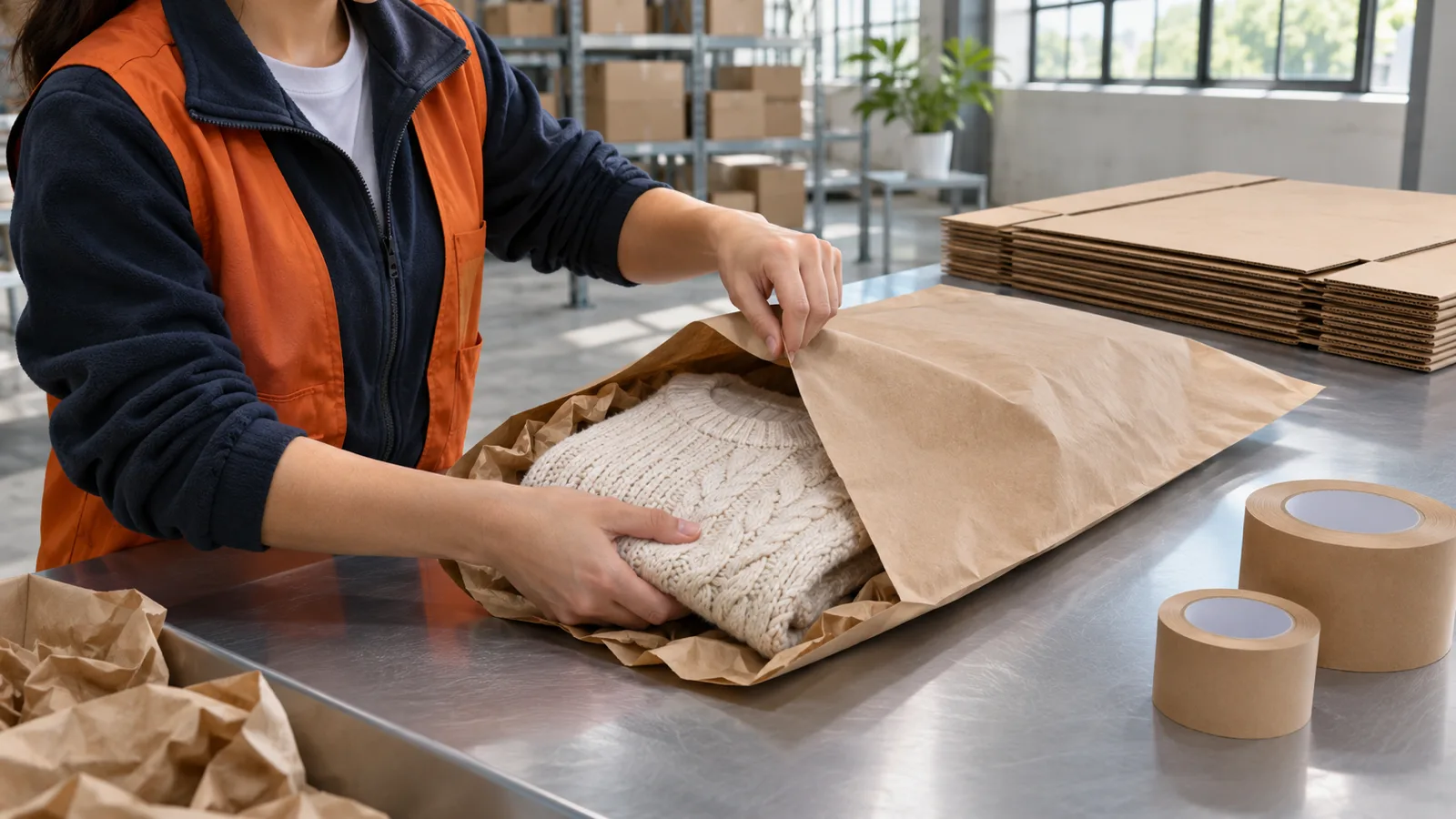
For apparel, soft goods and flat items, kraft paper mailers are a strong alternative to plastic poly mailers. They are accepted with mixed paper in most programs, and customers immediately recognise them as paper. The trade-offs are weight and water resistance: paper mailers are typically a little heavier, and they need a decent coating or a protective inner sleeve if your parcels sit on porches during a wet Vancouver winter or a Maritime spring.
Paper void fill and moulded pulp
Crumpled kraft paper, paper honeycomb wrap and moulded pulp inserts all go into the paper stream. Moulded pulp is especially good for fragile items like glass jars and cosmetics bottles because it can be shaped to hold the product in place, which reduces the need for loose fill altogether.
Materials that cause problems
Some popular packaging choices are much harder for Canadian customers to dispose of properly:
- Plastic poly mailers and air pillows. Plastic film is not accepted in many curbside programs. Some communities take clean film bundled in a bag, and some retailers run drop-off points, but many customers will simply throw it out.
- Padded mailers that combine paper and bubble plastic. Mixed-material mailers are hard to separate and are generally rejected from both the paper and plastic streams.
- Expanded polystyrene foam. Packing peanuts and foam inserts are excluded from most residential programs across the country.
- "Compostable" plastics. Many municipal composting facilities do not accept compostable packaging films, and if they end up in the recycling stream they can contaminate plastics. Unless you know your customers have access to facilities that take them, these can confuse more than they help.
None of this means plastic never has a place. A thin inner bag that keeps a garment clean or a sealed bag that protects a product from moisture can be justified. The goal is to remove plastic that is not doing a real job.
Balancing recyclability, protection and shipping cost
The greenest package is the one that arrives intact the first time. A broken product means a replacement shipment, a return trip and often a second set of packaging, which wipes out any benefit from switching materials. So recyclability has to be weighed against protection and cost.
Right-size every box
Oversized boxes waste corrugate, need more void fill and cost more to ship. Most Canadian couriers apply dimensional weight pricing, which means a large, light box can be billed as if it were much heavier. Matching box size to the order is the single change that tends to improve sustainability and margins at the same time. Fulfillment software with cartonization logic can recommend the smallest suitable box for each order based on item dimensions, so packers are not guessing.
Our guide on how package dimensions impact shipping costs explains the dimensional weight math in more detail.
Test for Canadian conditions
Parcels in Canada travel long distances and through big temperature swings. A box moving from a fulfillment centre in Ontario to a customer in Saskatoon in January will be handled several times, may sit in an unheated trailer and could spend time on a snowy porch. Before you switch materials across your whole catalogue, run test shipments to a few distant postal codes and check how the paper mailers, tape and inserts hold up in cold and damp conditions.
Watch the weight
Paper-based options can be heavier than plastic. On a light apparel order, swapping a poly mailer for a paper mailer may push a parcel into a higher weight band. Look at your typical order profiles and courier rate tables before committing, and consider whether a lighter-weight paper or a smaller format offsets the difference.
A practical checklist for switching packaging
- List every packaging component you use today: boxes, mailers, tape, void fill, inserts, inner bags, labels and printed materials.
- Mark each item by material and by whether it is commonly accepted in residential recycling across Canada.
- Identify the components that are not doing a real protective job and remove them first.
- Replace plastic void fill with paper, and look at moulded pulp for fragile products.
- Rationalise your box sizes so you can right-size most orders with a manageable number of SKUs of packaging.
- Run test shipments to several regions and seasons before a full rollout.
- Track damage rates and shipping costs for a few weeks after the switch to confirm nothing went backwards.
- Update your website, packing inserts and customer service scripts so your team can explain the change.
Helping customers recycle correctly
Even fully recyclable packaging can end up in the garbage if customers are not sure what to do with it. A small amount of guidance goes a long way.
- Print simple disposal instructions on an insert or inside the box flap: "Box and paper fill: recycle with cardboard and paper. Inner bag: check your local program."
- Encourage customers to check their municipality's guidelines, since the rules really do differ from city to city.
- If you ship into Quebec, remember that packaging, inserts and labels distributed there generally need French content under the Charter of the French Language, and bilingual instructions are a good habit nationally. Our article on package insert ideas for ecommerce has more ideas for what to include alongside disposal tips.
Be careful how you describe your packaging
Once you have improved your packaging, it is tempting to tell everyone about it. Do, but stay precise. The Competition Bureau treats environmental claims like any other marketing claim: they must not be false or misleading, and the Bureau has published guidance with the Canadian Standards Association on environmental claims for industry and advertisers. Broad claims such as "eco-friendly packaging" or "zero waste" are hard to support.
Specific statements are safer and more useful to the customer:
- "Our boxes and paper fill are made from corrugated cardboard and kraft paper, which are accepted in most Canadian curbside recycling programs."
- "We removed plastic air pillows from our packaging in favour of paper."
- "Check with your local program about the inner garment bag."
If you use a recycled-content box, state the percentage only if your supplier can document it. If a component is recyclable only in some areas, say so. Honest, specific language builds more trust than a green leaf icon and a vague slogan.
How fulfillment partners fit in
If you outsource order fulfillment, your packaging decisions are only as good as how consistently they are executed on the packing line. Ask your provider how it stores and manages custom packaging, whether it can enforce box selection rules per SKU, and whether it can track packaging usage so you can see what the change is costing.
ShipCarte's ecommerce fulfillment and value-added services can support custom packing instructions, branded inserts and kitting, while our pick and pack teams follow per-product rules so the right box and fill are used each time.
Common questions
Do I need to switch everything at once?
No. Start with your highest-volume order types, since that is where the material savings and customer impact are greatest. Switching one product line or one packaging format at a time also makes it easier to spot damage problems early.
Will recyclable packaging cost more?
It can, depending on the material and your order volume. Paper mailers and moulded pulp may have a higher unit price than basic plastic alternatives, but right-sizing often reduces how much material you buy overall and can lower dimensional weight charges. Look at the total landed cost per order rather than the price of a single mailer.
What about returns?
A sturdy box or a resealable paper mailer with a second adhesive strip makes it easier for customers to send items back without hunting for packaging. That can improve the returns experience and reduce how many returns arrive damaged.
Ready to rethink your packaging?
Recyclable packaging works best when it is chosen with real Canadian recycling rules, shipping distances and weather in mind, and when it is packed the same way on every order. If you would like help reviewing your packaging, box sizes and fulfillment workflow for customers across Canada, schedule a consultation with the ShipCarte team or request a quote.