
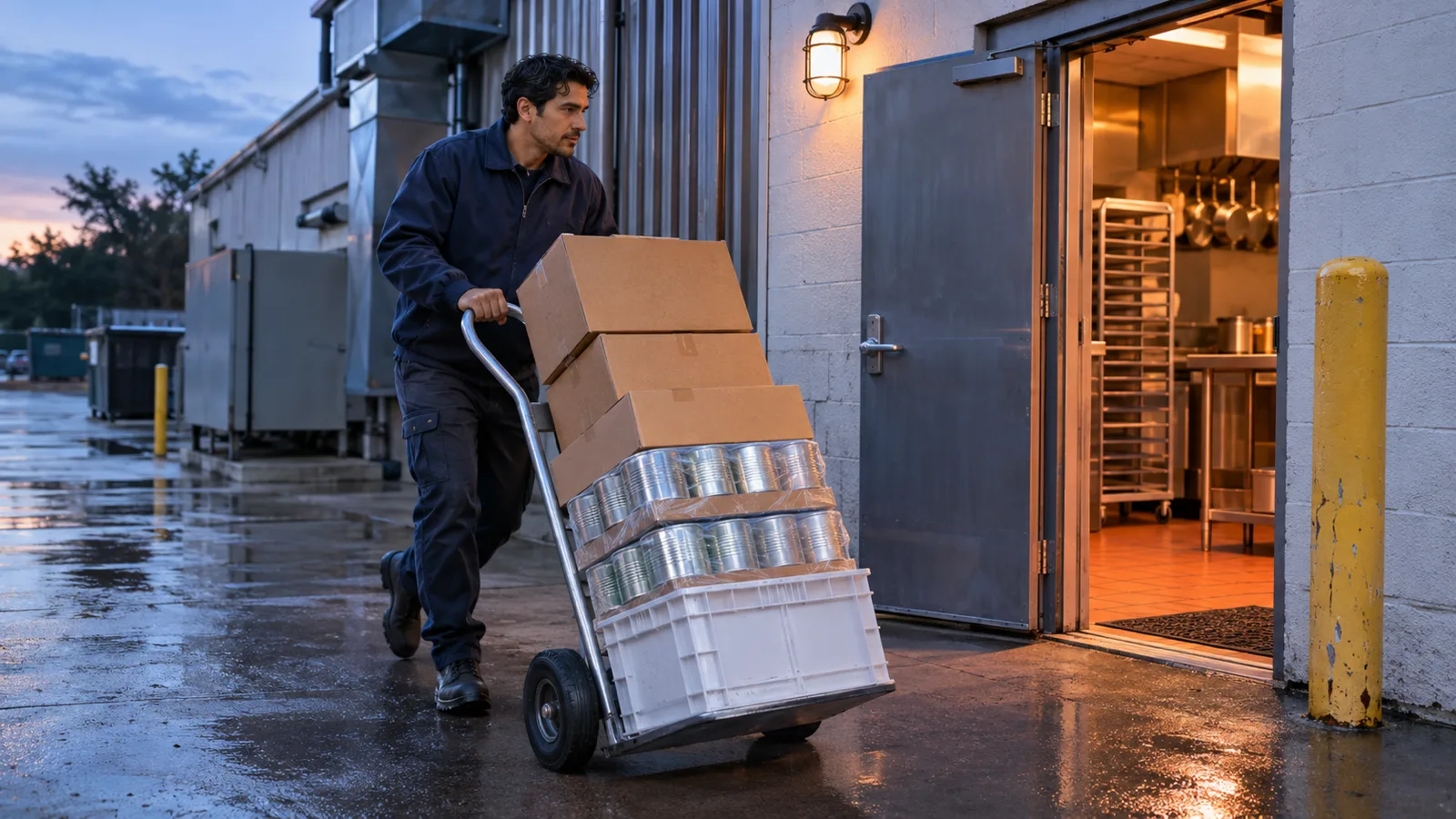
It is 6:40 on a Friday morning on Lakeshore Road in Port Credit. A chef is unlocking the back door of a busy brunch spot, already thinking about the 10 a.m. rush. The delivery from the supplier was supposed to land at 6:30 with cases of eggs, fryer oil, takeout containers and the specialty hot sauce the restaurant has built a following around. If it shows up at 11, half the menu is in trouble and the kitchen is working around a delivery van blocking the laneway during service.
For anyone supplying restaurants, that scene is the whole job in miniature. Kitchens have little storage, tight schedules and zero patience for missing items. A supplier who delivers the right things, in the right condition, in the right window, becomes almost impossible to replace. One who misses repeatedly gets swapped out for a competitor, no matter how good the product is.
Mississauga is home to a dense and varied restaurant scene, from independent spots in Streetsville and Port Credit to chains clustered around Square One, Heartland and the Dundas and Hurontario corridors, plus a growing number of ghost kitchens and catering operations in industrial units. It is also surrounded by restaurant-heavy markets in Toronto, Brampton, Oakville and Hamilton. This guide looks at how food-service suppliers, whether they sell ingredients, sauces, beverages, packaging or equipment, can build distribution that kitchens trust.
What kitchens actually need from a supplier
Ask a restaurant operator what they want from a distributor and the answer is rarely "the lowest price." It is usually some version of these four things:
- A predictable window. Deliveries before prep starts or between services, not in the middle of lunch.
- Complete orders. A missing case of a key ingredient can take a dish off the menu for the day.
- Product in proper condition. Chilled goods cold, frozen goods frozen, nothing crushed or leaking.
- Easy reordering. Standing orders, simple ways to add items and quick answers when something is wrong.
Everything in your distribution setup should serve those outcomes. The warehouse, the routing, the inventory system and the drivers are all tools for being on time and complete.
A week in the life of a restaurant supply operation
To see where things go right and wrong, it helps to walk through a typical week for a mid-sized supplier serving restaurants across Peel and the western GTA.
Monday: orders and forecasting
Restaurants place orders for the week, many of them standing orders that repeat with small changes. A good order system takes these in through a portal, email or EDI and checks them against available stock. If a restaurant orders a product that is running low, the supplier can call them now to suggest a substitute, rather than shorting them on delivery day. Seeing stock levels in real time through an order management system makes that conversation possible.
Tuesday: inbound receiving
The supplier's own inventory arrives: pallets from manufacturers, imported products cleared through customs, perhaps a refrigerated truck from a producer in Southwestern Ontario. Each delivery is checked against the purchase order, inspected for damage and temperature, and put away with lot numbers and best-before dates recorded. This step quietly determines whether everything downstream works. If a pallet is put away in the wrong location or its dates are not captured, it will cause picking errors and spoiled stock later.
Wednesday and Thursday: picking for routes
Orders are grouped by delivery route and picked in reverse stop order so the first delivery is loaded last and comes off the truck first. Products are picked by temperature zone: dry goods, chilled and frozen are kept separate until they are loaded into the right compartment. Stock is rotated so the oldest acceptable product goes out first. Our article on FIFO explains the principle, and many food suppliers use first-expired, first-out, which is stricter.
Friday: the big delivery day
Fridays and the days before long weekends are heavy, because restaurants stock up for their busiest service. Routes start early to hit kitchens before prep. Drivers carry delivery paperwork, and in many cases the chef or manager checks the order at the door. Any shortages or damaged items are noted so credits can be issued promptly.
Weekend: emergency orders
Something always runs out on a Saturday. Suppliers who can handle small rush orders, even with a premium charge, earn a lot of loyalty. That might mean a same-day courier run from the warehouse to a restaurant in Erin Mills or Churchill Meadows rather than waiting for Monday's route.
Getting delivery windows right in Mississauga
Traffic is the biggest variable in any GTA delivery plan. The 401 through Mississauga and the 403, 410 and QEW all have predictable rush hours, and an accident can turn a 20-minute run into an hour. Practical ways to manage that include:
- Delivering early. Routes that start before dawn often move through Mississauga and into Toronto well ahead of the worst morning traffic, and many kitchens prefer early deliveries anyway.
- Grouping by geography. Keeping a truck within one area, such as Port Credit and Lakeview, or the City Centre and Cooksville, cuts down on highway time between stops.
- Using 407 tolls selectively. The 407 ETR costs money but can save significant time on east-west runs during congestion. It is worth assessing on a route-by-route basis.
- Respecting site constraints. Restaurants in plazas, condos and main-street strips often have limited loading space, narrow laneways or rules about delivery hours. Record these in the route notes so every driver knows them.
Handling mixed-temperature loads
Many restaurant suppliers carry a mix of shelf-stable, chilled and frozen products. Running separate trucks for each is expensive, so most use multi-temperature vehicles or carefully planned loads with insulated containers. Whatever the method, the cold chain has to hold from the warehouse to the kitchen door. That means:
- Pre-cooling trucks and containers before loading.
- Loading chilled and frozen items last and unloading them first.
- Keeping doors closed between stops as much as possible.
- Recording temperatures at dispatch and, ideally, during the route.
The warehouse side matters just as much. Chilled and frozen inventory needs proper temperature-controlled warehousing with monitoring and alarms. Our post on handling perishable goods in fulfillment goes into more detail.
Food safety and traceability
Food businesses in Canada operate under the Safe Food for Canadians Regulations, overseen by the Canadian Food Inspection Agency. Depending on what you do, such as importing food or moving it across provincial lines, you may need a licence, a preventive control plan and traceability records that let you trace food one step back and one step forward. Even where licensing does not apply to a particular activity, restaurants increasingly expect suppliers to be able to tell them exactly which lot they received.
Practically, that means capturing lot numbers and dates at receiving and recording which lots went to which customers at shipping. If a manufacturer issues a recall, you can then contact only the affected restaurants instead of pulling product from everyone. A warehouse system that tracks lots automatically turns a stressful recall into a manageable task. ShipCarte's recall management capabilities were built for regulated products, and the same discipline applies to food.
Packaging and non-food supplies
Not every restaurant supplier sells food. Takeout containers, cutlery, napkins, cleaning chemicals and small equipment are a big part of what kitchens buy. These products are bulky relative to their value, which makes storage and delivery costs significant. A few things help:
- Selling in full cases where possible to reduce picking labour
- Storing fast-moving bulky items near the dock to speed up picking
- Combining packaging with food deliveries so restaurants receive one truck rather than several
- Handling cleaning chemicals according to their safety data sheets and keeping them separated from food
Should you run your own fleet or outsource?
Smaller suppliers often start with a van and a driver. That gives control and a personal relationship with customers. As the customer base grows across Mississauga, Toronto and the 905, running enough vehicles, covering driver absences and managing warehouse space becomes a full-time job in itself.
Some suppliers move to a model where a 3PL handles warehousing, picking and distribution, while the supplier keeps sales and customer relationships. Others keep their own delivery trucks but outsource the warehouse. There is no single right answer. The question is where your team's time is best spent. If you are losing sleep over forklift certifications and freezer alarms instead of winning new restaurant accounts, it may be time to look at outsourcing. ShipCarte's food and beverage services are designed with these suppliers in mind.
Signs your distribution needs attention
If any of these sound familiar, your distribution operation is probably costing you customers:
- Chefs regularly call to ask where the truck is
- Credits for short or damaged items are a weekly occurrence
- You discover expired stock during counts
- You cannot quickly tell which customers received a specific lot
- Drivers spend more time in traffic than at stops
- Rush orders disrupt the whole day's routing
Each of these has a fix, whether that is better route planning, tighter receiving, a proper warehouse system or a partner who can take part of the load.
Keep kitchens stocked with ShipCarte
Restaurants remember the suppliers who never let them down. If you supply kitchens in Mississauga and across the GTA and want a more reliable warehousing and distribution setup, ShipCarte can help with storage, picking, temperature control and delivery planning. Request a quote to tell us about your products and customers.