
Picture a specialty retailer with a dozen stores: five in the Greater Toronto Area, two in Ottawa, three in Calgary and Edmonton, and two in the Lower Mainland. On any given Saturday, the Yorkdale-area location sells out of its best-selling size while the Edmonton store has eight of the same item sitting in the backroom. Store managers phone each other, someone drives product across town, and head office sends another bulk shipment that lands on Tuesday, well after the weekend demand has passed.
Store replenishment is the unglamorous engine of multi-location retail. It decides whether customers find what they came for, whether staff spend their time selling or unpacking, and how much cash sits idle in backrooms across the country. For Canadian retailers, distance and weather make it harder than it looks on a whiteboard. A replenishment plan that works for stores along Highway 401 may fall apart when it has to reach Saskatoon, Halifax or Victoria on the same cycle.
Right now, many retailers are also heading into the holiday peak, when weaknesses in how stock flows to each location show up fastest. That makes it a useful moment to rethink replenishment. This article walks through the main replenishment models, how to choose between them, and what a working weekly cycle might look like.
Push, pull, or something in between
Most replenishment approaches fall somewhere on a spectrum between push and pull.
Push replenishment
Head office or a central planner decides what each store receives, usually based on forecasts, store size and planograms. New collections, seasonal resets and promotions are typically pushed. Push gives the business control over launches and keeps stores looking consistent, but it relies on forecasts, which are often wrong at the individual store level.
Pull replenishment
Stores receive stock based on what they actually sold. Point-of-sale data feeds a replenishment system that calculates what each store needs to return to a target level, then generates a pick list for the warehouse. Pull keeps inventory closer to real demand, but it requires accurate store inventory counts and reliable data flowing from every location.
The hybrid most retailers end up with
In practice, most Canadian chains push the first allocation of new or seasonal product and then switch to pull for ongoing replenishment of core lines. Some keep a reserve at the distribution centre rather than sending everything to stores up front, so they can react once early sales show which locations are outperforming. Holding back part of an allocation is one of the simplest ways to reduce the cross-country transfers that eat into margin.
Where the stock should flow from
The second big question is physical: where replenishment ships from, and how it travels.
A single national distribution centre
Many mid-sized Canadian retailers run one central DC, often in southern Ontario or the Montreal area, because that is where a large share of their stores and customers are. Stores in Ontario and Quebec can be replenished several times a week by truck. Stores in the West and Atlantic Canada are reached by LTL, consolidated truckload or intermodal rail, with longer transit times. This model is simple and keeps inventory in one place, but it means western stores need deeper safety stock to cover the longer lead time.
Regional distribution points
Retailers with a meaningful store count in Western Canada often add a second location in the Calgary, Edmonton or Vancouver area. The Calgary region in particular sits at the junction of major rail and highway routes and can serve Alberta, Saskatchewan and much of British Columbia. Splitting inventory adds complexity but can shorten lead times enough to cut safety stock and improve in-stock rates. ShipCarte's distribution warehousing and distribution services are designed for this kind of network.
Store-to-store transfers
Transfers are a useful tool for balancing stock within a city, but they are expensive across provinces. Treat them as an exception rather than a replenishment strategy. If transfers are routine, it usually means the original allocation or the replenishment frequency needs work.
How the shipments travel
The transport mode depends on store volume and distance:
- Dedicated or multi-stop truck routes work well for clusters of stores in the same metro area or corridor, such as the GTA, Ottawa-Montreal or the Calgary-Edmonton corridor along Highway 2. One truck can serve several stores in a planned sequence.
- LTL freight suits stores that receive a few pallets a week, especially in smaller centres where a dedicated route would run half empty.
- Small parcel works for low-volume stores, urgent top-ups and items like accessories that fit in cartons rather than on pallets.
- Full truckload or intermodal rail makes sense for moving bulk inventory from a central DC to a regional one, for example from Ontario to Alberta, rather than for individual stores.
Weather affects all of these. Winter closures on the Trans-Canada Highway through the Rockies or across northern Ontario can delay freight for a day or more. Replenishment calendars for western and northern stores should include a buffer between November and March.
A sample weekly replenishment cycle
The details will vary, but a working cycle for a retailer with stores in several provinces might look something like this:
- Sunday night: Store sales and on-hand inventory from the point-of-sale system are uploaded to the replenishment system.
- Monday morning: The system calculates each store's needs against target levels. A planner reviews exceptions, such as unusually high sales that might be a data error or a local event.
- Monday afternoon: Approved store orders are released to the warehouse as pick waves, grouped by delivery route so western stores, which have the longest transit time, are picked first.
- Tuesday: Western and Atlantic store orders ship by LTL or consolidated truck. Orders for nearby stores are picked for Wednesday and Thursday route departures.
- Wednesday to Friday: Deliveries arrive at stores before the weekend. Each store receives an electronic list of what is on the way so staff can plan their unpacking.
- Friday: Planners review fill rates, late deliveries and any stockouts from the previous weekend to adjust targets.
Higher-volume stores may run this cycle twice a week. The principle stays the same: data in, orders calculated and reviewed, picks sequenced by transit time, deliveries timed to land before peak trading.
Making stores easier to receive
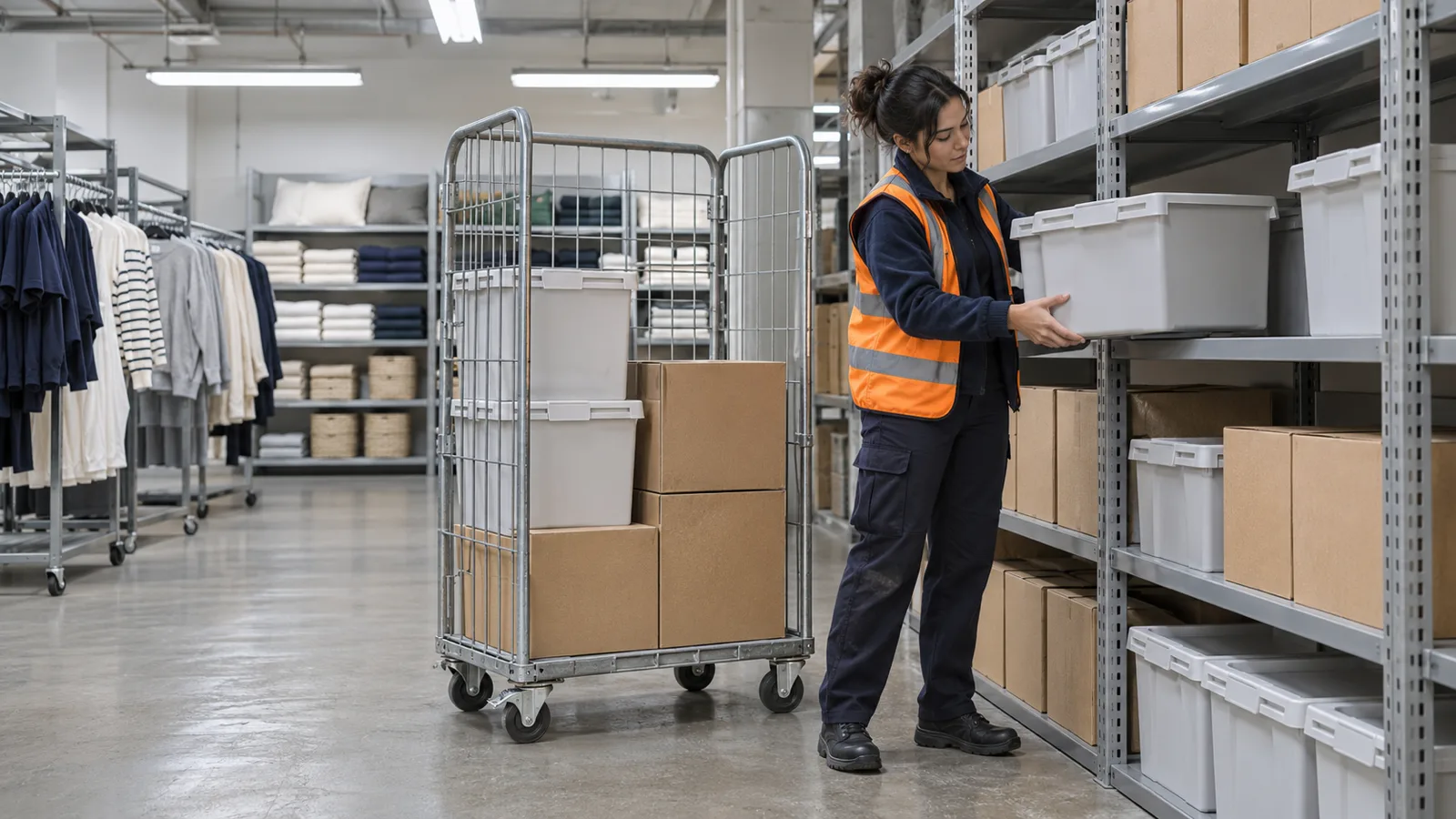
Replenishment is not finished when the truck arrives. Store labour is expensive and limited, and a messy delivery can tie up staff for hours. A few warehouse practices make a big difference at the store end:
- Pick by department or zone. Packing cartons by store department or fixture means staff can wheel each carton straight to its section.
- Use returnable totes where it makes sense. Totes stack neatly, protect product and cut cardboard waste, though they need a return loop that works with your delivery schedule.
- Floor-ready merchandise. Pre-ticketing, hanging garments, applying security tags or assembling displays at the warehouse saves time in stores. Our value-added services cover this kind of work.
- Accurate packing lists. When the delivery matches the electronic notice, stores can receive by scanning cartons instead of counting every unit.
Setting target stock levels by store
Pull replenishment depends on each store having a sensible target, sometimes called a model stock or max level. Set it too low and the store sells out between deliveries. Set it too high and the backroom fills with product that should be selling somewhere else. A practical target for each item usually combines three elements:
- Expected sales until the next delivery arrives, which depends on both delivery frequency and transit time. A Halifax store replenished weekly from Ontario needs more cover than a Greater Toronto Area store replenished three times a week.
- Safety stock to absorb normal swings in demand and occasional delivery delays, typically larger for distant stores and for winter months.
- Presentation minimum, the quantity needed to make the fixture look full and complete, even if sales are slow.
Review targets at least seasonally. Store traffic patterns shift, new competitors open nearby, and a target set last spring may no longer match reality.
Metrics that matter
To know whether replenishment is working, track a small set of measures across all locations:
- In-stock rate on core items at store level, not just at the DC.
- Store weeks of supply, to catch locations carrying far more than they sell.
- Order-to-delivery time by region, so you can see whether western or Atlantic stores are consistently disadvantaged.
- Pick accuracy, since every error creates a phantom stock problem at the store.
- Transfer volume, which should trend down as allocations improve.
Good reporting and analytics help you see these numbers together rather than piecing them together from different systems.
Stores as fulfillment points
Many Canadian retailers now use stores in more ways than selling off the shelf: curbside pickup, ship-from-store and buy online pick up in store. Each of these changes how much inventory a store needs and how it should be replenished. If a store is now fulfilling online orders, its stock is doing two jobs, and target levels need to reflect that. Our post on omnichannel fulfillment looks at how stores and warehouses can share that load.
Around the holidays, a phased replenishment plan helps. Move core lines to distant stores before winter weather and peak carrier volumes slow transit, keep reserve inventory central, and avoid sending full seasonal allocations to locations where early sales are still uncertain.
Keep your shelves full across Canada
Store replenishment works best when data, warehousing and transport are planned together. ShipCarte helps multi-location retailers across Canada with distribution warehousing, store-ready picking and packing, and LTL and truckload shipping to locations from coast to coast. Schedule a consultation to review your current replenishment cycle and where it could run more smoothly.