
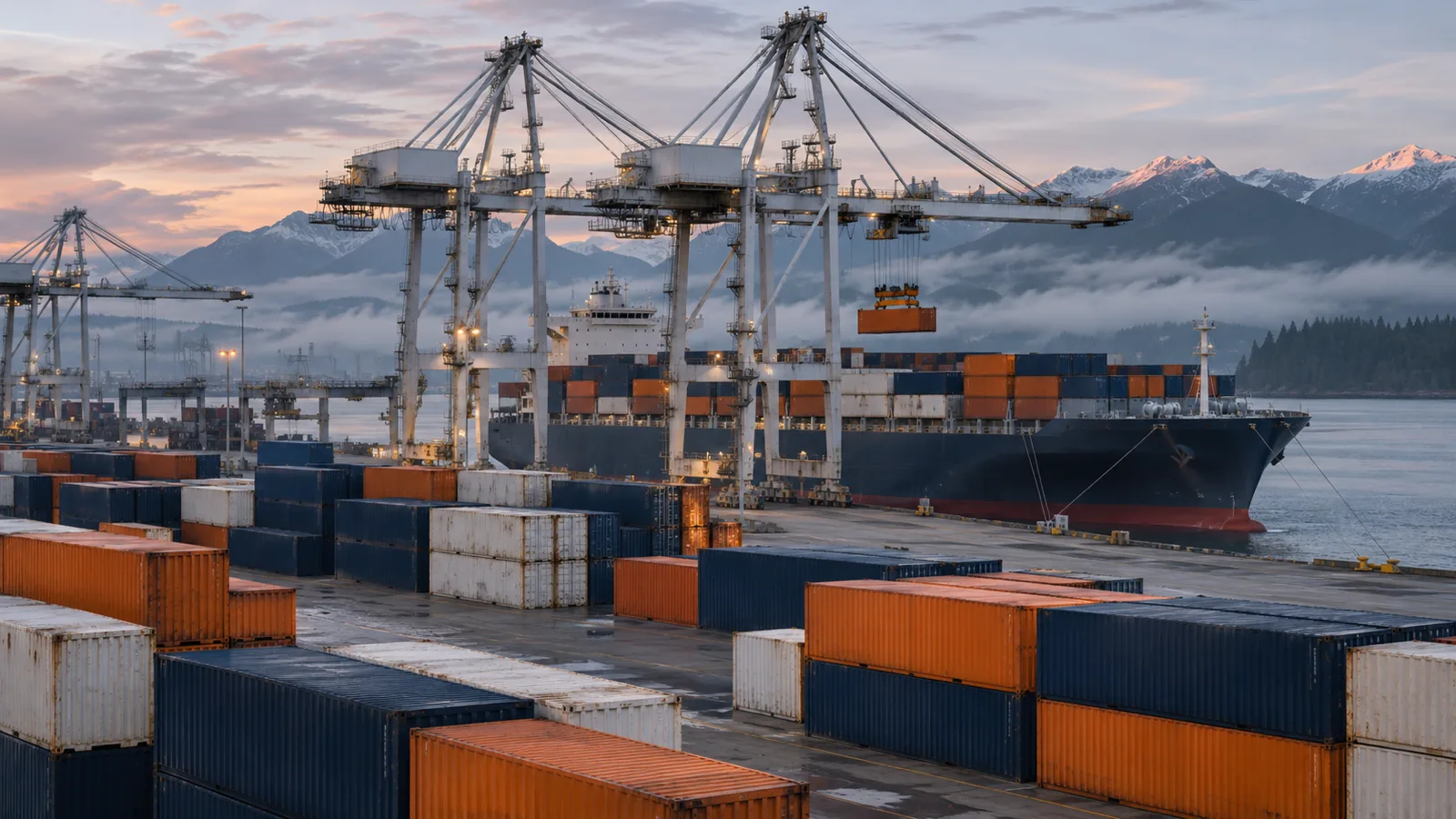
A Canadian importer orders a container of goods from an overseas factory. The supplier quoted a production time of five weeks, the ocean crossing to the West Coast takes roughly two to three more, and then the container still has to be discharged at the port, moved by rail across the country, cleared through customs and trucked to a warehouse. On paper, that is a long but predictable pipeline. In practice, any one of those steps can slip by a week or more, and the business finds out only when the reorder point has come and gone and the shelves are empty.
This is the problem safety stock is meant to solve. It is the extra inventory you carry on top of expected demand so that a late shipment or a sales spike does not turn into a stockout. For businesses in Canada that import a large share of their products, safety stock carries more weight than it does for a retailer buying from a domestic distributor two hours down the highway, because the lead times are longer and the variation within them is larger.
The first half of 2020 made the point painfully clear. Rail disruptions in February, followed by factory shutdowns overseas and then a surge in online orders at home, left many importers either badly short or holding the wrong products. This article explains how to think about safety stock when your supply chain crosses an ocean, and how to size it without locking up cash you need elsewhere.
What Safety Stock Is and What It Is Not
Safety stock is a buffer against uncertainty. It is not your normal cycle stock, which is the inventory you expect to sell between one delivery and the next. It is not seasonal pre-build, which is inventory you deliberately bring in ahead of a known peak. And it is not dead stock, which is inventory that is no longer selling at all.
Keeping those categories separate matters, because each one has a different cause and a different fix. If your warehouse is full, it is worth asking which of the four is actually taking up the space. Very often, what looks like too much safety stock is really slow-moving product that should be dealt with on its own terms.
Where the Uncertainty Comes From on Canadian Import Routes
Safety stock protects against two kinds of variation: variation in demand and variation in lead time. For importers, the second one is often bigger than people expect. Here is where the time tends to move on a typical inbound route into Canada.
At origin
Supplier production schedules slip, raw materials arrive late, and factories close for holidays such as Lunar New Year. Booking space on a vessel can also be harder in peak shipping periods, and a missed sailing can add a week before the container even leaves port.
At sea and at the port
Transpacific crossings to the Port of Vancouver or Prince Rupert are fairly consistent once the ship sails, but vessels can be delayed by weather, port congestion or schedule changes by the shipping line. Goods coming from Europe often land at the Port of Montreal or Halifax, where winter conditions and seasonal volume can affect timing.
Inland rail and trucking
Much of the container traffic that lands on the West Coast moves east by rail to inland terminals in Calgary, Edmonton, Winnipeg, the Greater Toronto Area and Montreal. Rail is efficient over these distances, but it is also exposed to disruptions: blockades, labour disputes, derailments, and winter weather through the mountain passes. From the rail terminal, the container still needs a dray truck and a dock appointment at your warehouse. Our explainer on what drayage is covers that last short leg.
Customs clearance
Most shipments clear the Canada Border Services Agency without trouble, but holds for examination, missing documents or incorrect tariff classification can add days. Products regulated by other bodies, such as food under the Canadian Food Inspection Agency or health products under Health Canada, can face extra scrutiny. A good customs broker reduces the risk; it does not remove it.
A Simple Way to Size Safety Stock
There are many formulas for safety stock, and you do not need a degree in operations research to use a sensible one. The most common approach considers both demand variation and lead time variation:
Safety stock = Z × √(average lead time × demand variance + average demand² × lead time variance)
That looks intimidating, so break it into its parts:
- Z is a service factor tied to how often you are willing to run out. A higher target service level means a larger Z and more safety stock.
- Average lead time is how long, on average, it takes from placing a purchase order to having sellable stock in the warehouse. Measure it end to end, not just the ocean leg.
- Demand variance captures how much your sales bounce around from week to week.
- Lead time variance captures how much your supply pipeline bounces around from order to order.
For many importers, the second term inside the square root dominates. If your average weekly demand is steady but your lead time swings between eight and fourteen weeks, it is the lead time uncertainty that is driving the buffer. That tells you where to focus improvement efforts.
If you do not have enough history to calculate variances properly, a practical starting point is to look at the worst realistic delay you have experienced in the last year or two, multiply it by average demand, and use that as a first estimate. Then refine it as you collect better data.
Walking Through a Scenario
Consider a home goods brand based in Ontario that sells online across Canada. One of its core products, a set of kitchen storage containers, sells about 300 units a week with fairly little variation. The product comes from a supplier in Asia, lands in Vancouver and moves by rail to a warehouse in the Greater Toronto Area.
Looking back at its last eight purchase orders, the brand finds that door-to-door lead time averaged around ten weeks, but ranged from eight weeks on a smooth run to fourteen weeks when a sailing was missed and the container sat at the rail terminal. Demand is steady; lead time is not.
If the brand simply reorders when it has ten weeks of stock left, it will run out every time a shipment is late. If it holds an extra four weeks of stock, roughly 1,200 units, it covers the worst delay it has seen. Whether that is the right number depends on what a stockout costs. For a hero product that drives repeat customers and marketplace rankings, the buffer is probably worth it. For a slower accessory, the brand might accept the occasional stockout and hold much less.
The brand then looks at ways to shrink the lead time variation itself: booking with the forwarder earlier, splitting orders across two sailings, and asking its warehouse to prioritise unloading this product's containers. Each improvement reduces the safety stock it needs.
Not Every SKU Deserves the Same Buffer
Applying one safety stock rule to an entire catalogue usually overstocks the slow movers and understocks the best sellers. A better approach is to segment:
- A items, the small group of products that drive most of your revenue, deserve higher service levels and more careful planning.
- B items get moderate buffers and periodic review.
- C items, the long tail, can often run with minimal safety stock or be ordered less frequently in larger batches.
Also consider the margin and the substitution risk. If a customer will happily buy a similar product when one is out of stock, the cost of a stockout is lower. If they will go to a competitor, it is higher.
The Real Cost of Carrying the Buffer
Safety stock is not free. Every unit sitting in the warehouse costs money in storage, insurance, financing and the risk that it becomes obsolete. For Canadian businesses, the landed cost of imported goods also includes duties, brokerage fees and the GST paid at import, which ties up cash until the goods are sold and the input tax credit is claimed. Our guide to landed cost per unit explains how to calculate that full number.
The aim is to find the point where the cost of carrying more inventory is roughly balanced by the cost of the stockouts it prevents. That point will be different for every business and every product, and it moves as your sales and supply chain change.
Where to Hold Safety Stock
Location matters as much as quantity. A business that sells across Canada may find that holding all of its buffer in one central warehouse means slow deliveries to customers on the other side of the country when the main stock runs low. Some businesses split inventory between a western and an eastern location, so that a delay on one inbound route does not empty both. Others keep the bulk of their buffer in a lower-cost reserve location and replenish a forward pick area as needed.
Using a provider that offers distribution warehousing can make that kind of setup practical without signing multiple leases. It also gives you flexibility to scale storage up and down as your buffer needs change during the year.
Review Safety Stock Regularly
Safety stock is not a number you set once and forget. Review it at least quarterly, and more often when conditions are changing quickly, as they have been this year. Triggers for a review include a change of supplier, a new shipping route, a jump or drop in sales, and any period of unusual disruption at ports or on the rail network.
Good data makes that review much easier. A system that records purchase order dates, ship dates, arrival dates and receiving dates lets you measure real lead times instead of relying on supplier quotes. Reporting and analytics that show weeks of cover, stockout history and inventory age by SKU help you spot where buffers are too thin or too thick before it becomes a problem.
Practical Ways to Reduce How Much Buffer You Need
- Place purchase orders on a regular rhythm so suppliers can plan production.
- Share forecasts with key suppliers and your freight forwarder.
- Work with a customs broker who knows your products and files documentation ahead of arrival.
- Consider a secondary supplier, potentially closer to home, for your most critical products.
- Speed up receiving at the warehouse so goods become sellable sooner after they arrive.
- Track lead time by supplier and route, and hold underperformers accountable.
Build a Buffer That Works for Your Business
Long import lead times are a fact of life for many Canadian brands, but stockouts do not have to be. With honest lead time data, sensible segmentation and a warehouse partner that receives quickly and reports accurately, you can carry the buffer you need and no more. ShipCarte supports importers across Canada with warehousing, inventory management and inbound freight coordination. Request a quote to see how we can help you keep stock flowing.