
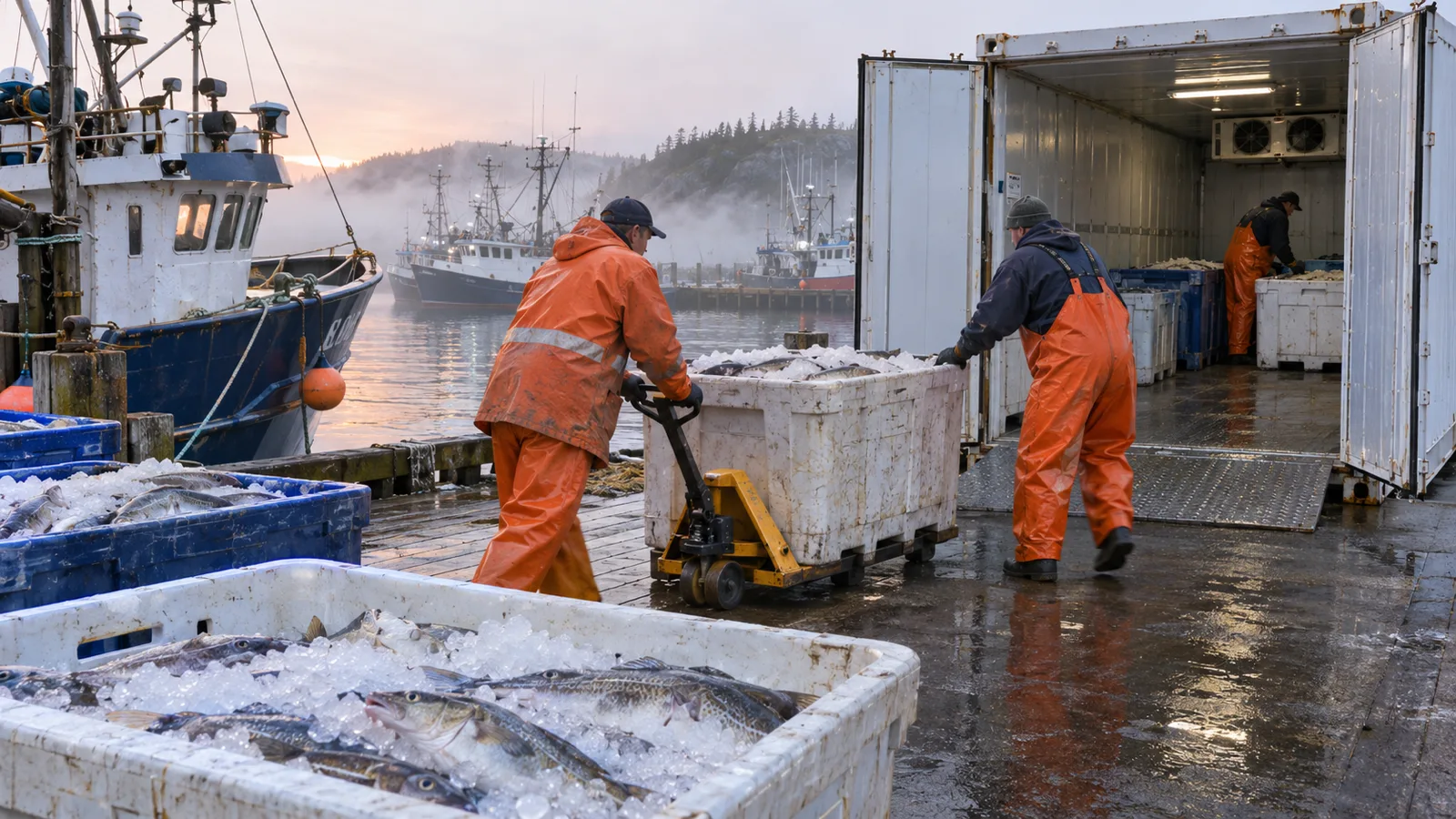
A boat ties up at a wharf in southwest Nova Scotia before sunrise with a hold full of lobster. By evening, some of that catch may be sitting in a cargo hold over the Atlantic, some will be in a holding pound waiting for the next order, and some will be cooked and frozen at a processing plant for shipment by sea weeks later. Every one of those paths depends on the same thing: keeping the product at the right temperature, every hour, from the moment it leaves the water.
Canada is one of the world's major seafood exporters, with lobster, snow crab, shrimp, scallops and groundfish from the Atlantic coast, salmon, halibut, spot prawns and geoduck from the Pacific, and freshwater fish from the lakes of Manitoba, Ontario and the North. The buyers are spread across the United States, Asia and Europe, and each market wants its product in a particular form: live, fresh on ice, or frozen.
This article follows seafood from the wharf to the buyer, stage by stage, and looks at where temperature control usually fails, which paperwork is needed, and how exporters can choose between air, truck and ocean freight.
Three product forms, three different supply chains
Before looking at each stage, it helps to separate the three main forms of seafood export, because their logistics are very different.
Live product
Live lobster, crab, oysters, geoduck and other shellfish command premium prices but have the least room for error. They need cool, moist conditions, not freezing, and they need to reach the buyer quickly. Live exports to Asia and Europe move almost entirely by air, typically through airports such as Halifax Stanfield, Moncton, Toronto Pearson, Montreal and Vancouver. Shipments to the US often travel by truck across the border in insulated or refrigerated trailers.
Fresh product
Fresh fillets, whole fish and scallops on ice must stay just above freezing. They have a short shelf life, so most fresh exports go to the US by refrigerated truck or to more distant markets by air. Every hour on a hot tarmac or in a warm warehouse shortens the product's life at destination.
Frozen product
Frozen seafood, including cooked and raw lobster, snow crab sections, shrimp and frozen fish, can travel by sea in refrigerated containers, which makes it far cheaper to move long distances. It must stay deeply frozen throughout. Temperature fluctuations, even if the product never fully thaws, can damage texture and lead to claims.
Stage by stage: where the cold chain breaks
- On the boat and at the wharf. Product quality starts at harvest. Icing, slurry, live wells and shading on deck all matter. At the wharf, catch that sits in the sun while waiting for a truck can lose quality before it even reaches the plant.
- Transfer to processing or holding. Live shellfish go to holding facilities or pounds; fish go to processing plants for gutting, filleting or freezing. Short, refrigerated transfer from the wharf is the norm, but delays at peak landing times are common.
- Packing for export. Live product is packed in insulated boxes with gel packs and damp packing material; fresh product is packed with ice or gel packs in waxed or insulated cartons; frozen product is boxed and palletised. Packing standards often come from the buyer or airline.
- Staging before departure. This is a frequent weak point. Pallets of fresh or live product waiting at an airport or a cross-dock may sit outside a cooler longer than planned. Cooler space at the departure point needs to be booked and confirmed.
- Main transit. Air freight transit time is short but subject to schedule changes and capacity limits. Truck transit to the US depends on border processing times. Ocean transit is long, so the reefer container's settings and power supply must be checked carefully.
- Arrival and clearance. Inspection holds at destination can leave product sitting in a warehouse or on a tarmac. Having documents correct and complete in advance is the best way to shorten that time.
- Final delivery to the buyer. Last-leg transport to a distributor, restaurant or retailer needs the same care as the first.
Temperature loggers that travel with the shipment are increasingly expected by buyers. They give you evidence if there is a dispute and help you identify which stage is causing problems.
Choosing a transport mode
Each mode has its strengths. The comparison below is general; costs and transit times vary by season, route and carrier capacity.
- Air freight: the only option for live product to distant markets, and common for high-value fresh product. It is fast but expensive, and capacity depends on passenger and cargo flight schedules, which have been unusually limited this year as the pandemic cut passenger flights.
- Refrigerated truck: the backbone of seafood exports to the United States, crossing at points such as St. Stephen–Calais in New Brunswick, the Lacolle and Windsor–Detroit crossings, and the Pacific Highway near Vancouver. Truck service also moves product from coastal plants to inland hubs and airports.
- Ocean reefer container: the most cost-effective way to move frozen seafood to Asia, Europe and other overseas markets. Ports at Halifax, Saint John, Montreal, Vancouver and Prince Rupert handle reefer containers, with Prince Rupert offering a short sailing time to Asia.
- Intermodal rail: frozen product from Atlantic Canada sometimes moves by rail to Montreal or across the country to Vancouver for export, combining rail economics with ocean routes to Asia.
For exporters, the right choice often mixes modes: refrigerated truck from the plant to a hub, then air or ocean. A partner who coordinates full truckload and LTL freight legs with cold storage at the hub reduces the hand-offs where product warms up.
The paperwork behind every shipment
Seafood is one of the most document-heavy categories in food exports. Requirements vary by country and product, but exporters commonly deal with the following:
- Safe Food for Canadians licence: businesses that process or export fish and seafood generally need a licence from the Canadian Food Inspection Agency, along with a preventive control plan.
- Export certificates: many countries require a health certificate issued by the CFIA for each shipment. The CFIA's export requirements library describes what each country needs.
- Catch and species documentation: some markets require catch certificates or documentation showing the product was legally harvested. Species listed under international trade conventions may need permits.
- Commercial documents: commercial invoice, packing list, bill of lading or air waybill, and, where relevant, certificates of origin to claim preferential tariff rates under agreements such as CUSMA, CETA with the European Union, or the CPTPP with markets including Japan and Vietnam.
- US requirements: seafood shipped to the US must meet FDA rules, including facility registration and prior notice, and HACCP-based controls apply to seafood processors.
Paperwork errors cause more delays than weather does. A single mismatch between the certificate and the invoice can hold a shipment at destination while the product deteriorates. Our post on what happens if customs seizes your merchandise is a useful reminder of what is at stake.
Seasonality and capacity
Canadian seafood harvests are highly seasonal and often regulated by fishing areas with set opening dates. The Atlantic lobster fishery, for example, opens in different areas at different times, and the landings in the first weeks after an opening can be very large. Snow crab, shrimp, salmon and spot prawn seasons each have their own peaks.
Those peaks create pressure on trucks, cold storage and air cargo space. Exporters who plan ahead and book capacity before a season opens are less exposed to last-minute price increases and shortages. Frozen product can be held in cold storage and released to market gradually, smoothing out the sales curve and allowing better prices.
This year has shown how quickly demand can shift. Restaurant closures in many markets and changes in air cargo capacity during the pandemic disrupted the usual flow of live and fresh seafood, and some exporters moved more product into frozen formats or retail channels. Flexible cold storage and a mix of transport options have been valuable buffers.
Domestic distribution as a second market
Not all seafood goes abroad. Canadian retailers, restaurants and online sellers buy significant volumes, and many coastal producers have built direct-to-consumer channels. Shipping seafood to consumers in Toronto, Calgary or Winnipeg uses the same principles on a smaller scale: insulated packaging, enough refrigerant for the transit time, and carriers that can deliver within one or two days. ShipCarte's cold chain fulfillment service supports this kind of perishable ecommerce, and our post on how to ship frozen foods for ecommerce goes into packaging detail.
Questions to ask your logistics partners
- What temperature range will my product be held at during each stage, and how is it monitored?
- How much cooler or freezer space is available at the departure point during peak landings?
- What happens if a flight is cancelled or a vessel is delayed? Where is the product held?
- Can you share temperature logs with my buyers?
- Who checks export documents before departure, and how quickly can errors be corrected?
- Do you have experience with the specific border crossing or port I use?
Keep your catch at its best
ShipCarte helps food and beverage businesses across Canada with temperature-controlled storage, cold chain fulfillment and freight coordination for products that cannot afford a break in the cold chain. To talk through your seafood lanes, seasons and markets, schedule a consultation with our team.