
A painter with a studio in Port Credit has just sold a large oil on canvas to a collector in Vancouver. The piece took eight months to finish, the varnish is barely cured, and the buyer wants it hanging before a family celebration in three weeks. The artist's instinct is to wrap it in bubble wrap, slide it into a cardboard box from a moving supply store and book the cheapest courier. That instinct is understandable, and it is how a lot of artwork ends up with a punctured canvas, a cracked frame or bubble wrap pattern pressed permanently into the paint surface.
Artwork is not like other cargo. Each piece is often unique and irreplaceable, values are subjective and can be high, and the materials react to shock, vibration, temperature and humidity in ways that ordinary packaging does not account for. Whether you are an artist, a gallery, a collector or a framer in Mississauga, shipping art well means making deliberate choices about packing, transport, climate and insurance.
This guide works through those choices in the order you will face them.
Step one: understand what you are shipping
Different works fail in different ways. Before choosing packaging, consider:
- Paintings on canvas are vulnerable to punctures, dents in the canvas, and surface contact with wrapping materials. Fresh oil paintings may still be soft.
- Works under glass such as prints, photographs and drawings risk glass breakage that then damages the artwork itself. Acrylic glazing reduces this risk.
- Works on paper are sensitive to humidity, creasing and light.
- Sculpture varies hugely: bronze is robust but heavy, ceramics and glass are fragile, and mixed-media pieces may have delicate protrusions.
- Frames are often more fragile than the work, especially gilded or ornate frames whose corners chip easily.
Write down the dimensions, weight, medium, framing and current condition. You will need this information for quotes, insurance and customs.
Step two: document condition before anything moves
A condition report is a written and photographic record of the work's state before shipping. It should include overall photographs of the front and back, close-ups of any existing marks, cracks, abrasions or frame damage, and notes on the materials. Photograph the work in good, even light, ideally with a scale reference.
This record is your best protection in an insurance claim. Without it, it can be very difficult to prove that damage occurred in transit rather than before. Ask the recipient to complete a matching condition check on arrival, before signing off on delivery.
Step three: choose the right level of packing
There is no single correct way to pack art. The right approach depends on the value, fragility, size, distance and how many times the piece will be handled. Here is how the common options compare.
Soft packing
The work is wrapped in a barrier layer such as glassine or acid-free tissue against the surface, then padded with foam or bubble wrap (bubbles facing out), with corner protectors on frames. Soft packing suits short, direct, hand-carried moves, for example a dedicated art shuttle from a Mississauga studio to a gallery in Toronto where the same handlers load and unload. It is not suitable for networks where parcels are sorted mechanically.
Box-in-box or travel frame
The wrapped work sits inside a rigid inner box, which is floated inside a larger outer box with cushioning between. Travel frames hold the artwork by its frame or stretcher so nothing touches the surface. This level suits moderate-value pieces travelling by courier or freight within Canada.
Custom wooden crate
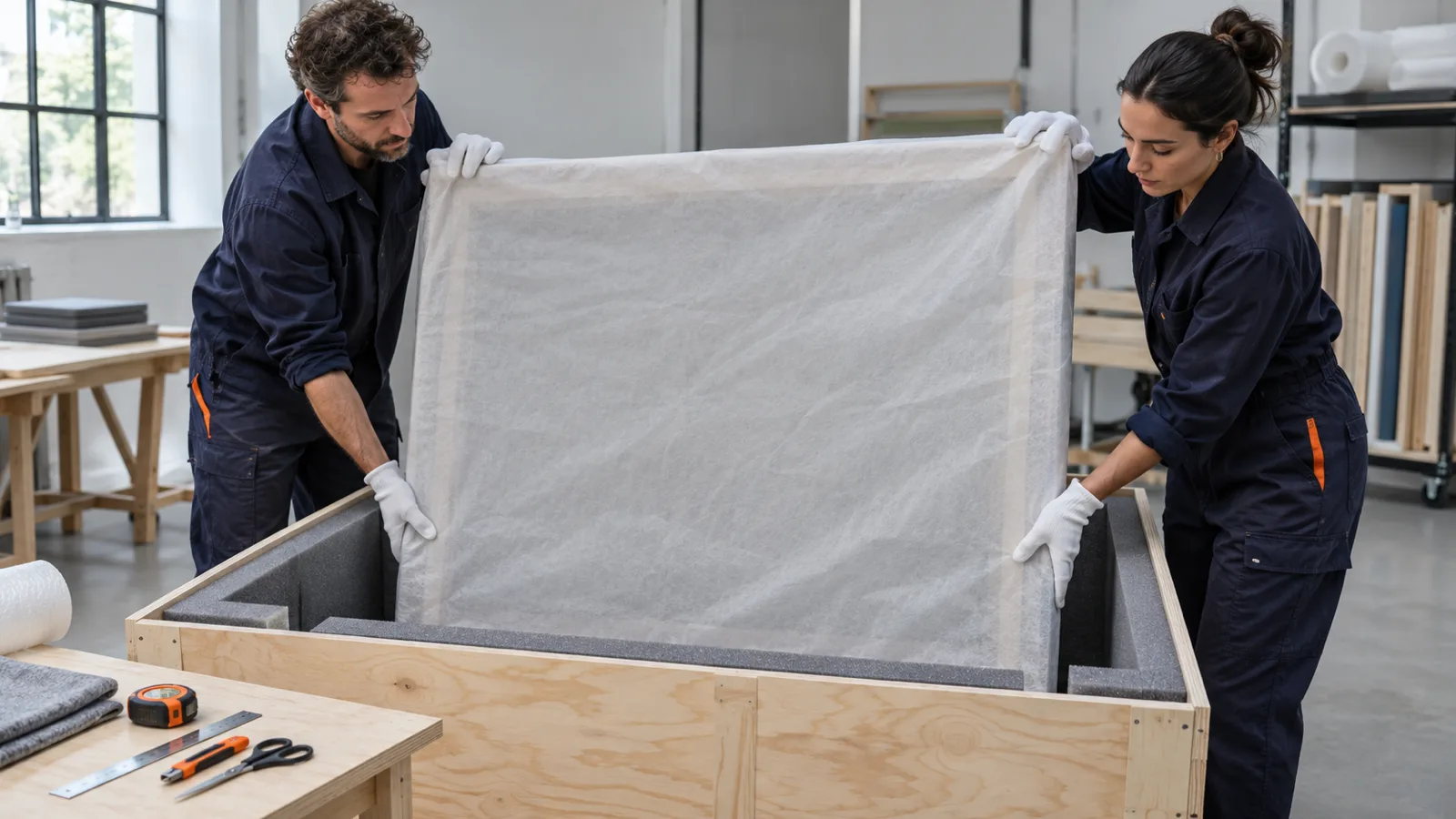
A crate built to the dimensions of the piece, typically of plywood with a lumber frame, lined with foam engineered to absorb shock. Higher-end museum-style crates may add insulation and moisture barriers to slow changes in temperature and humidity. Crates are standard for valuable, large or fragile works, international shipments and anything travelling by air or long-haul truck. They also make handling easier with forklifts and pallet jacks.
One practical note for international shipping: solid wood packaging must generally meet ISPM 15 phytosanitary standards (heat-treated and stamped) for many destinations. Plywood and other engineered wood are usually exempt, which is one reason art crates are commonly built from plywood. Confirm the requirements for your destination.
Packing details that matter
- Never let plastic or bubble wrap touch a paint surface directly; use glassine or a similar barrier.
- Tape a cross or grid of low-tack tape over glass glazing so that, if it breaks, shards are held in place. (This is not done on acrylic or on the artwork itself.)
- Mark crates clearly with orientation, "this side up," and which side the artwork faces.
- Include screws rather than nails on crate lids so recipients can open them without hammering.
- Include unpacking instructions inside the lid.
Step four: plan for climate
Rapid changes in temperature and relative humidity cause materials to expand and contract at different rates. Canvas slackens or tightens, paint layers can crack, wood panels warp, and condensation can form on cold surfaces brought into a warm room.
Canada's climate makes this a real concern. A crate loaded at a Mississauga warehouse in January and left on an unheated trailer overnight can drop well below freezing, then be unloaded into a heated gallery. In summer, a truck parked on asphalt near Pearson can become very hot inside. Practical measures include:
- Using climate-controlled vehicles or storage for valuable or sensitive works. ShipCarte's temperature-controlled warehousing shows how controlled storage is managed for sensitive goods.
- Insulated crates that slow the rate of change.
- Letting crates acclimatize for a period, often 24 hours, before opening them in a new environment.
- Avoiding scheduling that leaves works sitting on docks or in unheated trailers.
Step five: choose the transport mode
Local moves around the GTA
For moves within Mississauga, to Toronto galleries, or to collectors in Oakville, Burlington or Brampton, a dedicated vehicle with two handlers is often the safest and most practical option. The piece is not transferred between vehicles or sorted. Avoid rush hour on the QEW and 401 where possible, both to save time and to reduce time the work spends in a vehicle.
Long-distance within Canada
For Vancouver, Calgary, Montreal or Halifax, options include dedicated fine art shuttles that run scheduled routes, palletized freight, or air cargo through Toronto Pearson. Standard parcel networks with automated sorting are generally a poor fit for anything other than small, robustly boxed works on paper. If you use LTL freight, insist on a crated and palletized shipment, and ask about minimizing terminal transfers.
International shipments
Exporting art from Canada brings additional steps:
- Customs documentation. A commercial invoice with accurate description, value, origin and HS classification. Original artworks often fall under specific tariff headings.
- Cultural property. Certain objects of cultural significance, depending on age, value and category, may require an export permit under Canada's Cultural Property Export and Import Act. Check before you sell or ship older works.
- Restricted materials. Works containing materials such as ivory, certain tropical woods, tortoiseshell or feathers may fall under CITES rules and need permits.
- Temporary exports. For exhibitions and art fairs abroad, an ATA Carnet can simplify temporary entry into participating countries.
- Import duties and taxes. Rules vary by destination. Decide who pays them and set expectations with the buyer. ShipCarte's cross-border shipping service can help with documentation for shipments to the US.
Step six: insure it properly
Standard carrier liability is usually limited, often calculated by weight or capped at a modest declared value, and many carriers exclude or restrict coverage for fine art altogether. Do not assume a courier's declared value option fully covers an artwork.
Options include:
- Fine art insurance held by the owner, gallery or artist, which may include transit coverage. Check whether it covers the specific trip and mode.
- "Nail-to-nail" or wall-to-wall transit cover, which covers the work from the moment it leaves its original location until it is installed at the destination, including packing and unpacking.
- Cargo insurance arranged through a logistics provider or broker for the shipment.
Insurers will want the value substantiated by an invoice, appraisal or sales record, and they may require professional packing for higher values. Read the exclusions carefully, especially around inadequate packing, gradual climate damage and pre-existing conditions. ShipCarte's articles on freight insurance and getting shipping insurance explain the basics.
A shipping checklist for artists, galleries and collectors
- Measure, weigh and photograph the work; complete a condition report.
- Decide packing level based on value, fragility and route.
- Arrange crating or professional packing with appropriate surface protection.
- Confirm climate needs and choose transport accordingly.
- Confirm insurance that covers the full journey, with values documented.
- Prepare customs paperwork and check for permits on international shipments.
- Agree delivery details: access, stairs, elevators, and who will unpack and install.
- Ask the recipient to complete a condition check on arrival before signing.
How ShipCarte can help
ShipCarte works with businesses that ship high-value and fragile goods, offering freight coordination, insured shipping options, cross-border documentation support and value-added services. For galleries and artists who ship regularly, from Mississauga studios and showrooms to collectors across Canada and the US, having a single logistics partner simplifies quoting, booking and tracking. For one-off pieces, we can help you think through the right level of packing and transport for the work.
If you are planning to ship artwork from Mississauga, request a quote with the dimensions, weight, value and destination of the piece, and we will help you find a safe, well-documented way to get it there.