
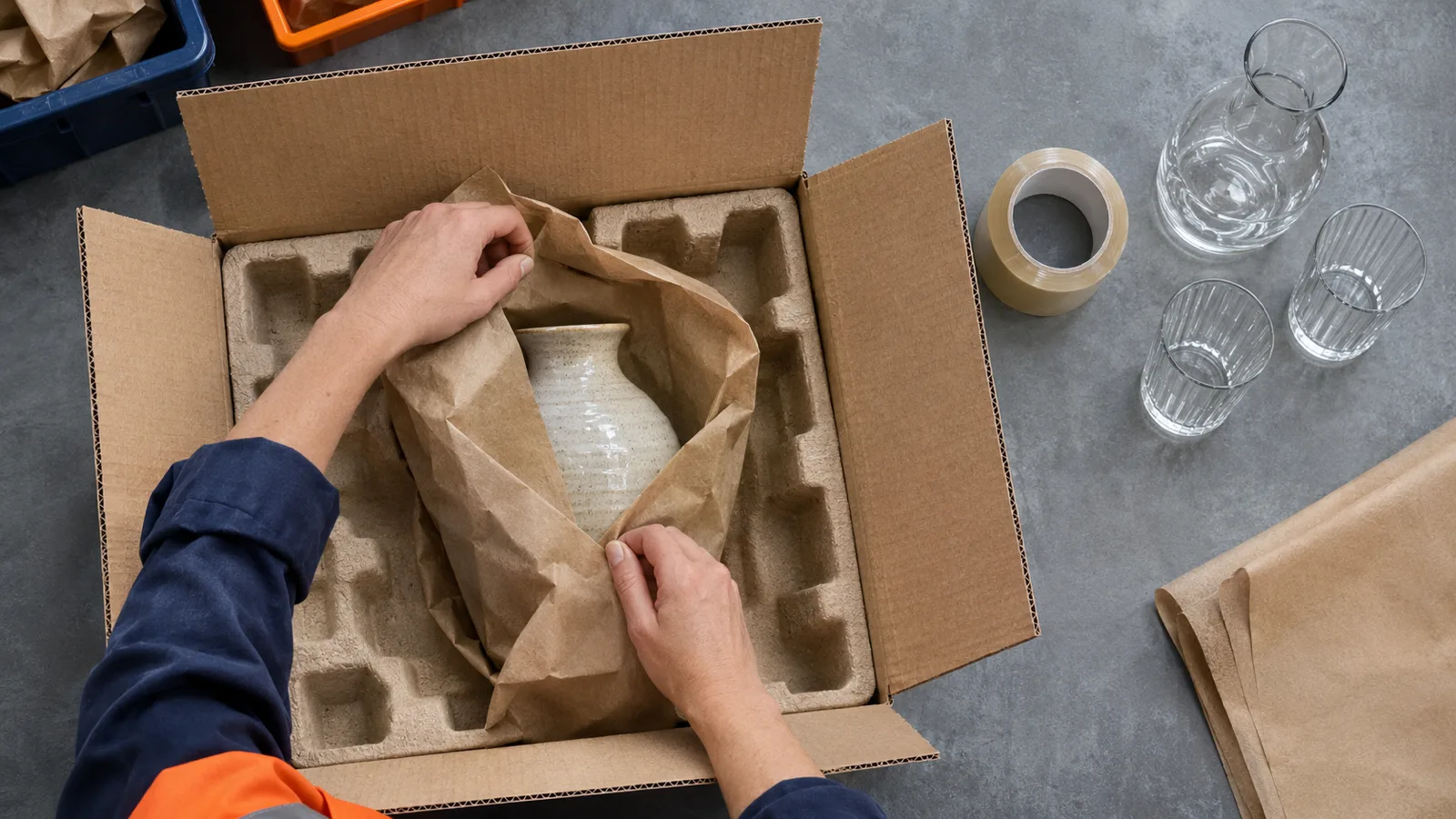
A ceramics studio in Port Credit started selling online and quickly learned an expensive lesson. The first month brought a run of customer photos showing shattered mugs and chipped bowls, each one meaning a refund, a replacement and a second shipping charge. The pottery itself was excellent. The packaging was the problem: a single layer of bubble wrap in a box that was a little too big, with crumpled newspaper doing most of the work.
Fragile goods are some of the most rewarding products to sell and some of the most frustrating to ship. Glassware, ceramics, candles, cosmetics in glass bottles, electronics, framed art and specialty foods in jars all have a way of arriving broken if the packaging is designed around hope rather than physics. For Mississauga businesses sending orders across Ontario, the rest of Canada and the US, parcels may pass through several sorting hubs, conveyor belts and trucks before reaching a doorstep.
This article goes beyond the basics to cover packaging methods by product type, the specific challenges of the Ontario climate, and how to test your packaging before your customers do it for you.
Understand what actually breaks things
Damage in a parcel network typically comes from a few forces:
- Drops: parcels fall from conveyors, sorting chutes and vehicle tailgates, often onto corners or edges.
- Compression: heavier boxes are stacked on top in trucks and cages.
- Vibration: long highway runs, including along the 401 and 400-series routes, shake contents loose over time.
- Puncture: other parcels' corners or equipment can pierce thin cartons.
- Temperature: extreme heat or cold can affect liquids, adhesives and some materials.
Good packaging handles all five. The aim is to stop the item moving inside the box, keep it away from the walls, and use a box strong enough not to collapse.
The core methods
Box-in-box
The item is wrapped and packed snugly in an inner box, which is then centred in a larger outer box with at least about five centimetres of cushioning on every side. Shocks to the outer box are absorbed before they reach the inner one. It's one of the most dependable methods for high-value or very fragile items.
Suspension and retention packaging
The item is held in place by a film stretched across a frame, suspending it in the centre of the box. These systems are reusable, fast to pack and excellent for electronics and small appliances, though they add cost per unit.
Moulded inserts
Moulded pulp or foam inserts are shaped to the product, so each item sits in its own pocket. They're ideal when you ship the same SKU repeatedly, such as a set of four glasses, and they make packing fast and consistent. Moulded pulp has the added benefit of being recyclable in many municipal programs.
Wrap and fill
The traditional approach: wrap the item in bubble wrap, foam or paper, then fill voids with air pillows, paper or loose fill. It works for low-volume and varied items, but it depends heavily on the packer's skill. Too little fill and items shift; too much and the box bulges and compresses the contents. Our article on dunnage covers void-fill materials in more detail.
Methods by product type
Glassware and ceramics
- Wrap each piece individually, and stuff hollow items like mugs and vases with paper to support the walls.
- Separate items with dividers or cell inserts so they never touch.
- Pack plates on edge rather than flat, as they handle vertical pressure better.
- Use double-wall corrugated boxes for heavier sets.
Liquids in glass bottles
- Check that caps are tight and add a shrink band or tape over closures.
- Bag each bottle in a sealed polybag so a leak doesn't ruin the rest of the order.
- Use bottle-specific moulded shippers for wine, oils, sauces and spirits.
- Check carrier rules for alcohol, perfume and flammable products, which may be restricted or need TDG handling. Our guide on shipping perfume safely covers one common case.
Electronics
- Use anti-static bags for circuit boards and components.
- Protect screens with a rigid sheet or the original manufacturer's foam.
- Follow carrier and TDG rules for lithium batteries, which are regulated whether packed inside the device or separately.
Framed art and mirrors
- Tape an X across glass so that, if it breaks, shards stay in place.
- Add corner protectors and a sheet of rigid board over the face.
- Ship in a mirror box or a custom crate for larger pieces; for very large or valuable items, consider freight rather than parcel.
Ontario weather adds another layer
Packaging that works in May may fail in January. Mississauga winters bring freezing temperatures and parcels that sit in unheated trucks or on doorsteps. Water-based liquids can freeze and expand, cracking glass; some cosmetics separate; candles can crack with rapid temperature changes. In summer, the reverse applies: wax softens, chocolate melts and adhesives weaken in a hot truck.
Practical steps include adding insulated liners for temperature-sensitive goods in winter, avoiding shipping liquids over weekends when parcels may sit in depots, and choosing faster services during extreme weather. For truly temperature-sensitive products, look at cold chain fulfillment rather than standard parcel.
Choose the right box size, consistently
Box size affects both protection and cost. A box that is too big forces you to use more fill, adds dimensional weight charges and lets items build momentum before hitting cushioning. A box that is too small leaves no room for protection. Cartonization software solves this by recommending the right box for each order based on item dimensions. ShipCarte's cartonization tool is designed for exactly this, and it helps keep packaging consistent from one packer to the next.
Set up the packing station for consistency
Many breakage problems aren't caused by the wrong materials but by inconsistent use of the right ones. When a busy afternoon hits, packers improvise. A well-organised station makes the correct method the easiest one:
- Packing specifications per SKU. A simple card or on-screen instruction showing the box size, insert and fill for each fragile product, with a photo of a correctly packed order.
- Materials within reach. Wrap, inserts, dividers and void fill stored at the station so packers don't skip a step because something is across the room.
- Pre-built inserts and partitions. For popular SKUs, fold dividers and inserts in advance during quiet periods.
- A scale at every station. Comparing packed weight against an expected weight catches missing items and missing protection alike.
- Short training for new staff. A fifteen-minute walkthrough on why each step matters is more effective than a list of rules, and it helps temporary staff during peak season.
Protective packaging with less waste
Customers increasingly notice excessive plastic, and some will mention it in reviews. Fortunately, several paper-based options protect fragile goods well. Honeycomb kraft wrap, moulded pulp inserts, corrugated dividers and paper void fill are widely available, and most can go in household blue box recycling in Mississauga and across Peel Region. The trade-off is that paper-based fill can compress more than air pillows over long journeys, so test it on your heaviest and most fragile items before switching completely. Right-sized boxes do more for sustainability than any single material, since they use less fill and less corrugate per order.
Test before you ship at scale
Industry testing standards such as those from the International Safe Transit Association (ISTA) set out drop, vibration and compression tests for parcels. Even if you don't commission formal testing, a simple in-house version will reveal weak points:
- Pack the product exactly as you would for a customer.
- Drop it from about waist height onto a hard floor, on each face, each edge and at least one corner.
- Stack weight on top, roughly what a pile of other parcels might add, and leave it for a while.
- Shake it vigorously to check for movement inside.
- Open it and inspect the product and packaging.
Repeat with any packaging change. Sending a few test orders to friends or staff in distant cities is also revealing, since it exposes your packaging to real carrier handling.
Carrier choice and claims
Packaging does most of the work, but carrier choice still matters. Some carriers handle fragile goods better on certain lanes, and some services involve fewer hub transfers. Keep records of damage rates by carrier and route. If you ship high-value items, check what your carrier's declared value coverage really includes, as many exclude improperly packed goods. Our earlier articles on how to pack fragile items and choosing a courier for fragile items cover the basics and the carrier side.
When a claim is necessary, keep photos of the damaged item, the packaging inside and out, and the shipping label. Report it promptly, since carriers set time limits for claims.
When to hand it off
As order volume grows, consistent fragile packing becomes harder to maintain in-house. Staff turnover, busy seasons and a crowded packing area all lead to shortcuts. A fulfillment partner with trained packers, standard packaging specifications per SKU and quality checks can reduce breakage and free your team to focus on the product. Our pick and pack services include packaging specifications tailored to fragile items.
Ship fragile goods with confidence
Whether you're a studio in Port Credit, a glassware importer near Pearson or an electronics reseller in Mississauga's business parks, breakage is a problem with practical solutions. ShipCarte can help you design packaging, choose the right carriers and handle fulfillment for fragile products. Request a quote and tell us what you ship, and we'll suggest a setup that gets it there in one piece.