
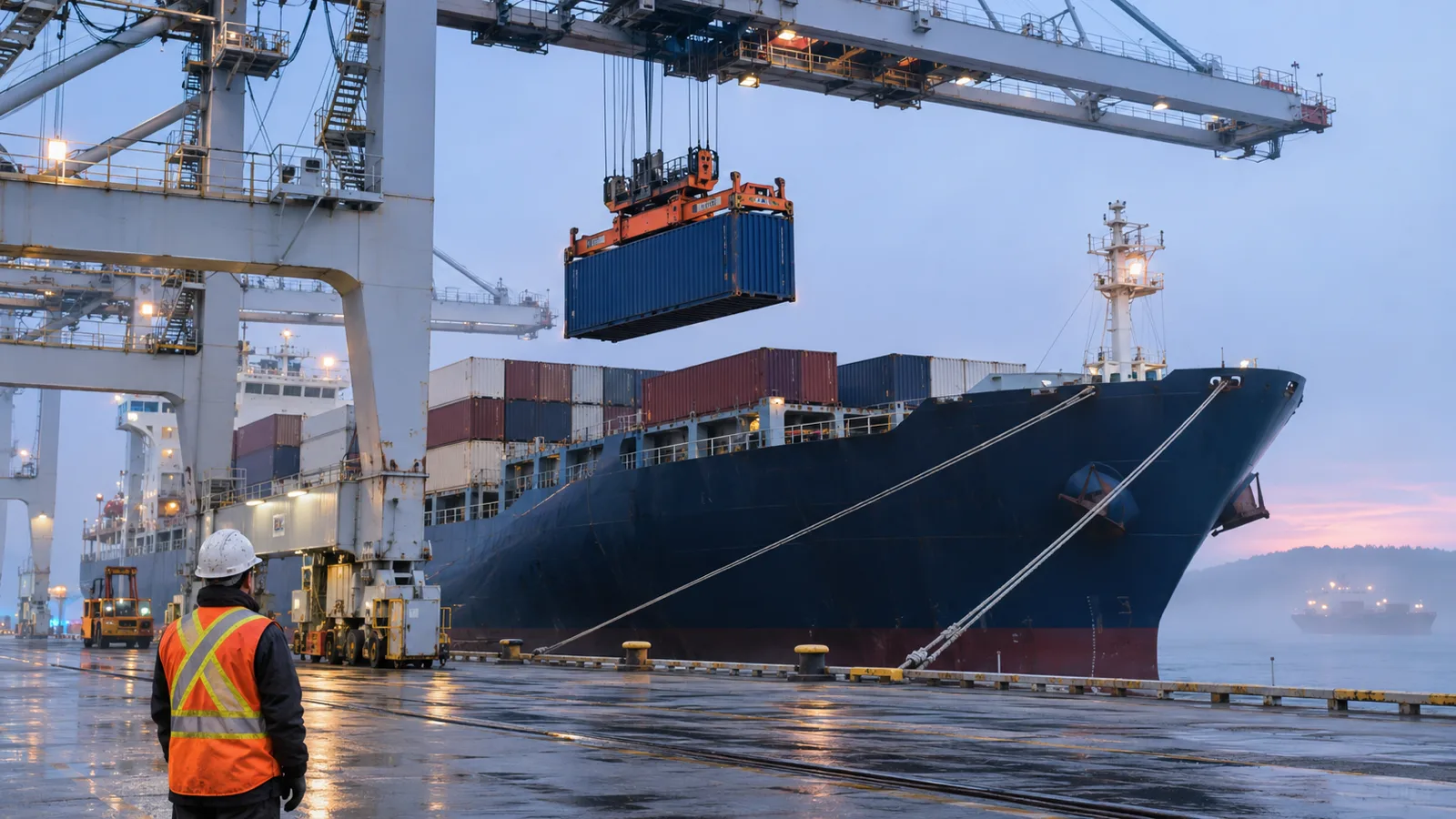
A distributor in Ontario gets an enquiry from a buyer in Accra asking for a container of packaged food ingredients. A machinery parts supplier in Alberta lands a maintenance contract with a mining operation in Zambia. A Quebec cosmetics brand starts getting wholesale requests from Abidjan and Dakar, where French-language packaging is an advantage rather than an afterthought. Each of these is a real opportunity, and each one raises the same first question: how do you actually get goods from Canada to a customer on the African continent, and how long will it take?
Africa is not one market. It is 54 countries with different ports, different customs regimes, different inspection requirements and very different inland infrastructure. A shipment to Durban behaves nothing like a shipment to Kinshasa, and a pallet heading to Nairobi follows a different path than one going to Casablanca. What they have in common is that there are very few direct services from Canada, so almost every shipment involves a transshipment hub somewhere in Europe, the Mediterranean, the Middle East or Asia.
This guide walks through the practical side of shipping from Canada to Africa: which routes your cargo is likely to take, what paperwork Canadian exporters need on both ends, how to set realistic timelines with buyers, and the mistakes that most often cause delays at destination.
How Freight Actually Moves From Canada to Africa
Before choosing a carrier or quoting a delivery date, it helps to picture the route. For most Canadian exporters, the journey has four legs: getting the goods to a Canadian gateway, the main international leg, transshipment at a hub, and the final leg into an African port or airport followed by inland delivery.
Ocean freight from Canadian ports
Canada's East Coast gateways are the natural starting point for most African lanes. The Port of Halifax and the Port of Montreal both have transatlantic services that connect to major European and Mediterranean hubs, and Saint John handles some transatlantic cargo as well. From those hubs, feeder or mainline services continue south to West, North and Southern Africa. Goods made in Ontario or Quebec usually reach Montreal or Halifax by rail or truck along Highway 401 and the Highway 20 and Trans-Canada corridors.
The Port of Vancouver and Prince Rupert are mostly oriented to transpacific trade, but they can make sense for shipments from Western Canada to East Africa, where cargo may be routed through Asian or Middle Eastern hubs before continuing to ports such as Mombasa or Dar es Salaam. Whether that beats railing the goods east to Montreal depends on the carrier schedules available at the time, so it is worth asking for both options.
Common transshipment patterns by region
- West Africa (Nigeria, Ghana, Côte d'Ivoire, Senegal and neighbours): cargo typically leaves Montreal or Halifax for a Northern European or Mediterranean hub, then moves on a feeder or regional service to ports such as Lagos, Tema, Abidjan, Lomé or Dakar.
- North Africa (Morocco, Algeria, Tunisia, Egypt): Mediterranean hubs make this region comparatively well connected, and transit can be shorter than to sub-Saharan destinations.
- East Africa (Kenya, Tanzania, Uganda, Rwanda, Ethiopia): cargo usually transits a Mediterranean, Middle Eastern or South Asian hub. Landlocked destinations add a long road or rail leg from Mombasa, Dar es Salaam or Djibouti.
- Southern Africa (South Africa, Namibia, Botswana, Zambia, Zimbabwe): Durban and Cape Town are the main entry points, with Walvis Bay serving some inland routes. Goods for landlocked countries continue by truck across one or more borders.
Air freight
Air cargo from Toronto Pearson or Montreal usually connects through a European or Middle Eastern hub before reaching airports such as Johannesburg, Nairobi, Lagos, Accra or Addis Ababa. Air makes sense for spare parts that are holding up equipment, samples, medical supplies, documents and high-value goods where the freight cost is small relative to the value. For heavy or bulky goods, the cost difference compared with ocean is usually large enough that air only wins when time really matters.
Courier and small parcel
For small, lighter shipments such as samples, the major international express carriers serve most African countries from Canada. Postal services also reach the continent, but tracking and delivery reliability vary widely between destination countries. If a buyer is waiting on a sample to approve a large order, it is usually worth paying for an express service with end-to-end tracking.
Choosing Between FCL, LCL and Air
The right mode depends on volume, value, urgency and how much handling your goods can tolerate.
- Full container load (FCL) suits regular buyers and larger orders. The container is sealed at origin and opened at destination, which reduces handling and the risk of loss or damage. It also simplifies inspection logistics, because the container can be presented as one unit.
- Less than container load (LCL) lets you ship a few pallets without paying for a whole box, but your cargo is consolidated with other shippers' goods and deconsolidated at destination. LCL services to some African ports are less frequent, and deconsolidation can add days. Pack accordingly: LCL cargo is handled more often.
- Air suits urgent, small or high-value shipments. Volumetric weight applies, so light but bulky items can be expensive.
Many exporters start with LCL or air to serve a new buyer, then move to FCL once orders become regular. Getting goods to the port is part of the decision too: a few pallets moving from a Western Canadian plant to a Montreal consolidator may travel as LTL freight, while a full export order may justify its own truck or rail container.
Export Documentation on the Canadian Side
Canadian export paperwork is relatively light compared with what many destination countries require, but it still has to be right.
Export declaration
Exports from Canada to countries other than the United States generally need to be reported to the Canada Border Services Agency when the commercial value of the goods is CAD $2,000 or more, and in other specific cases such as goods that need an export permit, regardless of value. Most exporters or their forwarders file this electronically through the Canadian Export Reporting System (CERS). The proof of report number then goes to the carrier. If you are not sure whether a shipment needs to be reported, ask your forwarder or check the CBSA's export guidance before the goods move, because the reporting deadline depends on the mode of transport.
Export permits and controlled goods
Some goods need a permit from Global Affairs Canada under the Export and Import Permits Act, including items on the Export Control List and goods going to countries subject to Canadian sanctions. Dual-use technology, certain chemicals and some electronics can be caught by these rules even when they look ordinary. Check before you quote a delivery date, because permits take time.
Commercial documents
- Commercial invoice with a full description of the goods, quantities, unit values, currency, Incoterms and HS codes.
- Packing list showing what is in each package or pallet, with weights and dimensions.
- Bill of lading or air waybill, issued by the carrier or forwarder. For ocean freight, decide early whether your buyer needs an original negotiable bill (common when payment runs through a letter of credit) or whether a sea waybill or telex release will do. Our overview of why the bill of lading matters covers the basics.
- Certificate of origin, often required by the buyer's customs authority or bank. Chambers of commerce across Canada issue these.
- Dangerous goods declaration if anything in the shipment is regulated, prepared under international ocean or air rules as well as Canada's Transportation of Dangerous Goods requirements for the domestic leg.
Import Requirements on the African Side
This is where most delays happen. Requirements change regularly and vary sharply from one country to the next, so treat the points below as a checklist of questions to ask your buyer and their customs broker, not a definitive rule book.
Pre-shipment inspection and conformity programs
Several African countries run programs that require goods to be inspected or certified for conformity with local standards before they leave the exporting country. Kenya and Tanzania, for example, have operated pre-export verification of conformity programs for many regulated product categories, and other countries have their own versions. These inspections are usually performed by an appointed inspection company in Canada. If a certificate is required and missing, goods can be refused, held or charged penalties at destination, so confirm this before booking.
Cargo tracking notes
A number of West and Central African countries require an electronic cargo tracking note (often called an ECTN or BESC) to be issued before the ship departs the loading port. The forwarder or shipper normally applies for it based on the bill of lading. Missing this step can lead to fines at destination and can be hard to fix after sailing.
Import permits, registrations and product approvals
Buyers in some countries must open an import application or obtain a licence before you ship, and the details on your invoice must match that application exactly. Food, health products, cosmetics, agricultural inputs and telecom equipment often need registration with a local regulator. If you are exporting food, the CFIA may also need to issue an export certificate depending on the product and the destination's requirements.
Labelling and language
French is an official or widely used commercial language in much of West and Central Africa and in North Africa, while English, Portuguese and Arabic dominate elsewhere. Canadian exporters who already produce bilingual English and French packaging have an advantage in francophone markets, but check local rules for importer details, expiry date formats and any mandatory local-language text.
Setting Realistic Timelines
Buyers will ask for a delivery date. The honest answer is a range, built leg by leg:
- Preparation and paperwork: a few days to several weeks, depending on whether you need a pre-shipment inspection, an export permit or a buyer-side import approval.
- Inland move to the Canadian port or airport: a day or two within Ontario and Quebec to Montreal, longer from Western Canada.
- Waiting for the vessel cutoff: sailings on some lanes are weekly or less frequent, so missing a cutoff can cost a week.
- Ocean transit including transshipment: typically several weeks. North African ports tend to be at the shorter end; East African and landlocked destinations at the longer end. Transshipment dwell time is the biggest variable.
- Destination port clearance: from a few days to a few weeks, depending on port congestion, document accuracy and inspections.
- Inland delivery: anything from same day to several weeks for landlocked countries, including border crossings.
Air freight shortens the international leg to days, but it does not remove clearance time at destination. A complete, accurate document pack does more to protect your timeline than almost any other factor.
Incoterms: Who Is Responsible for What
Many Canadian exporters new to African markets quote FOB Montreal or FCA their warehouse, which leaves the main freight, insurance and destination costs with the buyer. That is often sensible, because the buyer's local broker understands destination requirements better than you do. Quoting CIF or CIP to an African port is also common and gives you more control over routing. Delivered terms such as DDP can be difficult on these lanes because you would be responsible for import clearance, duties and local taxes in a country where you have no presence, so use them only with an experienced partner on the ground.
Packing for Long Routes and Multiple Handlings
Cargo bound for Africa may be handled several times, sit in hot, humid conditions at transshipment hubs and finish its journey on rough inland roads. A few practical habits help:
- Use heat-treated wood packaging marked to the ISPM 15 standard for pallets and crates; untreated wood can be refused.
- Stretch-wrap and band pallets, and use corner boards so loads survive repeated lifts.
- Add desiccants for moisture-sensitive goods in containers, which can experience condensation as they move between climates.
- Mark packages clearly with consignee details and package numbers that match the packing list.
- Consider cargo insurance. Our article on freight insurance explains what it typically covers.
If you need help with export-grade palletizing, relabelling or kitting before goods leave Canada, warehouse value-added services can take that work off your production floor.
Common Mistakes That Hold Cargo at Destination
- Invoice values or descriptions that do not match the buyer's import application.
- Vague product descriptions such as "parts" or "samples" instead of specific, classifiable descriptions.
- Shipping before the pre-shipment inspection certificate or cargo tracking note is issued.
- Inconsistent consignee names across the bill of lading, invoice and certificate of origin.
- Assuming the buyer knows the clearance process; first-time importers may not.
Ship to Africa With a Partner Who Plans the Whole Route
Exporting from Canada to Africa rewards careful planning: knowing the route, getting the paperwork in order before the goods move and giving buyers a realistic window rather than an optimistic date. ShipCarte works with businesses across Canada to coordinate the domestic legs to port, prepare and stage export shipments, and manage carriers through our carrier management and international and cross-border shipping services.
If you have an African buyer waiting on a quote, request a quote or schedule a consultation and we will help you map out the route, the documents and the timeline before you commit to a delivery date.