
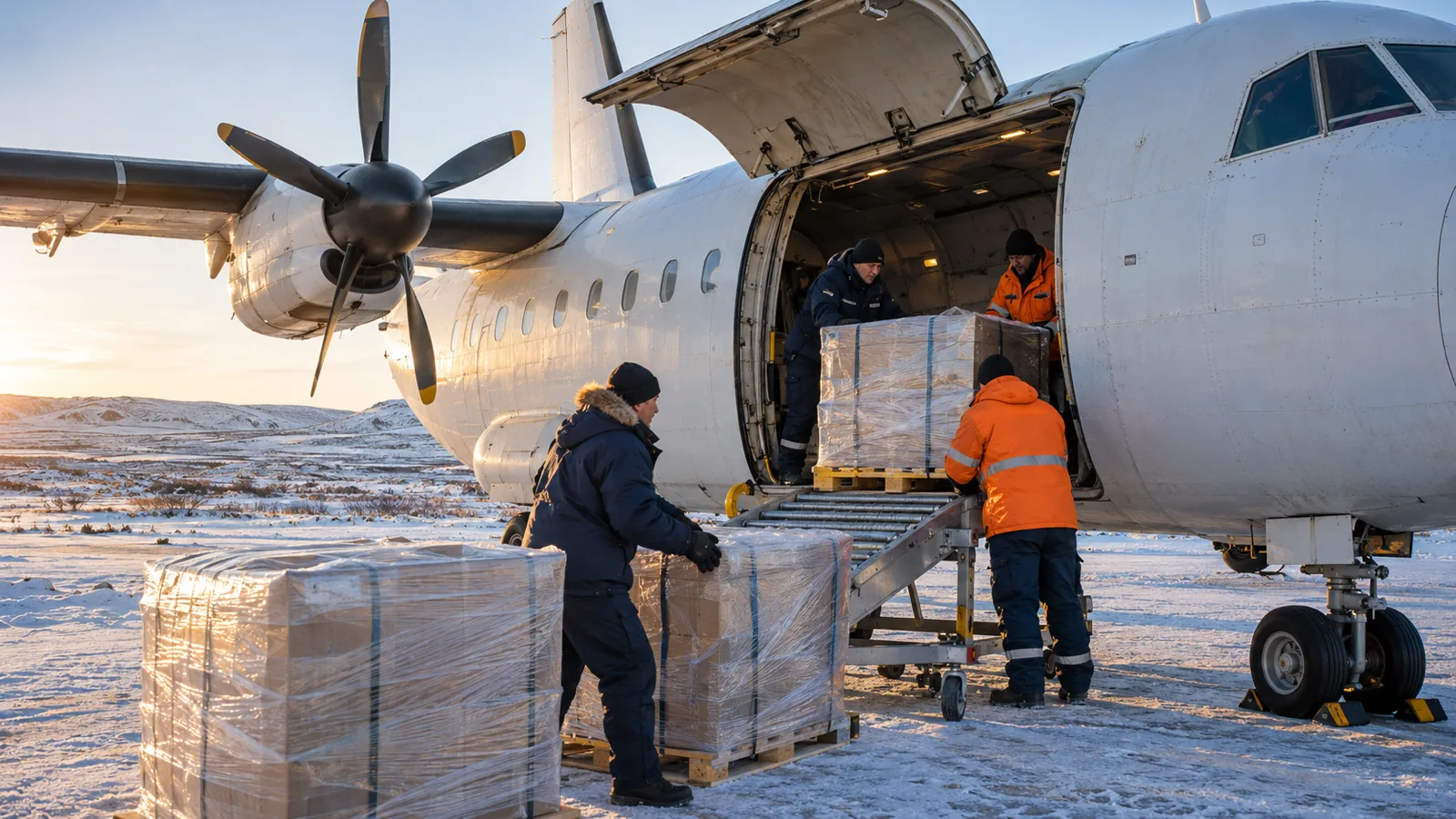
An order comes in from Rankin Inlet. Your checkout happily calculated a shipping rate, but when the parcel is booked, the carrier quotes a surcharge you did not expect, and the estimated delivery stretches well beyond what your customers in Ontario see. A week later, a contractor in Yellowknife asks for a quote on three pallets of building materials, and you realize you have no idea whether they should go by truck, plane or something else entirely.
The three territories cover a huge share of Canada's land area but hold a small fraction of its population, spread across communities that range from the city of Whitehorse to hamlets of a few hundred people reachable only by air for most of the year. Businesses that serve the North, whether they sell consumer goods online, supply mining and construction projects or distribute food and health products, need a different playbook from the one that works along Highway 401.
This guide explains how goods actually reach Yukon, the Northwest Territories and Nunavut, how each mode works, and how to plan shipments so northern customers get what they ordered at a cost you can live with.
Territory by Territory
Yukon
Yukon is the most road-connected of the three. The Alaska Highway links Whitehorse with northern British Columbia and, through it, the rest of the North American highway network. The Klondike Highway connects Whitehorse to Dawson City, and other routes reach most communities. Old Crow, in the far north, is the notable exception and is served by air.
For most Yukon destinations, freight moves by truck, often consolidated in Edmonton or the Vancouver area before heading north. Parcels travel through courier and postal networks, sometimes with an air leg into Whitehorse. Transit is longer than to southern cities, but road access keeps options relatively flexible year-round.
Northwest Territories
The Northwest Territories has a mix. Highway 1 (the Mackenzie Highway) connects northern Alberta with Hay River, and Highway 3 continues to Yellowknife across the Deh Cho Bridge over the Mackenzie River. Inuvik is reachable by the Dempster Highway from Yukon, and the all-season road to Tuktoyaktuk now extends that route to the Arctic coast. Many other communities depend on air service, seasonal winter roads or barge service on the Mackenzie River and its connecting waters during the open-water season.
Edmonton is the traditional staging point for much NWT freight, with trucks running north on Highway 35 through Alberta. Winter roads open for a limited window, usually in the coldest months, and their opening and closing dates depend on ice conditions, so they cannot be counted on for time-sensitive deliveries.
Nunavut
Nunavut has no road connection to the rest of Canada, and its communities are not connected to each other by road. Goods arrive in two main ways: by air, year-round, and by sealift, the annual summer and fall marine resupply. Eastern Arctic communities are commonly resupplied by sealift from ports in Quebec, while some Kivalliq communities have also been served through Churchill, Manitoba, which is linked to the south by rail.
Air cargo hubs such as Iqaluit, Rankin Inlet and Cambridge Bay connect to southern gateways like Ottawa, Montreal, Winnipeg, Edmonton and Yellowknife, with smaller aircraft serving outlying communities. Capacity on these routes is limited, and weather can ground flights for days.
Comparing the Modes
Each way into the North has its own trade-offs between cost, speed and what can be carried.
- All-season road (most of Yukon, parts of the NWT): the most economical for heavier freight, with predictable year-round access, though distances are long and winter driving can cause delays.
- Air cargo (all three territories): the fastest and most reliable option for communities without roads, but the most expensive per kilogram. Weight, size and dangerous goods restrictions are tighter, and bulky goods are especially costly.
- Winter roads (parts of the NWT and some northern areas of the provinces): allow heavy loads to reach otherwise isolated places at lower cost, but only during a short seasonal window that varies with conditions.
- Barge and sealift (Mackenzie River system, Arctic coast, Nunavut): ideal for large, heavy and non-urgent goods such as vehicles, building materials, fuel and a year's worth of dry goods, but limited to the open-water season and booked well in advance.
Parcel customers rarely see these choices directly, since couriers and Canada Post select the route, but the underlying mode explains why delivery times and costs to the North look the way they do.
Planning Around the Sealift Calendar
For businesses that supply northern retailers, contractors, schools or health facilities, the sealift is the backbone of annual planning. A typical approach looks like this:
- Late winter and spring: customers in the North finalize annual orders. Suppliers confirm availability and lead times.
- Spring: shipments are booked with the sealift operator for the relevant community and sailing. Cut-off dates for cargo delivery to the southern port are fixed and missing them can mean waiting a year or paying air rates.
- Early summer: goods are consolidated, packed and delivered to the marshalling yard. Packaging must withstand long storage, handling by crane and exposure to weather.
- Summer and early fall: vessels sail and deliver as ice conditions allow. Customers unload at the community.
- Fall onward: anything missed travels by air at a much higher cost until the next season.
A warehouse partner can help by receiving goods from multiple suppliers, consolidating them, building sturdy pallets and delivering everything to the marshalling point on time. Distribution services that handle consolidation are particularly valuable here.
Packaging for the North
Freight heading north often has a harder journey than freight moving between southern cities. It may be handled several times, sit in an unheated warehouse at an airport, or ride on an open barge deck. Some practical guidelines:
- Use strong corrugated cartons and stretch-wrap pallets securely, with corner boards for stacking strength.
- Protect liquids and anything that can freeze. Many products, from paint to beverages to some cosmetics, are damaged by freezing, and winter temperatures in the territories are extreme. Insulated packaging or heated service may be needed.
- Keep air shipments compact. Every centimetre counts when air cargo is priced on dimensional weight.
- Label clearly with the community name, consignee and phone number. Many addresses in small communities are post office boxes or general delivery, so confirm the exact delivery instructions with the customer.
Dangerous Goods and Restricted Items
Because so much northern freight moves by air, dangerous goods rules come into play more often than in the south. Fuels, aerosols, lithium batteries, some cleaning chemicals, paints and alcohol-based products may be restricted or require special handling on air services. Some goods that move easily by ground to Whitehorse cannot fly to a Nunavut community without proper classification, packaging and documentation under the Transportation of Dangerous Goods Regulations and air rules. Many communities also have local restrictions on alcohol. Check before you sell, not after the order arrives.
Ecommerce Tips for Northern Customers
Online shopping is an important lifeline in many northern communities, where local retail choice can be limited. Brands that serve these customers well often earn real loyalty. A few practical steps help:
- Show realistic shipping rates and delivery estimates for northern postal codes at checkout rather than surprising customers later.
- Offer postal shipping options where they work better than courier, since postal networks reach every community.
- Avoid blanket "we don't ship there" policies; instead, flag specific products that cannot travel by air.
- Consider whether free shipping thresholds should differ for remote regions, and explain why.
- Package for cold, especially from October to April.
Comparing carriers and services for each northern postal code is time-consuming to do manually. A multi-carrier shipping platform lets you see options side by side, and small parcel shipping support can help you find the most reliable service for each destination.
Frequently Asked Questions
Why are remote area surcharges so common for northern addresses?
Delivering to small, distant communities costs carriers more because of air legs, long road distances, limited volumes and partner hand-offs. Carriers recover those costs with surcharges based on postal code. Our guide to shipping surcharges explains how these work.
Can I send pallets to Yellowknife by LTL?
Yes. Yellowknife and Hay River are served by trucking companies running from Alberta, and LTL freight is a common choice for pallet shipments to road-connected NWT communities. Transit is longer than within the provinces, and winter conditions can add delays.
Is food subsidized for northern communities?
The federal Nutrition North Canada program provides a subsidy to registered retailers and suppliers for certain eligible foods and items shipped to eligible isolated communities. If you sell food to northern retailers, it is worth understanding how the program works, since it affects how your customers buy.
How early should I plan sealift shipments?
Months in advance. Booking and cargo cut-off dates come well before the sailing, and suppliers need time to source and prepare goods.
Ship North With a Plan
Shipping to the territories is not just a longer version of shipping to Toronto. It involves different modes, seasonal windows, tighter rules for air freight and packaging that has to survive extreme cold. ShipCarte helps businesses across Canada compare carriers, consolidate freight and prepare shipments for the North. Request a quote for your next northern shipment, or talk to us about building a repeatable process for northern orders.