
A customer in Halifax emails to say her $600 espresso machine never arrived. The tracking page says "delivered," the driver left it at the side door, and nobody saw it after that. A week later, a craft spirits shop in Ontario learns that one of its online orders was handed to a teenager who answered the door while his parents were at work. Both problems have the same root: the parcel was released without anyone confirming who received it.
Signature and age-verification options exist to close that gap. They cost a little more per parcel and they add friction for the customer, so they are not something to switch on for every order. Used deliberately, though, they cut down on "item not received" disputes, give you evidence when a claim does come in, and keep you on the right side of provincial rules for products that can only be sold to adults.
This guide walks through the main delivery-confirmation options offered by carriers in Canada, how they differ, which products genuinely need them, and how to set up rules so the right option gets applied automatically instead of relying on someone at the packing bench to remember.
The Delivery Confirmation Options, in Plain Terms
Every major carrier operating in Canada uses slightly different names, but the options fall into a small number of categories. Understanding the categories matters more than memorising the product names, because you will often be comparing Canada Post, Purolator, UPS, FedEx and regional couriers side by side.
Standard delivery with no signature
The default for most residential parcel services. The driver uses judgement to leave the parcel in a safe spot, scans it as delivered, and often takes a photo or records a location note. If there is no safe place, the parcel may be carded and redirected to a post office or depot. This is the cheapest and most convenient option for customers, and it is perfectly adequate for low-value, easily replaced goods.
Signature required (any adult or anyone at the address)
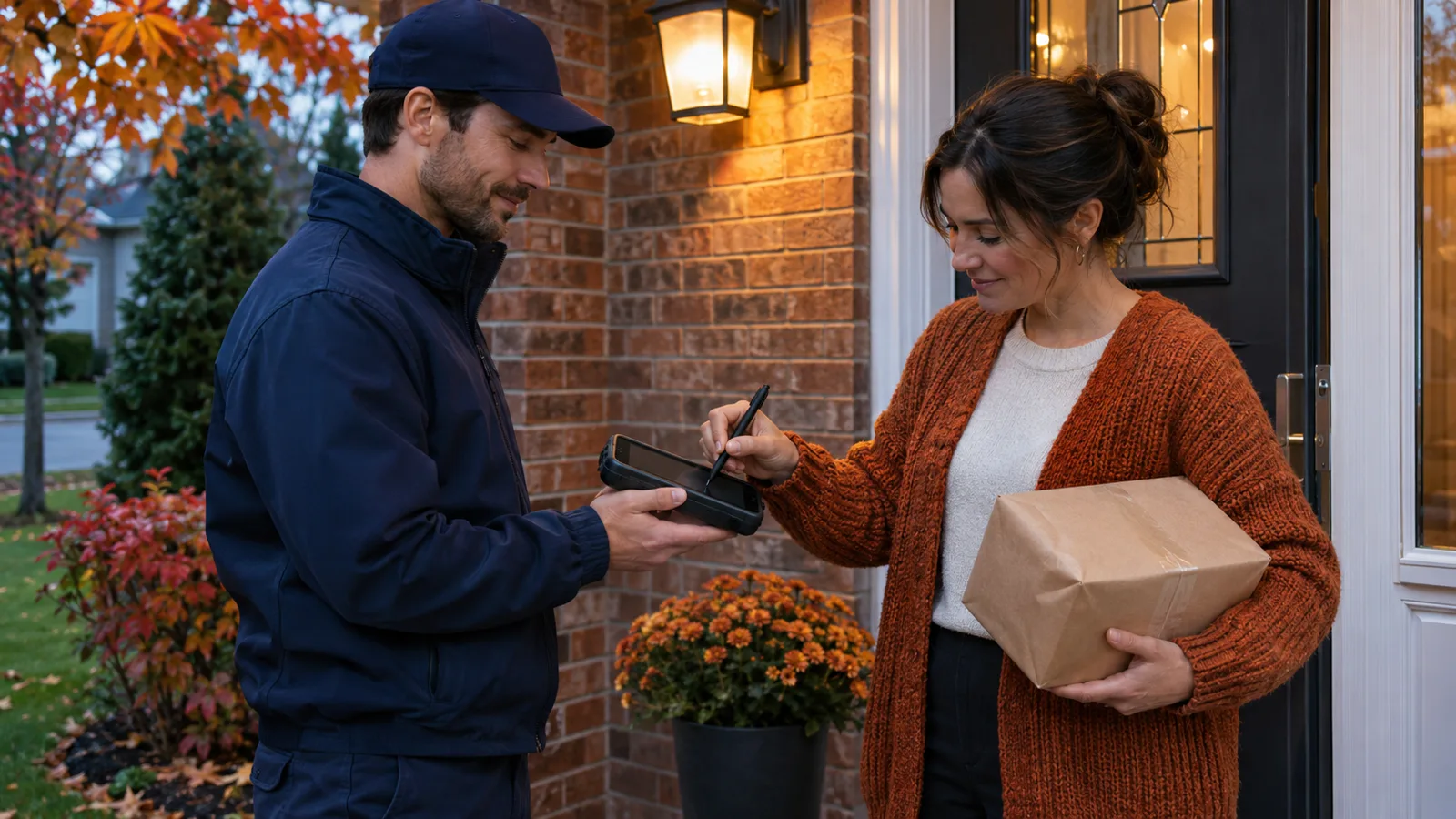
The driver must hand the parcel to a person and capture a signature or name. If nobody is home, the parcel is not left; a notice card is left instead and the customer picks it up or arranges redelivery. Some carriers distinguish between a direct signature (someone at the delivery address) and an indirect signature (a neighbour or building manager may sign, or the customer can pre-authorise release with a signed door tag). For apartment-heavy markets like downtown Toronto, Montreal and Vancouver, the indirect variety can noticeably reduce failed deliveries.
Adult signature or proof of age
Here the driver must confirm the recipient is at or above a minimum age, typically by checking government-issued photo ID. Canada Post offers a Proof of Age option at 18 or 19, and other carriers offer an adult signature service with similar ID checks. If the person at the door cannot show valid ID, the parcel is not released. These parcels usually end up at a pickup location where the named recipient must show ID in person.
Signature to the named addressee only
Some services, such as Canada Post's Deliver to Addressee option, require the parcel to go only to the person named on the label. This is stricter than an adult signature and is used for documents, prescription items in some programs, replacement bank or identity cards and other goods where the specific person matters, not just their age.
Do not safe drop and card for pickup
These are useful middle-ground options. "Do not safe drop" tells the driver not to leave the parcel unattended, without necessarily requiring a recorded signature. "Card for pickup" sends the parcel straight to a pickup point and notifies the customer. Both reduce porch theft without the full cost of an age check, and they suit mid-value items in neighbourhoods with known theft problems.
How 2020 Has Changed Signature Delivery
Since spring 2020, carriers across Canada have adjusted their doorstep procedures to limit physical contact during the pandemic. In many cases drivers stopped asking customers to sign on a shared handheld device and instead recorded the recipient's name or confirmed delivery from a short distance. Some signature-required parcels were carded to pickup locations more often than before. ID checks for age-restricted goods continued, but the process has looked different from carrier to carrier and has changed more than once.
For shippers this has two practical consequences. First, the evidence you get back from a "signature" delivery may be a typed name rather than a scribble, which still helps with disputes but is worth knowing about if you are relying on it for chargeback responses. Second, procedures can shift on short notice, so check each carrier's current service notices rather than assuming last year's rules still apply. Build your customer messaging so it says what to expect ("someone 19 or older with photo ID must be present") rather than promising a particular doorstep ritual.
Which Products Actually Need a Signature?
The honest answer is fewer than many merchants assume, but more than those who never use the option. Think in terms of three drivers: value, legal age restrictions, and how easily the item can be resold if stolen.
High-value or high-theft goods
- Electronics, phones, laptops, cameras and gaming consoles
- Jewellery, watches and designer accessories
- Premium small appliances and coffee equipment
- Limited-edition sneakers, collectibles and trading cards
- Replacement parts that are expensive and hard to source quickly
Many merchants set a value threshold, for example any order above a certain dollar amount requires a signature. The right threshold depends on your margins, your loss history and your shipping insurance terms. Check whether your insurance or carrier declared-value coverage pays out on a parcel scanned as delivered without a signature; many policies do not, which is a strong argument for requiring signatures on anything you would actually claim for.
Age-restricted products
In Canada, most age limits for restricted goods are set or adjusted provincially, so the minimum age on your label may need to change based on the destination province. As a general guide:
- Alcohol: the legal drinking age is 18 in Alberta, Manitoba and Quebec and 19 in the other provinces and territories. Who is allowed to ship alcohol directly to consumers, and across which provincial borders, is also controlled provincially, so confirm you are permitted to sell into a province before worrying about the label.
- Cannabis: recreational sales are tightly controlled through provincially authorised channels, and minimum ages differ (Quebec raised its minimum age to 21 at the start of 2020). Most private merchants cannot ship cannabis at all.
- Tobacco and vaping products: the federal minimum is 18, and several provinces set a higher minimum of 19 or more. Some provinces have also added rules on flavours and online sales.
- Other restricted items: certain knives, bear spray, some fireworks and other products may have age or licensing requirements depending on the province and the carrier's own prohibited-items list.
Because rules vary and change, use the highest age that could apply when you are unsure, and get specific legal advice for regulated categories. An adult signature option does not make an otherwise prohibited shipment legal; it only helps you prove that a lawful sale went to an eligible adult.
Healthcare and personal items
Prescription medication, medical devices supplied under a prescription, and certain diagnostic kits are often shipped with a signature or named-addressee requirement, either because a regulator or a program requires it or because the shipper wants a clear chain of custody. If you work in this space, your healthcare distribution partner should already have procedures for this.
The Trade-offs: Cost, Speed and Customer Experience
Signature options carry a per-parcel surcharge that varies by carrier and service level, with adult or proof-of-age checks usually costing more than a basic signature. But the bigger cost is often hidden: failed first delivery attempts. When nobody is home, the parcel is carded, the customer has to travel to a pickup point, and delivery time effectively stretches by a day or more. Some customers will contact support, some will be annoyed, and a few will refuse the parcel, which means you pay return freight too.
The balance looks different depending on where your customers live. In dense urban areas with many pickup counters, a carded parcel is a short walk away. In rural Saskatchewan, northern Ontario or the territories, the nearest pickup location might be a significant drive, and a carded parcel is a real burden. That is a good reason to keep signature rules targeted rather than blanket.
For a broader look at how delivery speed and friction affect repeat purchases, see our post on the real cost of slow shipping.
Setting Up Signature Rules That Run Themselves
The most common failure is not choosing the wrong option; it is applying the right option inconsistently. A packer forgets to tick the box on a busy Monday, or a new SKU is added without anyone flagging it as age-restricted. Build the logic into your systems instead:
- Flag SKUs, not orders. Add an attribute in your product catalogue or WMS for "signature required" and "minimum age." When any flagged SKU is in the order, the option is applied.
- Add a value threshold. Above a set order value, apply signature required automatically, regardless of SKU.
- Map minimum age by province. If you sell age-restricted goods, a simple table of destination province to minimum age lets the label carry the correct requirement.
- Handle carrier differences. Not every carrier offers every option on every service. Your shipping platform should only rate-shop carriers that support the required option for that parcel.
- Let customers opt in. Offer a paid or free "signature on delivery" choice at checkout for customers who prefer it, which also helps when someone has had parcels stolen before.
- Audit monthly. Pull a report of flagged SKUs shipped without the option and fix the cause.
If your orders are fulfilled by a third party, these rules belong in their system, not in a spreadsheet you email over. A good ecommerce fulfillment provider will let you set them once and then apply them on every order.
Telling Customers What to Expect
Signature requirements cause the most frustration when they come as a surprise. A few small communication changes make a big difference:
- State on the product page and at checkout when an item requires an adult signature, and give the minimum age for the customer's province.
- Include the requirement in the shipping confirmation email, with a reminder to have photo ID ready.
- Explain what happens if nobody is home: where the parcel goes, how long it is held and what ID is needed to collect it.
- Suggest a delivery address where someone will be present, such as a workplace, if that is allowed for the product.
- Link to live tracking so customers can watch for the delivery window.
For bilingual markets, especially Quebec and parts of New Brunswick, make sure this messaging is available in French as well as English. Customers who cannot easily read the instructions are more likely to miss the driver and less likely to pick up a carded parcel.
Using Signatures as Evidence
When a customer disputes a delivery, a signature record is often your best defence. Payment processors generally want to see proof of delivery to the cardholder's address, and a signature or recorded recipient name is stronger than a "left at front door" scan. Keep proof-of-delivery records alongside the order for at least as long as your chargeback window, and know how to pull them quickly from each carrier's portal.
If a signed-for parcel still goes missing, for example a building concierge signed and the parcel disappeared afterwards, the record at least tells you where custody changed hands. Our guide to lost parcel investigations in Canada covers what to do next.
Frequently Asked Questions
Does a signature requirement guarantee I am covered if the parcel goes missing?
No. It reduces the chance of loss and gives you evidence, but compensation depends on the carrier's liability terms, any declared value you purchased and any third-party insurance you hold. Read those terms carefully, especially for parcels scanned as delivered.
Can I ship age-restricted goods to a pickup location?
Often yes, and it can actually be easier for customers because they show ID at the counter on their own schedule. Confirm the carrier allows the product category and the option on that service first.
Should I require signatures for cross-border orders?
US carriers and US addresses have their own signature options and age rules, and shipping restricted goods into the United States raises separate legal questions. Treat cross-border signature logic as its own rule set, and see our cross-border shipping page for how we handle US-bound parcels.
Will requiring signatures hurt my conversion rate?
It can if applied to everything. Targeted rules, clear messaging and an opt-in choice at checkout keep the impact small while protecting the orders that really need it.
Get Signature Rules Right Across Every Carrier
Signature and proof-of-age options are a small line on a shipping label, but they protect your highest-value orders and your compliance obligations. ShipCarte helps businesses across Canada build carrier-aware delivery rules into their fulfillment and small parcel shipping, so the right option is applied every time without slowing down the packing line. Schedule a consultation to review how your orders are being delivered today.