
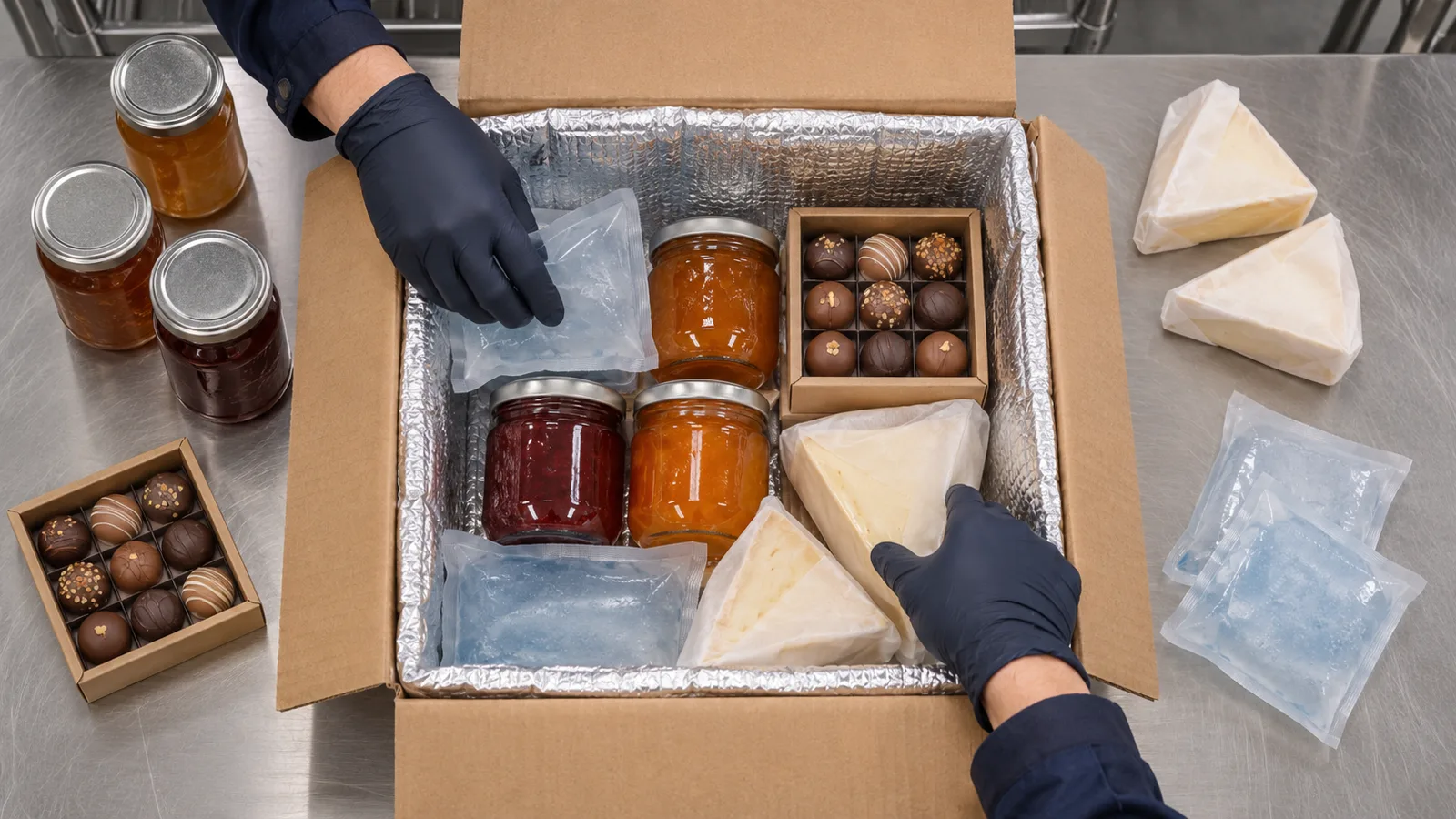
Picture a small food business that has built a following at farmers' markets: artisan preserves, small-batch hot sauce, aged cheese from a partner dairy, and hand-made chocolates around the holidays. This year, looking for sales that did not depend on market weekends and weather, the owners decided to sell online. Orders started arriving from across Canada, from Nanaimo to St. John's, and the owners discovered that a jar of jam and a wedge of cheese, sitting side by side on the market table, need completely different shipping plans.
Specialty food ecommerce has grown fast in Canada, as more people have been buying groceries and gifts online and seeking out local and artisan producers. Selling food online is not like selling apparel or electronics, though. Products melt, spoil, break or leak; regulators care about how they are labelled; and the cost of keeping something cold for a three-day trip across the country can exceed the price of the product itself.
This article offers a practical framework for specialty food sellers: sort your products by risk, match packaging and shipping to each category, and build an operation that keeps both customers and inspectors happy.
Step one: sort your catalogue by temperature risk
The single most useful exercise is to place every product in one of four groups. The group decides how it is stored, packed, shipped and priced.
Group A: truly shelf-stable
Jams, preserves, honey, sauces in sealed jars, dry spices, crackers, dried pasta, coffee, tea and many baked goods with long shelf lives. These can ship by standard ground service year-round with ordinary packaging, though glass needs protection and extreme cold can still crack jars or change textures.
Group B: heat-sensitive but not perishable
Chocolate, candy, some baked goods with fillings or icing, and products with fats that soften. These will not make anyone sick if they get warm, but they can melt, bloom or deform, and customers will be disappointed. Many chocolate makers ship freely in cooler months and add insulation and ice packs, or pause shipping, in summer.
Group C: refrigerated perishables
Fresh cheese, cured meats that require refrigeration, fresh pasta, dips, prepared meals and baked goods with dairy fillings. These must stay within safe temperatures throughout transit and need insulated packaging, refrigerants and fast delivery.
Group D: frozen
Ice cream, frozen desserts, frozen meals and frozen seafood or meat. These need the most robust packaging and the fastest shipping, often with dry ice, which is a regulated dangerous good when shipped and requires correct marking and carrier approval.
Once your products are sorted, look at your order data. Do customers often mix groups in a single order? If so, you need to decide whether to split shipments, pack everything to the standard of the most sensitive item, or restrict certain combinations at checkout.
Step two: match packaging to transit time
Insulated packaging is not about the product; it is about the product's exposure over a given number of hours. A box that keeps cheese cold for 24 hours is enough for a next-day delivery within Southern Ontario but not for a three-day trip to Calgary.
- Insulated liners and boxes: expanded polystyrene, recycled cotton or denim, reflective bubble liners, and corrugated insulated boxes all have different performance and environmental profiles. Test with real products and real transit times.
- Refrigerants: gel packs for chilled products, frozen gel packs or dry ice for frozen products. Gel packs should be conditioned at the right temperature before packing.
- Seasonal pack-outs: many sellers use a summer and winter configuration. In summer, more refrigerant and thicker insulation; in winter, less refrigerant and protection against freezing for products that should not freeze.
- Leak containment: bag any liquid product and anything packed with ice, so condensation or a leak does not soak the box.
- Glass protection: dividers, molded pulp or air cushions for jars and bottles, as covered in our guide to packing fragile items.
For perishable lines, a fulfillment partner offering cold chain fulfillment can store product at the right temperature and pack each order with a validated pack-out, so you are not freezing gel packs in a home freezer the night before shipping day.
Step three: decide where you will ship
Canada is large, and delivery times vary widely. A seller in the Greater Toronto Area can typically reach much of Ontario and Quebec within one or two business days by ground, while Western Canada, Atlantic Canada and remote communities take longer. That has practical consequences:
- Shelf-stable products (Group A) can usually ship anywhere in Canada.
- Heat-sensitive products (Group B) may need seasonal rules: ship anywhere in winter, restrict or upgrade service in summer.
- Refrigerated and frozen products (Groups C and D) often need a delivery zone, such as one- or two-day ground transit from your fulfillment location, or expedited service for anywhere further.
Display these rules clearly on product pages and at checkout. Customers in Winnipeg or Moncton appreciate knowing upfront whether they can order your cheese, rather than discovering it in an email after checkout. As volumes grow, a second fulfillment location in Western Canada can widen your perishable delivery zone considerably.
Step four: get labelling right
Food sold to consumers in Canada must meet federal labelling requirements, and Health Canada and the Canadian Food Inspection Agency take them seriously. Requirements depend on the product, but most prepackaged foods need:
- The common name of the food and the net quantity in metric units.
- A list of ingredients and an allergen statement, with priority allergens clearly declared.
- A Nutrition Facts table, unless an exemption applies.
- The name and address of the responsible business.
- A best-before date for products with a shelf life of 90 days or less, along with storage instructions where needed.
- Mandatory information in both English and French.
Health Canada is in a multi-year transition to updated Nutrition Facts table and ingredient list formats, so check which version applies to your products and when. If you sell across provincial lines, you may also need a Safe Food for Canadians licence, preventive controls and traceability records, depending on what activities you carry out. Small producers who started selling only locally are sometimes surprised by this when they launch nationwide ecommerce, so it is worth checking with the CFIA before you scale.
Step five: build a gift season plan
For many specialty food sellers, the holiday season brings the biggest share of the year's sales: gift boxes, hampers, corporate orders and seasonal products like shortbread, chocolate and preserves. It also coincides with peak carrier volumes and winter weather.
- Design gift boxes for shipping first. A beautiful hamper that cannot survive a courier network is a liability. Build the gift box around a sturdy shipper and add the presentation inside.
- Pre-assemble. Build shelf-stable gift sets before the rush. Kitting and assembly in batches is far more efficient than assembling each gift to order.
- Set order-by dates by region and product group. Perishable gifts need earlier cut-offs and may need to stop shipping to certain regions entirely in the final days before the holidays.
- Handle corporate orders separately. Corporate clients often send lists of dozens or hundreds of recipients. Agree on the format, gift messages, delivery dates and what happens with bad addresses.
- Plan for weather. Have a policy for delayed perishable shipments and communicate it clearly.
Pricing shipping without losing customers
Shipping costs are a common reason customers abandon online food orders, but insulated packaging and expedited service are genuinely expensive. A few approaches are common:
- Free shipping thresholds for shelf-stable orders, with perishable orders charged a separate cold-pack fee.
- Flat rates by region, which are easier for customers to understand than live rates.
- Local delivery or pickup options in your home city, where you can deliver cheaply.
- Bundles that raise the order value so shipping is a smaller share of the total.
Whatever you choose, track shipping cost as a share of order value by region and product group each month. A pricing structure that works for jam to Ottawa may lose money on cheese to Calgary.
When a food order goes wrong
Returns work differently for food. You almost never want a melted box of chocolates or a warm cheese parcel sent back, and you cannot resell food that has left your control. Most specialty food sellers handle problems with a replace-or-refund policy instead of returns. To keep that fair and affordable:
- Ask customers for a photo of the damaged or spoiled product and the packaging, along with the delivery date.
- Record each claim by product group, carrier, destination region and month. Patterns tell you whether to change a pack-out, a carrier or a delivery zone.
- File carrier claims where the parcel was clearly mishandled or delivered late against a guaranteed service.
- Be clear in your policy about deliveries left unattended or held because nobody was home, since those are outside your control.
A food safety complaint, such as a suspected allergen or contamination issue, is different and must be taken seriously. Keep lot records so you can identify which batch the customer received, and know how you would contact the CFIA and other customers if a recall were ever needed.
When to bring in a fulfillment partner
Many specialty food businesses pack orders themselves at first, often in a commercial kitchen or a corner of their production space. Signs that it may be time for outside help include running out of space, staff spending more time packing than producing, rising damage or spoilage, and difficulty handling peak season. A partner with food and beverage logistics experience, lot tracking and both ambient and temperature-controlled storage can take the packing off your hands while you focus on making food. Our post on handling perishable goods in fulfillment describes what good practice looks like.
Bring your treats to more of Canada
ShipCarte helps food brands across Canada store, pack and ship both shelf-stable and perishable products, with ecommerce fulfillment, cold chain options and multi-carrier shipping. Request a quote and tell us about your products and where you would like to sell them.