
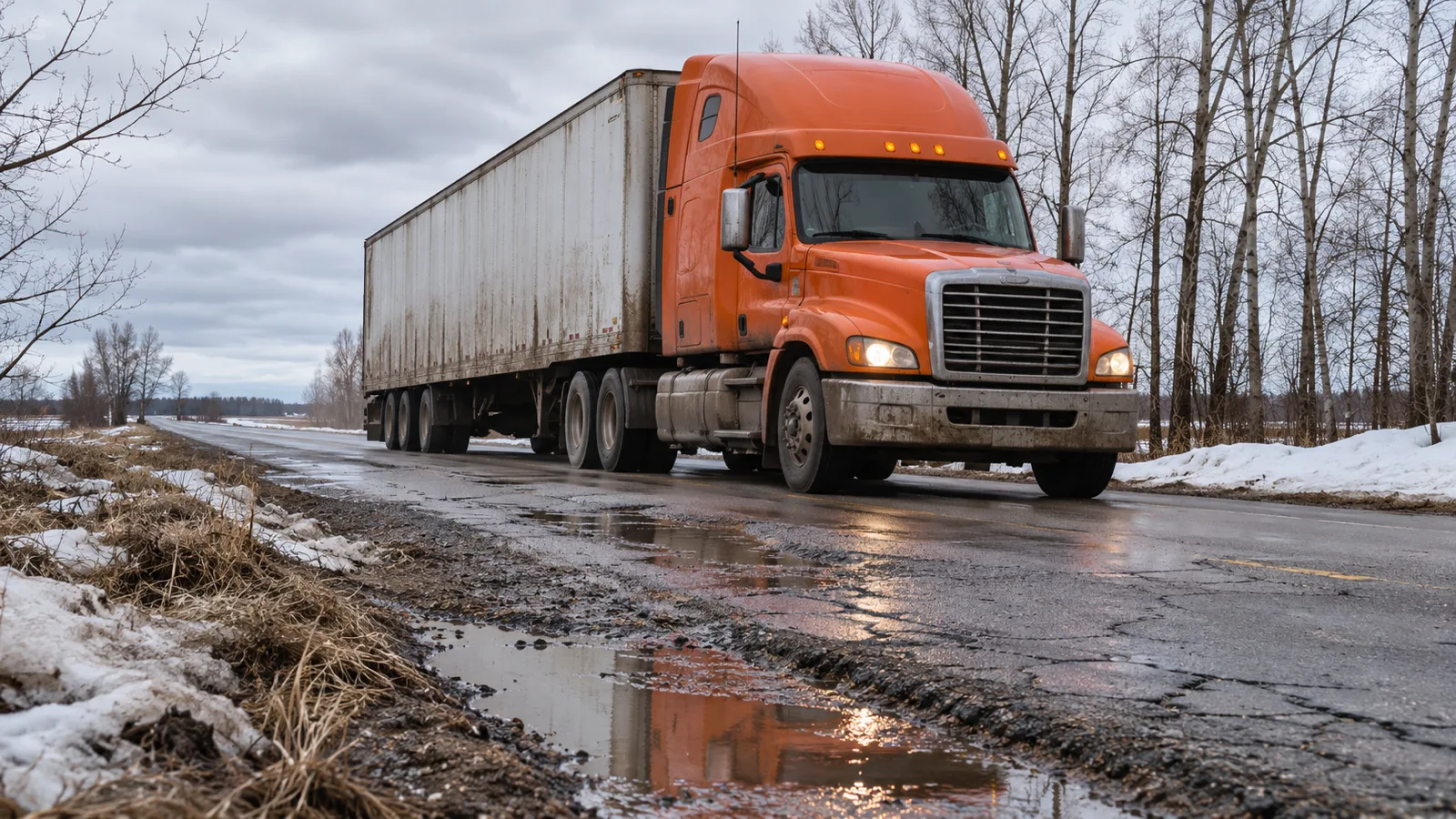
Every year, somewhere between late February and May, a familiar phone call happens across rural Canada. A farm supply dealer in Saskatchewan, a feed mill in Manitoba or a building supply store in northern Ontario has a full truckload on order, and the carrier explains that the delivery will need to be split into two smaller loads, rerouted or delayed. The reason is not weather or capacity. It is the road itself.
Spring weight restrictions, often called road bans, spring load restrictions or reduced load periods, are a normal part of freight planning in Canada. They exist because frozen ground thaws from the top down, leaving water trapped in the road base above still-frozen soil. During that period, pavement and gravel roads are far weaker than usual, and heavy trucks can cause serious damage. Provinces and municipalities protect their roads by lowering the weight trucks are allowed to carry.
With autumn under way, now is the right time to plan. Spring orders will soon be placed, and businesses that understand the restrictions before the thaw can move heavy inventory early and avoid paying more for smaller loads later.
Why the thaw weakens roads
In winter, frost penetrates deep beneath road surfaces. The frozen ground is actually very strong, which is why many provinces allow heavier loads on certain roads during the coldest months. When temperatures rise in spring, the top layers thaw first. Meltwater cannot drain down through the frozen layer beneath, so the road base becomes saturated and soft. Each heavy axle that passes over it can push the surface down and cause cracking, rutting and potholes that are expensive to repair.
The worst-affected roads are usually secondary highways, rural municipal roads and gravel roads built to lighter standards. Major routes such as the Trans-Canada Highway and other primary highways are generally built to withstand year-round heavy traffic and are often exempt, but that is not universal.
How restrictions are expressed
Restrictions are usually set in one of a few ways:
- Percentage of normal axle weight: for example, a road might be restricted to a certain percentage of the usual legal axle load.
- Fixed weight per axle: a set limit in kilograms per axle on designated roads.
- Gross vehicle weight limits on specific roads or bridges.
- Full closures to heavy vehicles on some local roads, with exemptions for emergency services or essential deliveries in certain cases.
Start and end dates vary each year based on actual conditions. Many jurisdictions monitor frost depth and temperatures and announce restrictions with only a few days' notice. Some divide the province into zones that go on and off restrictions at different times, with southern areas typically thawing first and northern areas later.
An overview by region
The details differ by province and change from year to year, so always check the current orders before shipping. As a general picture:
British Columbia
BC applies seasonal load restrictions to many roads outside the main highway network, particularly in the Interior and northern regions. Restrictions are announced by area and can be significant for forestry, construction and agricultural deliveries.
Alberta
Alberta's provincial highways and many rural municipalities impose spring road bans expressed as a percentage of normal axle weights. Municipal bans can be stricter than provincial ones and are announced by each county or municipal district, which means a delivery to a farm or oilfield site may face different rules on the last few kilometres than on the highway.
Saskatchewan
Saskatchewan applies spring road restrictions on many provincial highways and rural roads, with restriction levels that vary by road. Given the size of the rural network and the importance of agriculture, these restrictions have a large effect on deliveries of seed, fertiliser, fuel and equipment.
Manitoba
Manitoba applies spring road restrictions across much of its highway network outside the main truck routes, with the dates determined by monitoring. Winnipeg is a major distribution hub, so freight that moves easily into the city may face restrictions on the way out to rural destinations.
Ontario
Ontario designates reduced load periods on certain highways, mainly in northern Ontario, with lower axle weight limits during the thaw. Many municipalities across the province also post their own half-load restrictions on local roads.
Quebec
Quebec imposes a thaw period with reduced load limits across the province, divided into zones with different dates. Carriers serving Quebec are very familiar with the schedule and plan around it each spring.
Atlantic Canada
New Brunswick, Nova Scotia, Prince Edward Island and Newfoundland and Labrador all apply spring weight restrictions on designated roads, often affecting rural and forestry routes. Delivery to smaller communities may require lighter loads during this period.
The territories
In Yukon, the Northwest Territories and Nunavut, spring thaw affects all-season roads and ends the winter road season entirely. See our article on winter roads and ice roads for more on how that shapes northern freight.
How restrictions affect your freight
The practical effects for shippers and receivers include:
- Smaller payloads: a truck that normally carries a full legal load may only carry part of it on restricted roads, so the same order may require more trucks.
- Higher per-unit costs: splitting loads, using trucks with more axles to spread the weight, or taking longer routes all add cost.
- Longer transit times: detours to avoid restricted roads and tighter carrier capacity can stretch delivery windows.
- Capacity crunches before and after: many businesses rush to move freight just before restrictions start, and there is a backlog when they lift.
- Delivery refusals: carriers may decline loads to destinations they cannot reach legally at full weight.
A planning checklist for the thaw season
- Know your destinations. List every regular delivery point that sits on a secondary highway or rural road. Those are the addresses most likely to be affected.
- Move heavy inventory early. Where possible, pre-position stock with your customers or in a nearby warehouse before restrictions begin.
- Talk to customers. Explain that orders placed during the restriction period may arrive in smaller loads or take longer, and encourage them to order early.
- Ask carriers about their plans. Carriers serving rural areas have experience with restrictions and may have equipment configured to carry more weight legally.
- Use regional warehousing. A distribution centre closer to rural customers can turn long, heavy deliveries into shorter, lighter ones. ShipCarte's distribution warehousing can help you position inventory ahead of the season.
- Watch announcements. Follow provincial transportation ministry updates and municipal notices for your delivery areas, as start dates shift with the weather.
- Budget for the change. Expect higher costs per unit during the restriction period and build them into pricing or plans.
A worked example: one order, two seasons
Consider a distributor in Winnipeg that supplies a co-op store in a small town on a secondary highway in western Manitoba. In January, a full trailer of bagged products, building supplies and hardware can travel to the store in one trip at the normal legal weight. If the same order is placed in early April, while spring restrictions are in force on the last stretch of road, the carrier may only be able to carry part of the weight legally. The distributor now has a few options:
- Split the order into two trucks, which roughly doubles the trucking cost for that delivery.
- Send a lighter, higher-value portion of the order now and hold the heavy items until restrictions lift.
- Use a truck configuration with more axles that can carry more weight within the restricted axle limits, if the carrier has one available.
- Deliver to a transfer point on an unrestricted highway and have the store collect smaller loads locally.
None of these is free. The cheapest option of all would have been to ship the heavy items in February. That is the core lesson of spring restrictions: the planning happens months earlier, not when the bans are announced.
Talking to customers about road bans
Customers in rural Canada generally understand road bans, but they still appreciate clear communication. A short note in your winter newsletter or on order confirmations explaining that heavy orders placed during the thaw may be split or delayed, along with a suggested date to order by, prevents frustration. For B2B customers with regular orders, consider offering a pre-season delivery program so they can stock up before restrictions start.
Which industries feel it most
Almost any business that delivers to rural Canada is affected, but some sectors plan their year around spring restrictions:
- Agriculture: seed, fertiliser, chemicals and equipment are needed just as restrictions are in force.
- Forestry: log hauling often stops or slows during the thaw, a period sometimes called spring breakup.
- Construction and building supply: heavy materials such as aggregate, concrete products and lumber.
- Energy and resources: deliveries to oil, gas and mining sites on rural roads.
- Food and beverage distribution: grocery, beverage and foodservice deliveries to small-town stores, which may switch to smaller trucks. Our food and beverage logistics services can help keep regional supply steady.
Frequently asked questions
Do spring restrictions apply to LTL shipments?
They apply to the truck, not the shipment type. LTL trucks are often well below maximum weights, so they may be less affected, but a heavy LTL shipment on a lightly built rural road can still run into limits. Carriers may adjust routes or equipment.
Can I get a permit to exceed the restriction?
Some jurisdictions issue permits for essential goods or particular situations, but they are limited and conditions vary. Do not count on one being available.
How long do restrictions last?
It depends on the year and the region. They typically last several weeks, sometimes longer in northern areas or during a slow thaw.
Do restrictions affect parcel delivery?
Parcel vans are light enough that restrictions rarely matter for them. Heavier freight is where planning is needed.
Plan ahead before the thaw
Spring weight restrictions are predictable in principle even when the exact dates are not. Businesses that position inventory early, communicate with customers and work with experienced carriers get through the season with fewer delays and lower costs. ShipCarte arranges full truckload and LTL freight across Canada and can help you plan spring deliveries now. For a broader look at matching shipments to the right mode, see our article on choosing freight solutions. When you are ready to plan, schedule a consultation and we will map out your thaw-season strategy together.