
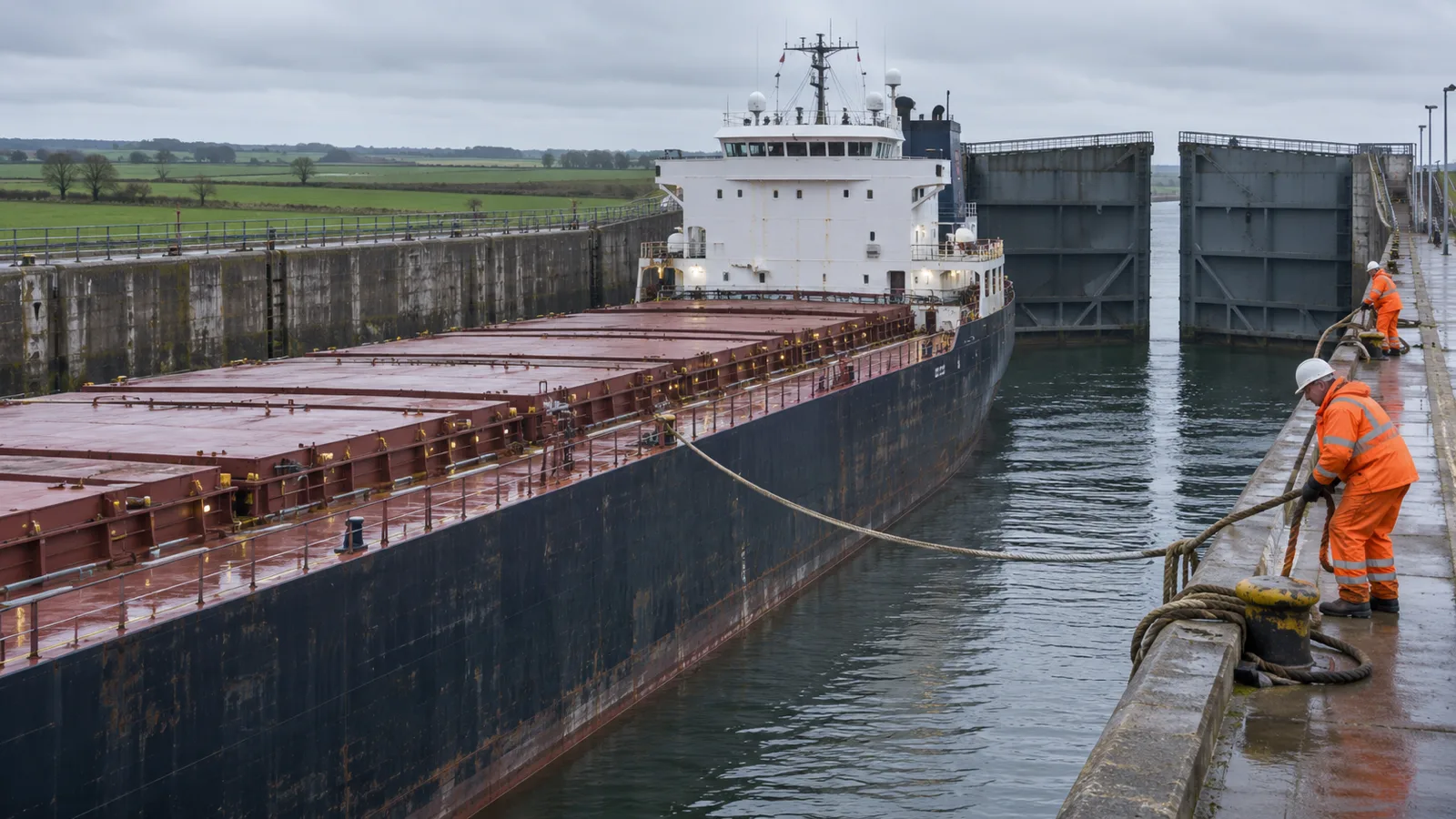
Stand on the edge of the Welland Canal in Thorold on a summer afternoon and you can watch a ship longer than two football fields rise more than 14 metres in a single lock, the water churning as it fills the chamber. That vessel might be carrying grain loaded at Thunder Bay, iron ore heading for a steel mill, or a cargo of European steel coils bound for a manufacturer in southern Ontario. It is one of the most impressive sights in Canadian logistics, and one of the least understood by the businesses that could benefit from it.
The St. Lawrence Seaway turns Ontario into a maritime province. It allows ocean-going ships and Great Lakes freighters to sail from the Atlantic into the heart of the continent, calling at ports from Cornwall to Thunder Bay. For businesses moving bulk commodities or large, heavy breakbulk cargo, the Seaway can be the most economical way to move freight in or out of Ontario.
This guide explains how the Seaway works, what kinds of cargo it suits, the practical limits that shape every shipment, and what Ontario shippers should know before booking cargo through the system.
How the Seaway Works
The St. Lawrence Seaway opened in 1959 as a joint project of Canada and the United States. Together with the Great Lakes, it forms a navigable waterway reaching more than 3,500 kilometres inland from the Gulf of St. Lawrence to the western tip of Lake Superior. The Canadian sections are operated by the St. Lawrence Seaway Management Corporation, with a US counterpart responsible for the American locks.
The Seaway itself, the part with the locks, runs from Montreal to Lake Erie and has two main sections:
- The Montreal to Lake Ontario section. Seven locks lift ships from Montreal up the St. Lawrence River past Cornwall and Iroquois to Lake Ontario. Five of these are in Canada and two are on the US side near Massena, New York.
- The Welland Canal. Eight locks carry ships roughly 100 metres up and over the Niagara Escarpment between Port Weller on Lake Ontario and Port Colborne on Lake Erie, bypassing Niagara Falls.
In total, a ship climbing from Montreal to Lake Erie rises more than 170 metres. Beyond Lake Erie, vessels continue through the Detroit and St. Clair rivers to Lake Huron, and through the Soo Locks at Sault Ste. Marie to Lake Superior and Thunder Bay.
Lakers and Salties: Two Kinds of Ships
Two broad categories of vessel use the system, and the difference matters for shippers.
Lakers
Lakers are built specifically for the Great Lakes and Seaway. They are long and narrow, designed to fit the locks as closely as possible and carry the maximum cargo. Many are self-unloaders, with conveyor systems that can discharge bulk cargo without shore equipment. Lakers mostly carry domestic and cross-lake bulk cargo: grain, iron ore, coal, salt, aggregates and cement.
Salties
Salties are ocean-going vessels that enter the Seaway from the Atlantic. They bring imported cargo such as steel products, project cargo and some bulk commodities, and they often carry Canadian grain outbound on the return voyage. For Ontario importers, salties are the link to overseas suppliers.
The Limits That Shape Every Shipment
Vessel size
The locks set a maximum vessel size, often called Seawaymax: roughly 225.5 metres long and 23.8 metres wide, with a maximum draft of about 8 metres in the Seaway. Many large ocean-going vessels cannot enter, and those that can may not be able to load fully. That is why cargo is sometimes transshipped between larger ships and Seaway-sized ships at lower St. Lawrence or coastal ports.
The navigation season
Ice closes the Seaway each winter. The season typically runs from late March to late December, roughly nine months. Ships do not move through the locks during the closure, which is also when maintenance is carried out. Any shipment planned via the Seaway must fit within that window, with some margin for late-season delays.
Transit time
Ships move slowly through the locks and canals. Transiting the full Seaway between Montreal and Lake Erie typically takes a few days, and weather, lock queues and traffic can add more. Water transport is economical but not fast; plan accordingly.
Ontario's Seaway Ports
Ontario has more Seaway and Great Lakes ports than many shippers realize. The main ones include:
- Thunder Bay, the largest grain port on the Great Lakes, shipping Prairie grain east and handling forest products, potash and project cargo.
- Hamilton, the busiest Canadian port on the Lakes, serving steel, agri-food, bulk and breakbulk cargo for the Golden Horseshoe.
- Windsor, handling salt, aggregates, construction materials and some breakbulk.
- Sarnia, serving petrochemical, grain and bulk shippers at the foot of Lake Huron.
- Goderich, a major salt shipping port on Lake Huron.
- Port Colborne, at the Lake Erie end of the Welland Canal, with grain and bulk handling.
- Oshawa, now part of the same port authority as Hamilton, handling steel, agri-food and bulk products east of Toronto.
- Toronto, handling sugar, salt, cement and aggregates.
- Johnstown, near Prescott on the St. Lawrence, with grain storage and bulk handling.
Choosing the right port depends on where your cargo is going or coming from inside Ontario, and which ports have the handling equipment and storage your commodity needs.
What Cargo Suits the Seaway
Dry bulk
Grain, iron ore, coal, salt, fertilizer, cement and aggregates are the bulk of Seaway traffic. Moving these by ship is far cheaper per tonne than by truck, and a single laker can carry the equivalent of many hundreds of truckloads.
Liquid bulk
Petroleum products, chemicals and other liquids move in specialized tankers, serving refineries and industrial users along the Lakes.
Breakbulk
Breakbulk means cargo shipped as individual pieces or bundles rather than in containers or loose in a hold. Steel coils, plate, beams, pipe, lumber bundles, bagged goods on pallets and crated machinery all fall into this category. Breakbulk is a strong fit for the Seaway because it avoids the vessel size limits that restrict large container ships.
Project cargo
Wind turbine blades, towers and nacelles, transformers, mining equipment and industrial modules are often too large to move easily by road over long distances. Water delivery to a port near the project site avoids complex oversize trucking permits and escorts for much of the journey.
Preparing Breakbulk Cargo for the Seaway
Breakbulk cargo is handled piece by piece, often several times, so preparation matters. Before your cargo leaves its origin:
- Mark every piece. Clear shipping marks with the consignee, destination port, piece number and weight on each item help stevedores sort and deliver correctly.
- Identify lifting points and centre of gravity. Heavy items should be marked where slings and spreaders can safely attach.
- Protect against moisture. Steel and machinery can rust in a ship's hold. Use wrapping, corrosion inhibitors or desiccants where appropriate.
- Crate or skid smaller items. Loose small pieces are easily lost or damaged. Group them on skids or in crates.
- Document dimensions and weights accurately. The vessel operator uses these figures for stowage planning, and inland carriers use them to send the right equipment.
Understanding the Costs
A Seaway shipment involves more cost components than a typical truck or container move. Expect some combination of:
- Ocean or lake freight charges.
- Seaway lock tolls, based on vessel and cargo.
- Pilotage fees, since ocean-going vessels must take on licensed pilots in Seaway and Great Lakes waters.
- Port charges, wharfage and harbour dues.
- Stevedoring to load and discharge cargo.
- Storage at the port if cargo is not collected immediately.
- Inland transportation to your facility or customer.
- Customs brokerage and any duties or taxes on imports.
A good freight forwarder will bundle many of these into one quote. Our article on working with freight forwarders explains what to look for in a forwarding partner.
How Ontario Businesses Use the Seaway
A few common patterns show how Ontario businesses fit the Seaway into their supply chains:
- Manufacturers importing steel or aluminium from Europe bring material directly into Hamilton or Oshawa during the season, then build up stock before the winter closure.
- Grain handlers in southwestern Ontario ship corn, wheat and soybeans from Lake Huron and Lake Erie ports to overseas buyers.
- Construction and infrastructure projects receive aggregates, cement and road salt by laker, reducing heavy truck traffic on Ontario roads.
- Energy and industrial projects use the Seaway to bring oversized components close to remote or rural project sites.
In each case, the water leg handles the long, heavy part of the journey, while trucks handle the final stretch. Seaway shipping and road freight work together, not in competition.
When the Seaway Is Not the Answer
The Seaway is not the right route for every shipment. Containerized consumer goods generally arrive via coastal container ports and travel inland by rail and truck. Small or urgent shipments are better suited to trucking or air. And any shipment that must arrive between January and March needs an alternative route. For container importers, our guide to FCL versus LCL shipping is a better starting point.
Connect Your Seaway Cargo to the Rest of Ontario
ShipCarte helps businesses across Ontario connect water-borne cargo to their facilities and customers. Once your cargo reaches port, we can arrange truckload and LTL transportation, warehousing and distribution, and value-added services such as repacking and labelling. Request a quote or schedule a consultation to plan your next Seaway shipment.