
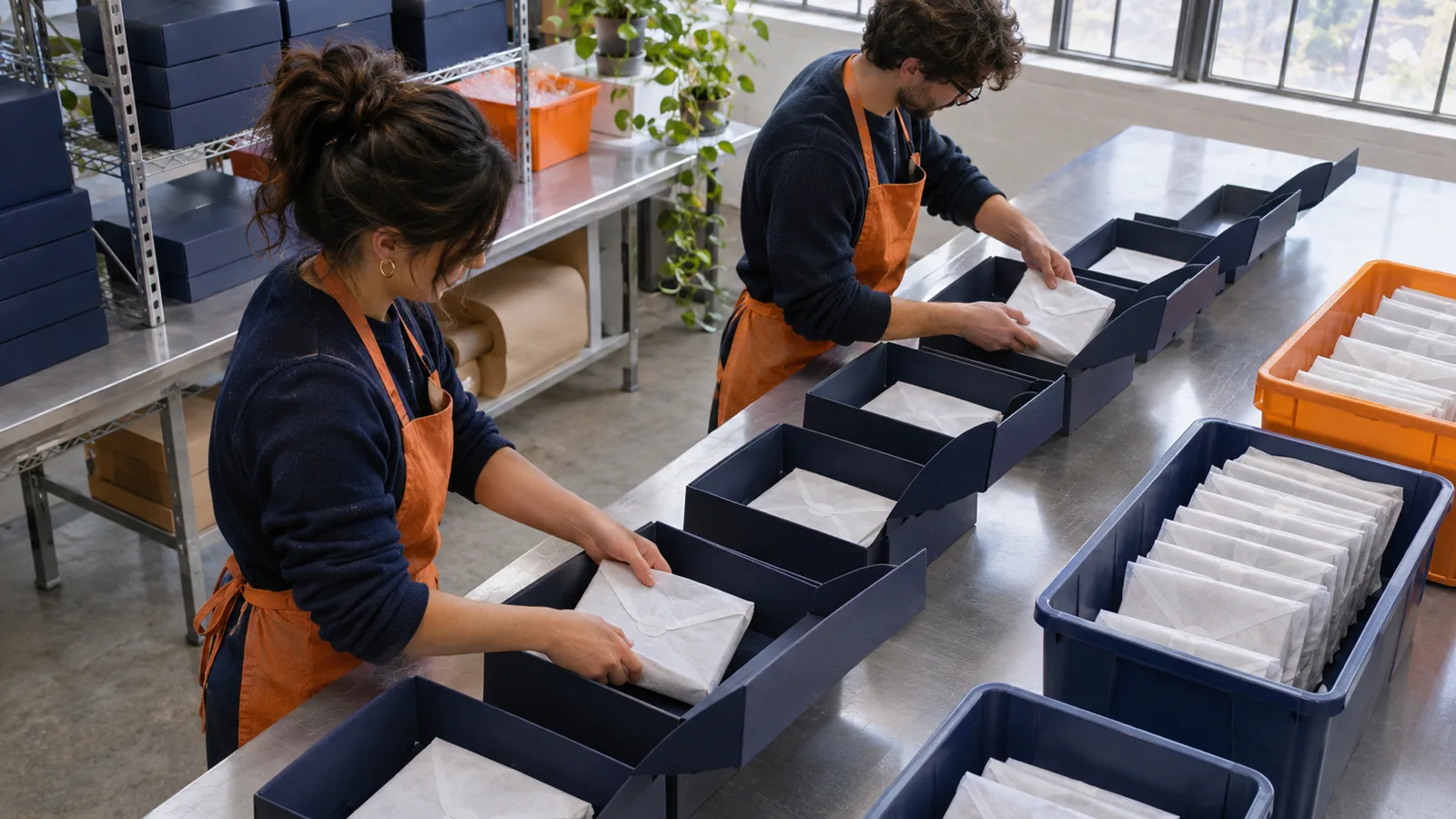
A subscription business looks wonderful on a spreadsheet. Predictable monthly revenue, a known number of boxes to ship, customers who come back without being asked. Then the first few billing cycles go out and the founder discovers that shipping a box to Whitehorse costs several times what it costs to ship the same box across town, that one extra centimetre of packaging bumped every parcel into a higher rate tier, and that the warehouse needs three days to pack a cycle that customers expect in one.
Subscription commerce in Canada has grown quickly in recent years, helped along by busy households getting comfortable having coffee, pet food, snacks, skincare and hobby kits delivered on a schedule. But the economics of recurring shipping are unforgiving. Because the customer pays the same price every month, any cost that creeps up comes straight out of your margin, and you cannot easily pass it on without risking cancellations.
This guide looks at the levers that decide whether a recurring order makes money once it has been picked, packed and delivered somewhere in Canada, and how to pull them in the right order.
Start with the true cost of one shipped box
Many subscription brands price their plans based on product cost plus a target margin, then treat shipping as a line to be "figured out." Flip that around. Before you finalize pricing, build a landed cost for a single box delivered to a representative set of Canadian postal codes. At minimum, that cost should include:
- The products inside, including any samples or inserts.
- The outer box, void fill, tissue, stickers and printed cards.
- Pick, pack and kitting labour, whether in-house or through a fulfillment partner.
- Postage or courier charges, including fuel surcharges and any residential or remote-area fees.
- Payment processing on the recurring charge.
- An allowance for replacements, since lost or damaged subscription boxes are almost always reshipped at your expense.
Run the calculation for a customer in downtown Toronto, a suburb of Calgary, a town in rural Quebec, Halifax, and somewhere genuinely remote such as northern Manitoba or Nunavut. The spread between those numbers tells you whether a single national price is realistic or whether you need regional shipping charges or minimum plan lengths.
Box size is the biggest lever you control
Canadian carriers, like carriers almost everywhere, bill parcels on whichever is greater: the actual weight or the dimensional (volumetric) weight calculated from length, width and height. Subscription boxes are often light but bulky, packed with tissue paper and a carefully designed unboxing experience. That makes them a prime candidate for dimensional weight charges.
A few practical consequences:
- Design the box around the product, not the brand moment. A beautiful box that is two centimetres too deep can cost you on every single shipment, every month, for the life of the subscriber.
- Test against carrier tiers. Canada Post and the courier networks publish size and weight thresholds. Small changes can move you from one pricing tier to another, and some lettermail-sized or small-packet formats are dramatically cheaper than a full parcel if your product fits.
- Plan for variation between cycles. If next month's curated item is bulkier, you may need a second box size. Know that before you source it, not after.
Cartonization tools inside a warehouse management system can suggest the smallest suitable box for each order automatically. For subscription brands that offer add-ons or variable contents, cartonization keeps packers from defaulting to the biggest box on the shelf. Our existing article on how package dimensions impact shipping costs explains the dimensional weight formula in more depth.
Billing-cycle timing shapes your warehouse workload
The way you bill customers determines how orders hit the warehouse, and that in turn affects cost and delivery speed.
Single ship date
Many curated boxes bill everyone on the same date and ship the whole cycle at once. This is efficient to kit, because the warehouse can build hundreds or thousands of identical boxes in a production run. The downside is a huge spike: you need enough labour, packaging and carrier pickup capacity for a few intense days, and very little for the rest of the month.
Rolling or anniversary billing
Replenishment subscriptions, such as coffee, razors or vitamins, often bill on each customer's sign-up anniversary. Orders arrive steadily throughout the month, which is easier on labour but makes each order a normal pick-and-pack job rather than an assembly line.
Hybrid approaches
Some brands bill on two or three fixed dates per month. That smooths the spike while still allowing batch kitting. If your volume is growing quickly, a hybrid schedule can delay the need for more space or staff.
Whichever model you choose, share the billing calendar with your fulfillment team or partner well in advance. A provider offering subscription box fulfillment will plan labour and pre-kitting around those dates, but only if they know them.
Pre-kitting: build boxes before the cycle bills
For curated subscriptions, one of the most effective cost reductions is assembling boxes before the billing run. Once orders are released, the warehouse simply applies a label to a box that is already built. This turns a multi-item pick into a single-item pick and compresses the time from billing to shipping.
Pre-kitting does require good forecasting. Build too many and you have finished boxes sitting on shelves with contents that may be seasonal or perishable. Build too few and you are back to assembling on the fly. Most brands build to their active subscriber count minus expected cancellations, then hand-assemble the remainder. Kitting and assembly services are designed for exactly this kind of work.
Choosing carriers for recurring Canadian shipments
There is no single best carrier for subscription commerce in Canada. Canada Post reaches every address in the country and is often the most economical option for small, light parcels going to residential and rural addresses. Courier networks can be faster and more competitive in dense urban corridors such as the Quebec City to Windsor corridor or the Lower Mainland. Regional carriers sometimes offer strong pricing within a province.
For a subscription brand, the right answer is usually a mix:
- Use the most economical service that meets your promised window for each region, rather than one carrier for everything.
- Consider consolidated injection: trucking a full cycle's worth of boxes to a carrier facility in another region and inducting them there, which can shorten transit to Western or Atlantic Canada.
- Track delivery performance by region each cycle. A carrier that performs well in Ontario may not perform as well in the Maritimes.
A multi-carrier shipping platform lets you rate-shop every label automatically, which matters when you are generating thousands of labels on a single day.
Remote and northern subscribers
Every Canadian subscription brand eventually has to decide how to handle customers in the territories, northern parts of the provinces and other remote areas. Shipping there typically costs more and takes longer, and some products, especially liquids, aerosols or perishables, may face additional restrictions when moving by air.
Options include charging a regional shipping supplement, requiring a longer prepaid commitment for remote postal codes, offering a quarterly instead of monthly box so shipping is amortized, or simply being transparent that some areas are not served yet. What does not work is ignoring the issue and absorbing the cost silently. A small number of remote subscribers can quietly turn a profitable cycle into a loss.
Taxes and pricing on recurring orders
Canadian sales tax applies to subscription orders just as it does to one-time purchases, and the rate depends on the province of delivery: GST in some provinces, HST in others, and GST plus a provincial tax such as PST or QST elsewhere. Shipping charges are generally taxed the same way as the goods they accompany. Make sure your subscription platform calculates tax by destination province and that your pricing (tax-inclusive or tax-exclusive) is clear on the sign-up page. Speak with an accountant about registration obligations as you grow, since thresholds and rules differ by province.
Reducing churn through fulfillment
Subscription profitability depends on lifetime value, and lifetime value depends on how many cycles a customer stays. Fulfillment has a bigger influence on churn than many founders assume. Late boxes, damaged contents, wrong items and poor communication are among the most common reasons people cancel.
Some fulfillment practices that help retention:
- Send a shipping notification with tracking the moment the cycle ships.
- Pack fragile or liquid items so they survive winter handling and freezing temperatures in transit.
- Make it easy to skip, pause or change a delivery address before the cut-off for the next cycle.
- Handle reshipments quickly and without making the customer prove the box went missing.
- Keep the unboxing consistent. If the box looks different every month because it was packed in a rush, customers notice.
Frequently asked questions
Should I offer free shipping on subscriptions?
Many subscription brands build shipping into the plan price and present it as free, because a separate shipping line feels like a recurring penalty. That works if the plan price covers your average shipping cost across all regions. If your subscribers are concentrated in a few provinces, the average may be manageable; if they are spread across the country, consider regional pricing or a minimum commitment.
When should a subscription brand move to a 3PL?
Common signals are when packing a cycle takes the team away from marketing and product work for days at a time, when you are running out of space at home or in a small unit, or when you want to offer faster delivery to regions far from your base. A 3PL can also negotiate carrier rates you may not reach on your own volume.
Can I ship perishable or temperature-sensitive subscriptions across Canada?
Yes, but it requires insulated packaging, cold packs, careful transit planning around weekends, and often a different carrier mix. Food subscriptions may also need to meet Canadian Food Inspection Agency and labelling requirements. Look at cold chain fulfillment if your boxes contain chilled or frozen items.
How do I handle add-ons and one-time purchases?
Ideally, add-ons ship in the same box as the subscription cycle to avoid paying for a second parcel. That means your storefront needs to hold add-on orders until the next cycle ships, and the warehouse needs a clear way to merge them. Discuss this workflow with your fulfillment provider before launching add-ons.
Build a subscription model that ships profitably
Recurring revenue is only valuable if each cycle leaves something on the table after the box is delivered. The brands that grow sustainably in Canada are the ones that design packaging, billing and carrier strategy together from the start. ShipCarte supports subscription brands with kitting, recurring fulfillment and multi-carrier shipping across the country. Our article on fulfilling orders for a subscription box business is a useful next read, and when you are ready to compare costs, request a quote and we will look at your box, your cycle and your subscriber map with you.