
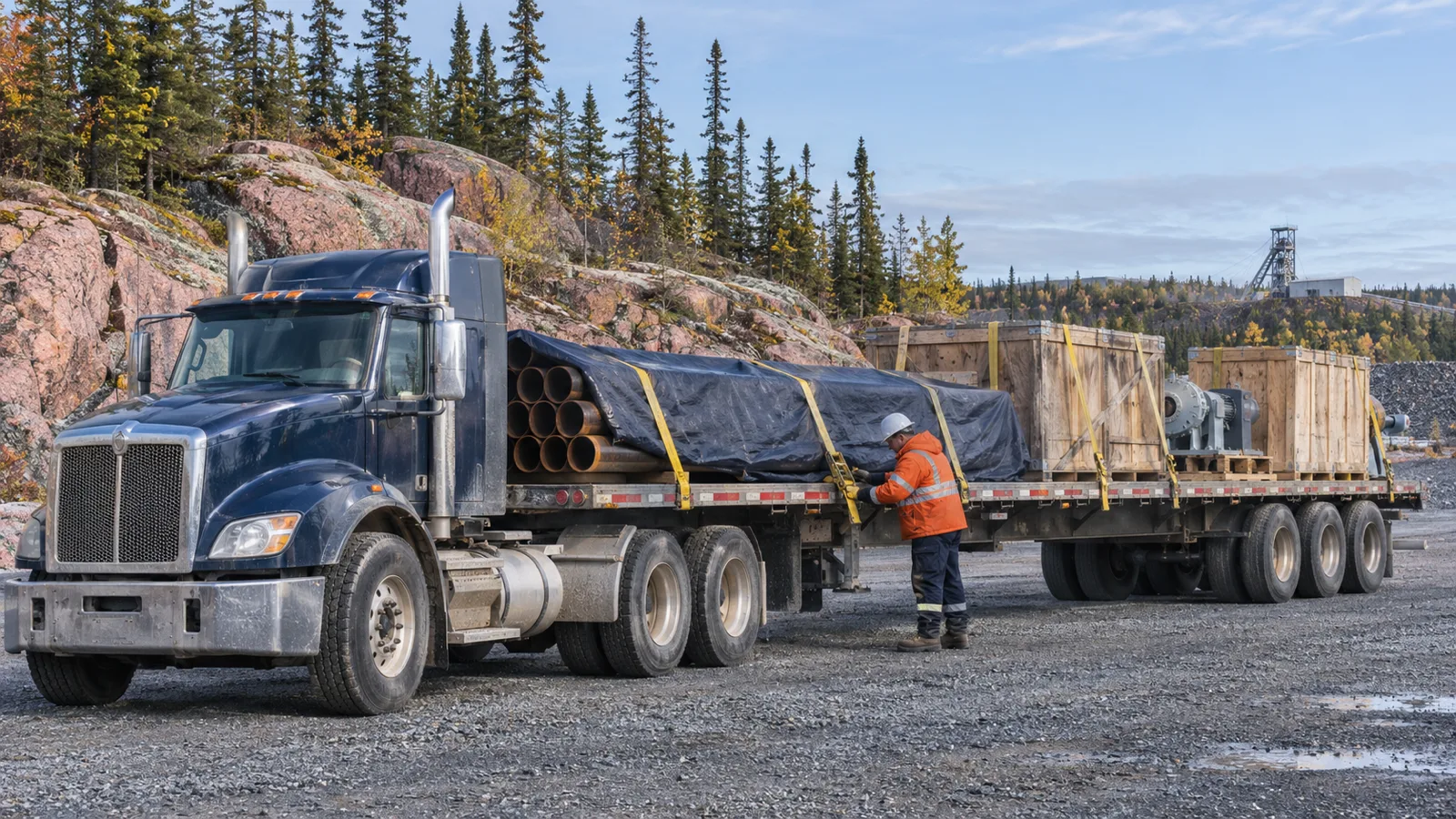
A pump rebuild kit leaves a machine shop in Hamilton on a Tuesday afternoon. The mill in Greater Sudbury needs it Thursday morning because a planned shutdown starts at 7:00 a.m., and every hour the crew waits costs far more than the freight bill ever will. On paper the trip is roughly 450 kilometres up Highway 400 and Highway 69. In practice the kit has to clear a terminal in Sudbury, get onto a truck that is allowed through the site gate, and arrive with paperwork the receiver will accept. Miss any one of those and the part sits in a warehouse in Garson while a maintenance supervisor makes angry phone calls.
That gap between distance and reality is what makes mining supply freight in Northern Ontario different from ordinary B2B shipping. Sudbury is the hub for one of the largest mining supply and services clusters in the world, and from there freight fans out to operations near Timmins, Kirkland Lake, Wawa, Marathon and Red Lake, as well as exploration camps that are reachable only by gravel road, winter road or float plane for part of the year.
This guide is written for suppliers in Southern Ontario and for distributors already based in the north who want fewer surprises. It covers how freight actually moves into the Sudbury Basin and beyond, what mine sites expect from carriers, and how to plan around the seasons that shape everything north of the French River.
How freight reaches the Sudbury Basin
Most mining supply freight into Sudbury arrives by road. From the GTA and the Golden Horseshoe, the main corridor is Highway 400 to Highway 69, which the province has been gradually four-laning for years. Freight from Ottawa and Eastern Ontario usually comes across Highway 17 through North Bay, and loads from Western Canada or Thunder Bay come east on Highway 17 along the top of Lake Superior. Sudbury is served by both CN and CP, so heavy or bulky commodities such as grinding media, steel and reagents often travel by rail and transload locally.
For a typical supplier, the practical options are:
- LTL through a northern terminal. Several regional and national carriers run scheduled service from the GTA to Sudbury, usually next-day for terminal-to-terminal moves. This works well for pallets of consumables, filters, wear parts and safety supplies.
- Dedicated or full truckload. When you have a mill liner set, conveyor components or a full order for a single site, a dedicated truck removes the terminal handling step and often arrives at the gate faster.
- Expedited and team service. For breakdown parts, a straight truck or a hot-shot pickup leaving Toronto in the evening can be at a Sudbury-area site the next morning.
- Air for the far north. Fly-in camps and remote exploration sites are supplied by charter from Sudbury, Timmins, Thunder Bay or Red Lake, so freight must be weighed and dimensioned with aircraft limits in mind.
Most shippers end up using a mix. A steady flow of consumables moves as LTL freight, while project deliveries and shutdown kits go as full truckload or expedited loads. The trick is deciding in advance which orders belong in which lane rather than scrambling when a crisis order arrives.
What a mine site expects from your freight
Mine and mill receivers in Ontario run controlled sites. The Occupational Health and Safety Act and its mining regulation apply, and each operator layers on its own rules. Drivers who show up unprepared are turned around, and the freight goes back to the terminal for another attempt the next day. Before you book, find out:
- Gate hours and receiving windows. Many sites receive only during day shift and close the warehouse during shift change. Some refuse deliveries on weekends even when they are operating.
- Driver requirements. Expect to need safety boots, hard hat, high-visibility clothing and safety glasses at a minimum. Some sites require a short orientation or an escort.
- Purchase order and reference numbers. Receivers match every delivery to a PO line. A bill of lading without the PO number is the most common reason freight is refused or held at the gate.
- Unloading equipment. Know whether the site has a forklift that can reach the trailer deck or whether you need a tailgate truck, flatbed side-unload or a crane. Underground equipment and large castings often require the carrier to bring the right trailer.
- Delivery location. Large operations have a central warehouse and several satellite shafts or mills. Make sure the address on the bill of lading is the actual receiving point, not the head office.
Building these details into a standing delivery profile for each site saves you from re-learning them on every order. A good carrier management process keeps the profile current and passes it to whichever carrier is handling the load that week.
Seasons that shape Northern Ontario freight
Winter
From November to April, Highway 69, Highway 17 and Highway 144 north to Timmins can close for hours after a collision or whiteout, and there are few detours. A load that should arrive in six hours can take two days. Build an extra day into any delivery that matters during winter, and avoid scheduling critical parts for the last possible moment before a shutdown. Winter roads in the Far North, which typically open from late January to March depending on conditions, open a short window to move heavy supplies to remote camps that would otherwise need air freight.
Spring thaw
When the frost leaves the ground, the Ontario Ministry of Transportation and many municipalities impose reduced load periods on designated roads, typically through March, April and into May. Axle weights drop, and heavy loads on secondary roads to mine and exploration sites may need to wait or be split. If you supply a site off a municipal or forest access road, ask your customer when restrictions usually apply and plan heavy deliveries before or after.
Summer and fall
Summer is construction season, with lane closures on the main northern highways, and it is also when exploration programs ramp up. Fall brings planned maintenance shutdowns at many mills before winter. Both create demand spikes, so book capacity early for project freight in those months.
For a deeper look at seasonal routes, our post on seasonal roads and ice roads in Canada explains how winter roads are built and used.
Packaging and documentation for heavy, awkward freight
Mining supply freight is rarely tidy. Drill steel, liners, hoses, bits, cable reels and pump components are heavy for their size, irregular in shape and hard on packaging. A few habits prevent most damage claims:
- Use hardwood skids sized to the load, with cargo strapped or banded to the skid rather than just shrink-wrapped.
- Crate machined surfaces and sensitive components, and add blocking so parts cannot shift on gravel roads.
- Mark the centre of gravity and lifting points on large items so the receiver can unload safely.
- Keep weights and dimensions accurate. Northern carriers check, and a reweigh or reclass adjustment arrives weeks later on an invoice.
Chemicals and fuels used in processing and maintenance, from solvents to compressed gases to certain reagents, are dangerous goods. Shipments must follow the federal Transportation of Dangerous Goods Regulations, which means proper classification, packaging, labels, placards where required and a shipping document, plus a driver trained under TDG. Explosives are regulated separately and move only through specialized licensed carriers. If you are unsure whether a product is regulated, check the safety data sheet before you book, not after the carrier refuses it.
Stocking closer to the mine: a scenario
Consider a distributor of ground engagement tools and wear parts based in the GTA. Its customers include three operations in the Sudbury area and two near Timmins. Every order ships from the GTA, which means a minimum of one to two days in transit, and emergency orders often go expedited at three or four times the normal rate.
After reviewing a year of orders, the distributor finds that about 40 fast-moving SKUs account for most of its emergency shipments. It decides to hold a buffer stock of those SKUs in a warehouse in the north, replenished weekly by a consolidated truckload from the GTA. The results are predictable but significant:
- Emergency orders for stocked SKUs now ship same day by local delivery and arrive within hours.
- The weekly replenishment truck costs much less per unit than dozens of separate LTL and expedited shipments.
- Its customers can reduce their own on-site inventory because they trust the distributor's response time.
The trade-off is the cost of holding stock in two places and the discipline needed to keep the forward inventory accurate. This is where inventory management tools and clear reorder points matter. Without them, the northern stock drifts and the emergency shipments creep back.
Getting freight to remote camps
Exploration camps and fly-in operations add another layer. Freight usually moves by truck to a staging point such as Timmins, Hearst, Pickle Lake or Red Lake, then by charter aircraft, barge or winter road to the camp. Each handoff is a chance for freight to be left behind, so:
- Label every piece with the camp name, the client's project code and the consignee contact, not just the staging address.
- Weigh and measure each piece individually, since charter loads are planned by aircraft weight and door size.
- Avoid sending freight to the staging point without confirming that someone will receive and stage it.
- Pack food, fuel and equipment separately, as many aircraft and operators segregate these loads.
Our related article on mining supply logistics in Canada covers how operators in other provinces approach fly-in supply and may give you useful comparisons.
Controlling costs without slowing down
Freight to Northern Ontario is not cheap, and mining customers know it. Still, a few changes make a noticeable difference:
- Consolidate by site. Hold non-urgent orders for a day or two and ship them together to the same receiver.
- Separate urgent from routine. Agree with customers which orders really need expedited service. Many "rush" orders are simply placed late.
- Use the backhaul. Trucks returning south from the north are often empty, so return shipments of cores, rebuildable components and empty totes can be cheaper if timed well.
- Quote with accurate data. Rate requests with correct weights, dimensions and accessorial needs such as liftgate, inside delivery or site orientation produce fewer billing surprises.
- Review lanes quarterly. Carrier performance in the north varies with driver availability and season. A quarterly review keeps you on the best options.
A shipping platform that compares LTL, truckload and courier options side by side, and stores the site delivery profiles described above, saves dispatchers time and reduces the number of shipments booked on the wrong service. ShipCarte's shipping platform is built for exactly that kind of multi-carrier comparison.
Common questions from suppliers
Can I get next-day service from Toronto to Sudbury?
For terminal-to-terminal LTL, next-day service is common. Delivery to a mine site outside the city may add a day, depending on the carrier's local routes and the site's receiving window. Expedited service can reach most Sudbury-area sites overnight.
What about Timmins, Kirkland Lake and Red Lake?
Timmins and Kirkland Lake are usually one to two days from the GTA by LTL. Red Lake and other Northwestern Ontario communities are often three days or more, routed through Thunder Bay or Dryden, and winter weather can stretch that further.
Do I need a special carrier for oversize equipment?
Yes. Loads that exceed legal dimensions or weights need an oversize or overweight permit from the Ministry of Transportation and may require pilot vehicles. Plan these moves weeks ahead, especially in spring when load restrictions are in effect.
For broader timing and service options going north, see our guide on shipping to Northern Ontario.
Talk to ShipCarte about your northern lanes
Whether you ship a few pallets of consumables to Sudbury each week or need a plan for shutdown kits, forward stock and fly-in camps, the right mix of carriers and warehousing makes Northern Ontario freight far more predictable. ShipCarte works with suppliers across Ontario to match each shipment to the right service and keep site requirements on file. Request a quote for your next load, or schedule a consultation to review your mining supply lanes.