
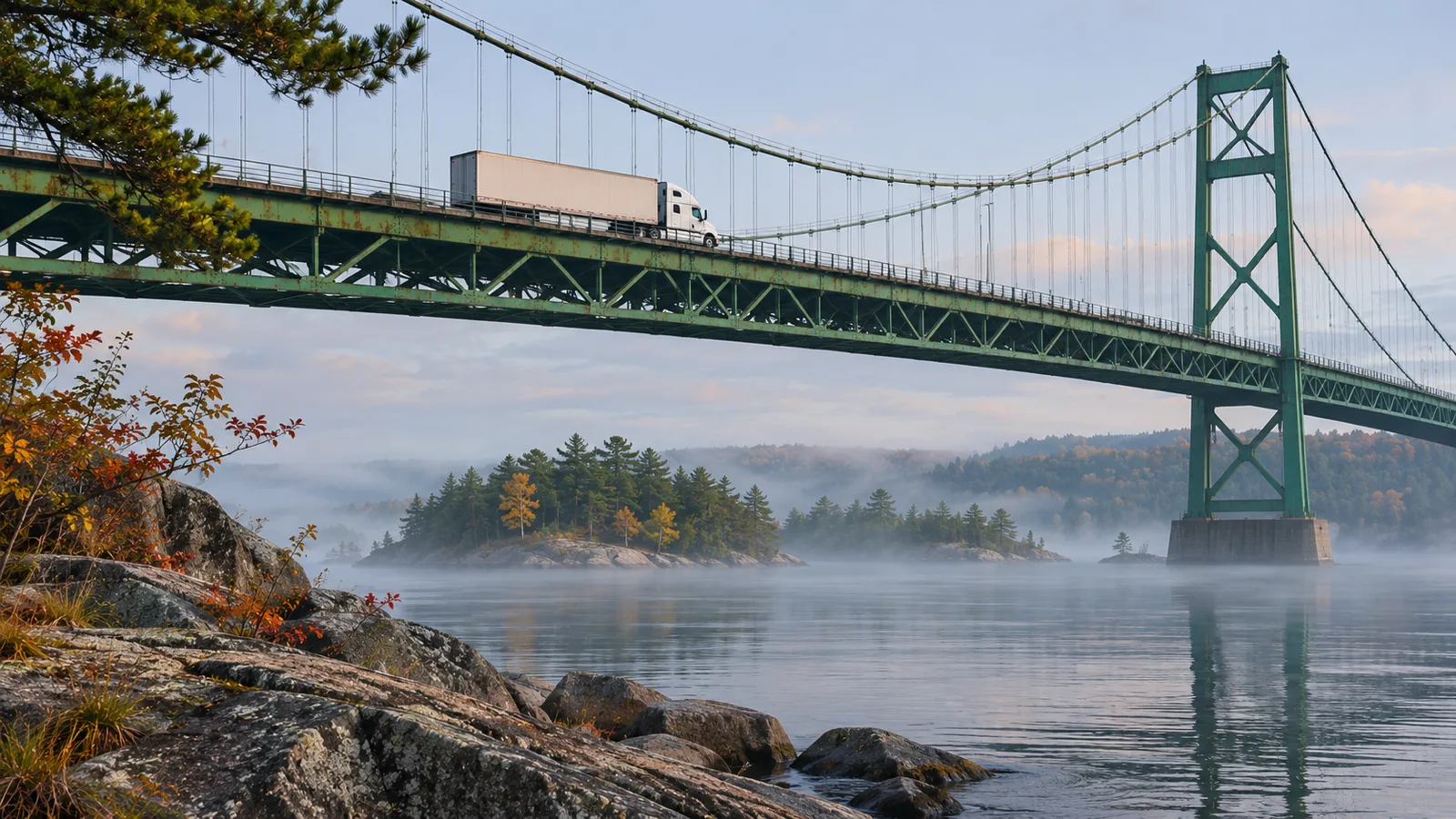
Picture a food manufacturer in Kingston with a full truckload of shelf-stable product bound for a distribution centre outside Harrisburg, Pennsylvania. The carrier's dispatcher, based in the GTA, routes the load west along Highway 401 to the Queen Elizabeth Way and over the Peace Bridge at Fort Erie, because that is the crossing the company's drivers use every day. The truck spends three extra hours heading in the wrong direction before it even reaches the border, then sits in a commercial queue at Buffalo. Meanwhile, a 45-minute drive east of the plant, the Thousand Islands Bridge connects almost directly to Interstate 81, a straight run south through New York and into Pennsylvania.
That scenario plays out more often than you might think. Most cross-border freight in Ontario funnels through the big three southwestern crossings: the Ambassador Bridge at Windsor, the Blue Water Bridge at Sarnia and the Peace Bridge at Fort Erie. For shippers in the Kingston, Brockville, Belleville and Ottawa Valley areas, though, the smaller eastern crossings can be faster, cheaper and less stressful, especially when the destination sits along the I-81 corridor.
This guide explains how the Thousand Islands crossing works for commercial freight, which destinations it suits, how it compares to the other eastern Ontario bridges, and what you need in place before your first shipment rolls across.
Where the Crossing Is and How It Connects
The Thousand Islands Bridge is actually a system of spans that hop across the St. Lawrence River between Ivy Lea, near Lansdowne in the Township of Leeds and the Thousand Islands, and Wellesley Island on the New York side. On the Ontario side, trucks leave Highway 401 at the Highway 137 interchange and follow a short connector over Hill Island to the Canadian port of entry at Lansdowne. On the American side, the bridge feeds onto Interstate 81 at Alexandria Bay.
That I-81 connection is the whole point. Interstate 81 runs south through Watertown and Syracuse, meets the New York State Thruway, continues through Binghamton and Scranton, and then heads down the Susquehanna and Cumberland valleys through Harrisburg and Carlisle toward Virginia and Tennessee. Those Pennsylvania valleys hold one of the densest clusters of distribution centres in North America. For an exporter in eastern Ontario, the Thousand Islands crossing is effectively a front door to that corridor.
Rough driving distances help frame the decision:
- Kingston to the Lansdowne port of entry: roughly 40 km along Highway 401.
- Brockville to Lansdowne: roughly 40 km west along Highway 401.
- Belleville to Lansdowne: roughly 120 km.
- Toronto to Lansdowne: close to 280 km, about three hours in normal traffic.
- The bridge to Syracuse: roughly 160 km on I-81.
Which Shipments Suit the Thousand Islands Route
The crossing is not the right answer for every load leaving Ontario. It shines when both the origin and the destination line up with it. Here are the situations where it usually makes sense.
Origins east of the GTA
Once your shipment starts east of roughly Port Hope or Cobourg, heading west to the Niagara crossings means doubling back across the busiest stretch of Highway 401 in the country. Freight from Belleville, Trenton, Napanee, Kingston, Gananoque and Brockville is usually better off heading east or south. Shippers in Prince Edward County and the Quinte region often overlook this because their carriers are headquartered in the GTA and default to the routes they know.
Destinations along or east of I-81
Central and northern New York, northeastern Pennsylvania, the Harrisburg area, and much of the mid-Atlantic can be reached efficiently through Alexandria Bay. New England is another candidate: trucks can pick up the Thruway at Syracuse and head east toward Albany, then into Massachusetts. For destinations in Ohio, Michigan or the Midwest, the southwestern Ontario crossings remain the logical choice.
Full truckloads and dedicated runs
A full truckload moving direct from your dock to a US consignee benefits most, because the driver chooses the route. LTL shipments are different. A less-than-truckload carrier routes freight through its own terminals and border consolidation points, and many national LTL networks cross through Fort Erie or Windsor regardless of where your shipment started. If you want your LTL freight to use an eastern crossing, you need a carrier whose network actually runs that way.
Comparing the Eastern Ontario Crossings
The Thousand Islands Bridge is one of three commercial crossings between Ontario and New York east of Lake Ontario. Each has its own personality.
Thousand Islands Bridge (Lansdowne and Alexandria Bay)
Best for freight heading to I-81 and points south. The approach from Highway 401 is short and simple. Commercial volumes are far lower than at the southwestern bridges, so waits are usually modest outside of peak tourist periods. The bridge carries heavy recreational traffic in summer, when cottagers, boaters and day-trippers pour into the Thousand Islands, so weekend afternoons from June to September can be busier than you would expect.
Ogdensburg-Prescott International Bridge (Johnstown)
Located just east of Prescott, near the junction of Highway 401 and Highway 416. For Ottawa-area shippers this crossing is often the most direct route south: Highway 416 runs straight from the capital to the bridge approach. On the American side, trucks connect toward Route 37 and onward toward Watertown or into northern New York. It is a quieter crossing and handles a smaller volume of trucks, so it pays to confirm hours and services for commercial processing before relying on it.
Seaway International Bridge (Cornwall and Massena)
The easternmost Ontario crossing, linking Cornwall with Massena, New York. It suits freight from Cornwall and the eastern counties heading to northern New York and Vermont. Because the route passes through Akwesasne territory, there are specific procedures on the approaches that carriers unfamiliar with the crossing should review in advance.
Many eastern Ontario exporters end up using two of these crossings regularly, choosing the bridge based on where each order is going. The key is giving your carrier a clear instruction rather than letting a default route decide for you.
The Paperwork Does Not Change With the Bridge
A common misconception is that a smaller crossing has looser requirements. It does not. Customs requirements are the same at Lansdowne and Alexandria Bay as they are at the Ambassador Bridge. Before your truck leaves, these items need to be in order.
US entry requirements
- ACE eManifest. The carrier must transmit an electronic manifest to US Customs and Border Protection before the truck arrives at the border. Highway carriers generally need to submit at least one hour before arrival, or 30 minutes for FAST participants.
- PAPS entry. Your US customs broker files the entry against the carrier's Pre-Arrival Processing System barcode so the shipment can be released at the booth.
- Commercial invoice. Accurate descriptions, quantities, values, country of origin and Harmonized System codes.
- NAFTA Certificate of Origin. If your goods qualify under NAFTA rules of origin, a properly completed certificate lets your US customer claim duty-free treatment. The new Canada-United States-Mexico Agreement was signed late last year but is still awaiting ratification, so NAFTA rules continue to apply for now.
- Agency-specific documents. Food shipments may require FDA prior notice, and certain goods need additional permits or declarations.
Canadian export reporting
Most commercial exports from Canada to the United States do not require an export declaration, but controlled goods, certain strategic items and some regulated products do. It is worth confirming your obligations with a broker or reviewing our guide to Canadian export reporting so a missing filing does not hold up a truck at the bridge.
Return trips into Canada
If the same truck backhauls freight into Ontario, the carrier must transmit ACI eManifest data to the CBSA, generally at least one hour before arrival, and the importer's broker handles release through the Pre-Arrival Review System. The Lansdowne port of entry processes commercial imports, but as with any port, confirm that the specific commodity can be cleared there, especially regulated food, plants or animal products that may involve CFIA review.
A Practical Routing Walkthrough
Let's return to the Kingston manufacturer from the introduction and walk through how a better-planned shipment would look.
- Confirm the destination corridor. The consignee is near Harrisburg. That sits squarely on I-81, so the Thousand Islands Bridge is the logical crossing.
- Brief the carrier in writing. The shipper's routing instructions specify the Lansdowne and Alexandria Bay crossing. Without this, the dispatcher might default to Fort Erie.
- Line up the US broker early. The commercial invoice, NAFTA certificate and FDA prior notice are sent to the broker the day before pickup, giving time to resolve any questions.
- Time the departure. The truck loads at 6 a.m., reaches the bridge before 7 a.m., and avoids both Highway 401 commuter traffic around Kingston and any afternoon tourist traffic at the bridge.
- Track the crossing. The shipper receives confirmation when the truck clears CBP, then a delivery appointment confirmation from the consignee.
Compared with the western routing, the truck travels hundreds fewer kilometres, burns less fuel, and arrives at the consignee the same day instead of the next morning. For a shipper sending several loads a week, the savings in mileage-based rates and driver hours add up quickly.
Seasonal and Operational Considerations
Tourist season
The Thousand Islands is one of Ontario's best-known summer destinations. Long weekends and summer Fridays bring heavy passenger traffic onto the bridge approaches and the Highway 137 connector. Booking early-morning crossings or mid-week departures in July and August keeps transit times predictable.
Winter and the Tug Hill snow belt
South of the border, I-81 passes near the Tug Hill Plateau east of Lake Ontario, one of the snowiest places in eastern North America. Lake-effect squalls between Watertown and Syracuse can slow trucks dramatically or close stretches of highway for hours. From November through March, build buffer time into delivery appointments for loads crossing at Alexandria Bay, and ask your carrier how it monitors New York conditions. Our post on winter freight delays in Ontario covers the Ontario side of the same challenge.
Bridge tolls and restrictions
The bridge is a toll crossing, with commercial vehicles paying more than passenger vehicles based on axle count. The cost is small compared with the mileage you save, but it should appear in your carrier's quote. Oversize or overweight loads require advance coordination with the bridge authority and permits from the jurisdictions on both sides.
Questions Eastern Ontario Exporters Often Ask
Will my carrier charge more to use a smaller crossing?
Usually the opposite. Truckload pricing is largely driven by distance and time, so the shorter route should reduce your rate. Where you might see higher costs is with LTL carriers whose networks do not normally cross in the east, since they may need to deviate from their usual linehaul.
Can I ship parcels through the Thousand Islands crossing?
Parcel carriers route shipments through their own consolidation hubs and border facilities, so you generally have no control over which bridge a parcel uses. For e-commerce and small business shipments, focus on choosing the right service level rather than the crossing. Our cross-border shipping team can help you compare options for parcels and freight.
Is it worth using for Ottawa freight?
For Ottawa origins, the Ogdensburg-Prescott bridge via Highway 416 is often shorter. The Thousand Islands Bridge becomes attractive when the destination is farther south along I-81 and the driver would otherwise need to work through smaller New York state roads to reach the interstate.
Does a quieter crossing mean faster clearance?
Shorter lines help, but clearance speed depends mostly on your paperwork. A shipment with an incomplete invoice or a missing PAPS entry will be held no matter which bridge it uses. Clean documents are what make a crossing truly fast.
Building an Eastern Ontario Export Strategy
If your business ships regularly to the United States from eastern Ontario, a few habits can turn the Thousand Islands crossing into a dependable advantage:
- Map your top US destinations and group them by crossing, so every lane has a default bridge.
- Put routing instructions on your bills of lading and in your carrier agreements.
- Choose carriers and brokers who already work the eastern crossings and know the local procedures.
- Keep a shared calendar of US and Canadian holidays and local tourist peaks.
- Review transit times quarterly to make sure the expected savings are actually showing up.
Technology helps too. A shipping platform that compares carrier quotes and stores your routing preferences makes it easier to keep every load on the right crossing, even when different people in your office book shipments.
Talk to ShipCarte About Your Cross-Border Lanes
ShipCarte works with businesses across Ontario to plan truckload, LTL and parcel shipments into the United States, including routing that takes advantage of the eastern crossings when it makes sense. We can review your current lanes, identify freight that is travelling further than it needs to, and coordinate with carriers and customs brokers so your paperwork is ready before the truck leaves your dock. Request a quote for your next US shipment, or schedule a consultation to review your eastern Ontario export routes.