
Every autumn, the same thing happens across the Greater Toronto Area. The first cold snap arrives, usually a week or two after Thanksgiving, and suddenly every drive-in bay in Mississauga is booked solid with customers swapping to winter tires. Dealers and independent garages that ordered conservatively start calling their distributors for same-day and next-day top-ups. A tire wholesaler in an industrial park off Highway 401 can go from steady to overwhelmed within days.
Tires are an unusual product for a warehouse. They are bulky but not fragile, heavy but awkward to palletize, highly seasonal, and sold in sizes that number in the hundreds or thousands across brands and models. They also go to a customer base that expects fast delivery because a car is often sitting on a hoist while the garage waits.
This article looks at tire distribution from a Mississauga base: how to store tires so they stay in sellable condition, how to plan for the spring and fall changeover peaks, and how to build delivery routes that keep dealers and shops supplied.
Why tires are different from other warehouse products
Before talking about solutions, it helps to understand what makes tires tricky.
- Cube, not weight: Tires take up a lot of space relative to their value per cubic metre. Storage cost per unit can be high if space is not used efficiently.
- Huge SKU counts: A single tire line may come in dozens of sizes, load ratings and speed ratings. Multiply by brands and seasons and the SKU list grows quickly.
- Look-alike products: Two tires of nearly identical size are easy to confuse visually. Picking errors are costly because the wrong tire may not be discovered until it is being mounted.
- Age matters: Tires carry a manufacturing date code, and many buyers and installers check it. Older stock can be harder to sell.
- Extreme seasonality: Volume spikes in fall for winter tires and again in spring when drivers swap back.
Storing tires properly
Environment
Rubber compounds degrade with exposure to sunlight, heat, ozone and certain chemicals. Tire manufacturers generally recommend storing tires indoors in a cool, dry, dark space, away from direct sunlight, heat sources and equipment that generates ozone, such as some electric motors and chargers. Tires should also be kept away from solvents, fuels and oils. Follow the specific storage guidance from the manufacturers you carry.
Racking options
There are several common approaches, each with trade-offs:
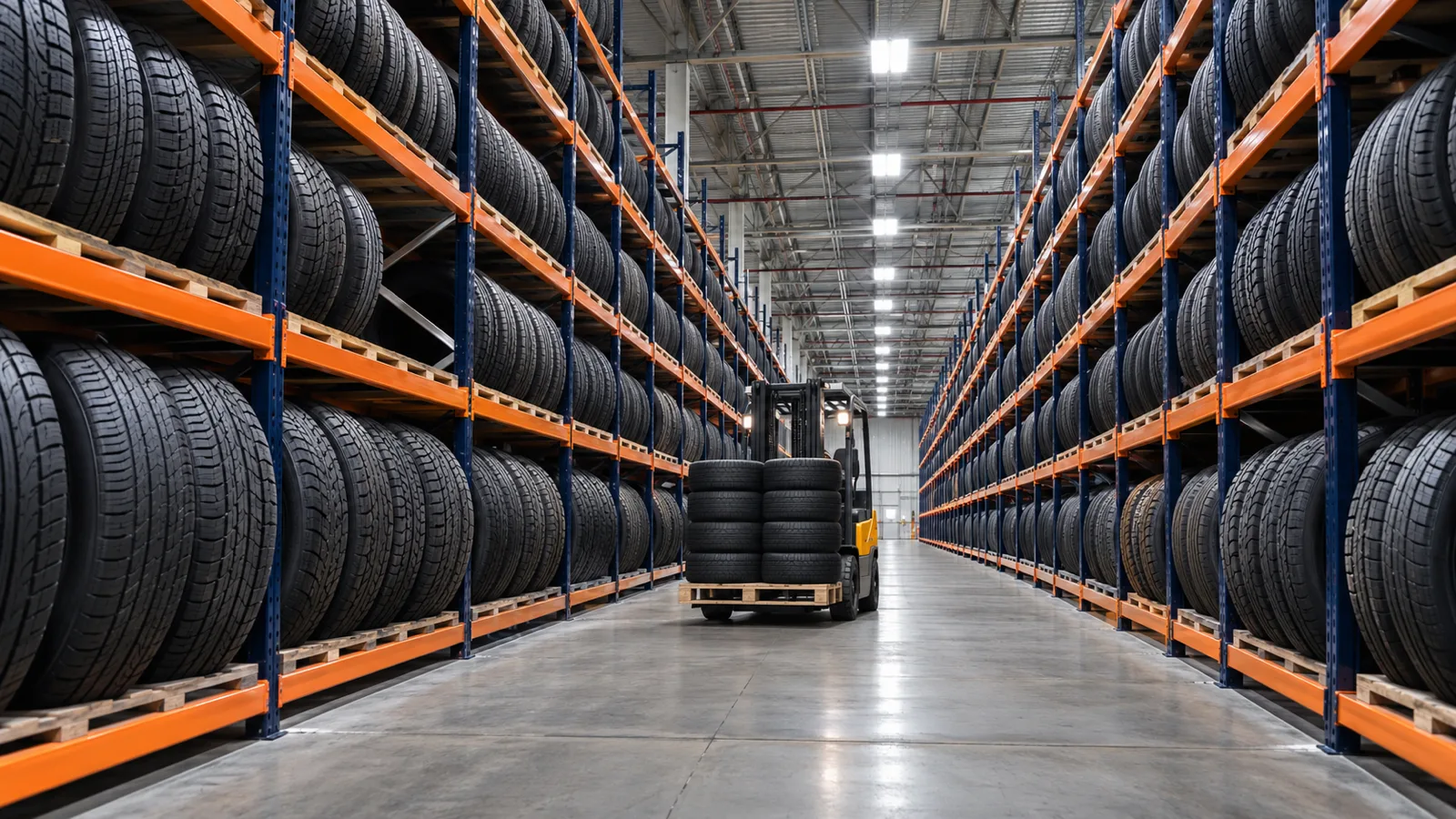
- Dedicated tire racks: Tires stand upright on beams, which makes individual tires easy to see, count and pick. This is often used for fast-moving sizes.
- Stacked on pallets: Tires are laid flat or laced in a pattern on pallets and stored in selective pallet racking. This makes good use of vertical space for slower movers and bulk reserve stock.
- Bulk floor stacks: Common for very high-volume sizes during peak season, provided stack heights follow manufacturer and safety guidance.
Many operations use a mix: a forward pick area with upright racks for the most popular sizes, backed by palletized reserve stock in high racking. A warehouse management system keeps track of where each size and date code sits so replenishment happens before the pick face runs empty.
Rotation by date code
Because tire age matters, first-in, first-out rotation is especially important. Track the date code at receiving and direct pickers to the oldest sellable stock. Our explainer on what FIFO means covers the principle. Regular cycle counts help catch stock that has been pushed to the back of a rack and forgotten.
The tire calendar: planning the year around two peaks
Tire distribution in Ontario runs on a predictable rhythm. Here is how a typical year breaks down and what a Mississauga distributor should be doing at each stage.
Summer: preparing for winter
Winter tire inventory usually arrives through the summer, often as import containers that come through Canadian ports and reach the GTA by rail and truck. This is the time to receive and put away stock, label it, and make space. Planning ahead matters because storage space in the GTA is in demand, and finding extra space in October is much harder than in July.
October to December: the winter rush
Although Ontario does not require winter tires, many drivers use them, and insurers in the province offer discounts to drivers who do. Demand rises once temperatures drop and spikes with the first significant snowfall. Quebec, which does require winter tires during a set winter period, creates its own deadline-driven demand for distributors shipping east along Highway 401. During this period:
- Extend picking shifts and add delivery capacity before the first snow, not after.
- Move the most popular winter sizes into forward pick locations.
- Set clear order cut-off times for next-day delivery so dealers know when to order.
- Monitor stock levels daily and arrange transfers or top-ups early.
January to February: the quiet period
Use the slower months for full inventory counts, slotting reviews, and planning next season's purchasing. It is also a good time to address any accuracy problems that surfaced during the rush.
March to May: the spring swap
Drivers switch back to all-season or summer tires, and demand for those categories increases. The spring peak is typically less intense than fall, but it still benefits from forward planning. Unsold winter stock needs to be consolidated and stored properly for the following season.
Delivering to dealers and garages
For many tire distributors, delivery speed is the main competitive weapon. An independent garage in Erin Mills or a dealership on a busy arterial road does not want to keep large amounts of stock. They want to order in the evening and have tires on site the next morning.
Route design
Mississauga's location makes it a strong hub for dealer delivery. From here, trucks can reach Toronto via the 427 and Gardiner, Brampton and Caledon via the 410, Oakville, Burlington and Hamilton via the QEW and 403, and Kitchener-Waterloo and London via the 401. Effective route design groups stops geographically, respects the opening hours of each shop and leaves time for congestion on the 401 and 403. Many distributors run early morning routes so tires arrive before the shop's first appointments.
Vehicle choice
Tires are usually loaded loose in straight trucks or cube vans for multi-stop dealer routes, which avoids the need for a dock at each stop. Longer-distance replenishment to other distribution points may use full trailers. The right mix depends on order sizes and route density. Our distribution services page outlines how multi-stop programs can be structured.
Proof of delivery
Electronic proof of delivery with a signature and photo is particularly helpful for tires, because disputes about missing or wrong sizes are common in a busy season. Scanning tires onto and off the truck creates a clear record.
Reducing picking errors on look-alike sizes
Mis-picks are the most frustrating problem in tire distribution because they are expensive to fix. A wrong tire means a second delivery, an unhappy garage and a customer whose car is stuck on a hoist. A few practices make a real difference:
- Scan every tire at pick and at load. Relying on visual size matching leads to errors, especially late in a long peak shift.
- Separate near-identical sizes. Avoid slotting tires that differ by one aspect ratio or rim size in adjacent locations.
- Label locations clearly. Large, readable location labels help pickers find the right bay quickly, and the system confirms the choice with a scan.
- Stage by route and stop. Group each route's tires in a staging lane, sorted by stop, so the driver can load in reverse order and unload quickly.
These habits matter most during the fall rush, when temporary staff join the floor and volume is at its highest.
Selling tires online
More drivers now buy tires online and have them shipped either to their home or to an installer. That adds a parcel channel to what was traditionally a B2B freight business. Tires can be shipped by parcel carriers, but they are heavy and oversized, which can trigger surcharges. Accurate weights and dimensions in your shipping system help keep costs predictable. Our article on types of shipping surcharges explains the common ones.
Shipping to an installer rather than a residential address often works better: the installer receives the tires, mounts them and handles any disposal. An order management system can route each order to the right channel, whether parcel, dealer route or freight.
Compliance points to keep in mind
- Product standards: Tires sold in Canada must meet federal motor vehicle tire safety requirements administered by Transport Canada.
- End-of-life programs: Ontario has rules under the Resource Productivity and Recovery Authority that place responsibilities on tire producers and others for collecting and managing used tires. Understand where your business fits.
- Fire safety: Large tire storage areas are subject to fire code requirements. Work with your landlord or warehouse partner to confirm compliance.
- Workplace safety: Handling heavy tires repeatedly creates ergonomic risks. Lifting aids, proper rack heights and training help protect staff.
Should you outsource tire warehousing?
Some distributors run their own warehouses year-round. Others use a 3PL for overflow during peak, or outsource fully. Outsourcing makes sense when your volume swings sharply by season, when you want to avoid a long lease on space you only fill for part of the year, or when you need a broader delivery network than you can run yourself. Look for a partner offering distribution warehousing with experience handling bulky, high-SKU products and the ability to scale labour for peaks.
Plan your next tire season with ShipCarte
Tire distribution rewards preparation. ShipCarte supports distributors and importers in Mississauga with warehousing, inventory management and delivery coordination across Ontario. Request a quote to talk about your storage needs and delivery routes before the next changeover season.