
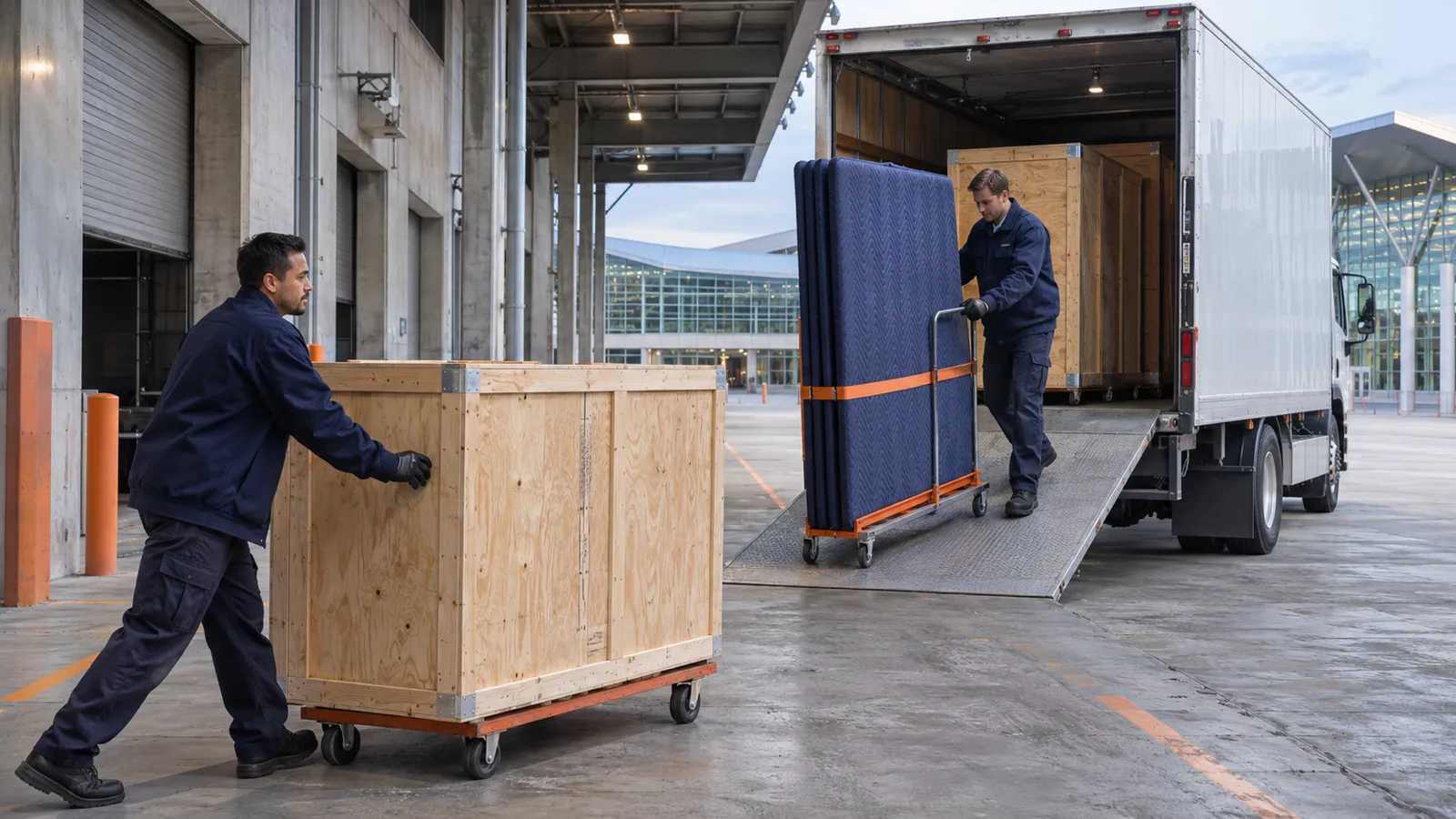
It is the Tuesday before a three-day industry show, and a Mississauga manufacturer's marketing coordinator is on the phone with the show's general contractor. The booth graphics, the demo unit and two cases of brochures left the office in a cube van on Friday, but nobody booked a delivery window, so the driver was turned away at the marshalling yard. The booth space is paid for, the flights are booked, and the most important part of the exhibit is sitting in a parking lot.
Trade show shipping looks simple from the outside: put the booth on a truck, drive it to the venue. In practice it runs on a separate set of rules from everyday freight. Show managers publish strict deadlines, venues control their loading docks, and the general contractor charges for every pound it moves between the dock and your booth. Get the sequence right and the exhibit is waiting for you on the floor. Get it wrong and you pay rush fees, late surcharges, or both.
This guide walks through a trade show shipment from start to finish, the way it usually unfolds for a business shipping out of Mississauga, whether the show is down the road at The International Centre on Airport Road, across the city at the Enercare Centre or the Metro Toronto Convention Centre, or across the border in Chicago or Las Vegas.
Why trade show freight is different from regular shipping
Ordinary freight has one goal: get the goods from point A to point B by a target date. Trade show freight has three goals that pull against each other. It has to arrive inside a narrow window, it has to be packed so that it can be unpacked and repacked by people who did not pack it, and it has to come home again in usable condition. That return trip is where many exhibitors lose money and materials.
There is also an extra party in the chain. Most large shows appoint an official general contractor (sometimes called the show decorator) who manages the floor. That contractor receives your freight, moves it to your booth, stores your empty crates during the show and brings them back at teardown. Their services are billed as material handling, often called drayage in the show world, and the rate is usually calculated per hundredweight with minimums, plus extra charges for overtime hours, late arrivals and special handling. Rates vary widely by show and city, so read the exhibitor manual before you decide how to pack.
The timeline: working backwards from show day
The easiest way to plan is to count backwards from the first day the hall opens for exhibitor move-in. Here is a realistic sequence for a mid-sized booth.
Eight to ten weeks out: read the exhibitor kit
The exhibitor services manual tells you nearly everything that matters: the advance warehouse address, the first and last day it accepts freight, the direct-to-show target move-in times, the general contractor's material handling rates, the labelling format and whether the venue allows exhibitors to hand-carry items through the front doors. Print the freight section and share it with whoever is booking your transport. Most shipping problems at shows come from someone who never saw this document.
Six weeks out: inventory and pack-out list
List every piece that needs to travel: booth structure, flooring, lighting, monitors, demo equipment, product samples, literature, giveaways, tools and the small box of extension cords and zip ties that nobody remembers until it is missing. Weigh and measure each crate or case. This is also the time to decide what can ship as small parcel to the hotel or booth and what needs to go as freight. Literature and swag shipped as separate parcels can arrive at different times and in different places, which is fine if you plan for it and chaotic if you do not.
Four weeks out: choose advance warehouse or direct to show
This is the single most important decision, and it gets its own section below.
Two to three weeks out: book the carrier and confirm the window
For a local show, a straight truck or a dedicated van from Mississauga may be all you need. For a show in another province or the US, LTL freight is often the economical choice for a handful of crates, while a full truckload makes sense for a large island exhibit with heavy flooring. Either way, the carrier must know the delivery window and the venue's check-in procedures. Many venues route trucks through a marshalling yard where drivers wait for a dock assignment, and waiting time may be billed as detention.
The final week: labels, paperwork and contacts
Label every piece with the show's required format, including the exhibitor name, booth number and piece count (1 of 6, 2 of 6). Send the bill of lading and tracking information to the person who will be on site. Make sure that person has the carrier's dispatch number in their phone.
Advance warehouse versus direct-to-show delivery
The general contractor usually offers an advance warehouse that accepts freight for a set period before the show. Your freight is received, stored and delivered to your booth before you arrive. Direct-to-show means your truck rolls up to the venue on a specific target date and time during move-in.
- Advance warehouse works well when you want certainty that your booth is in place before you land, your shipment is small to medium, or you are shipping from far away and cannot control the arrival hour. It usually costs a bit more in handling, because the freight is moved twice.
- Direct-to-show works well when your shipment is large, the show is close to Mississauga, and you can guarantee the truck will hit its target window. It can save on handling, but missing the window can trigger penalties or a long wait.
- Watch the cut-off dates. Freight arriving at the advance warehouse after the deadline is often charged a late surcharge, and freight arriving at the venue outside your target window may be bumped to the back of the line.
For Toronto-area shows, Mississauga exhibitors have a geographic advantage. Access to the 401, 427 and 410 puts most GTA venues within an easy drive, so direct-to-show is realistic as long as you avoid rush-hour departures and give the driver buffer time. For The International Centre in Malton, the trip from many Mississauga business parks is short enough that a booked morning slot is easy to hit.
Packing booth materials so they survive two trips
Your exhibit will be handled by forklift operators and labour crews who are moving dozens of booths at once. Packing should assume that.
- Use reusable crates or road cases for structure, monitors and demo equipment. A wooden crate with foam inserts protects better than a stretch-wrapped pallet and can be reused for years.
- Build crates with forklift access and keep them stackable where possible. Odd shapes and unstackable items can attract special handling charges.
- Put a packing diagram and a contents list inside the lid of every crate. At teardown, tired staff need to know what goes where.
- Pack literature in strong, uniformly sized cartons on a pallet, and stretch-wrap the pallet. Loose cartons are easy to lose on a busy floor.
- Pack lithium batteries, compressed gas or aerosols with care. Some of these items are regulated as dangerous goods under Canada's Transportation of Dangerous Goods rules, and carriers may refuse them or require specific documentation.
- Photograph everything before it leaves. If there is damage, photos make the claim conversation much easier.
If your graphics or samples are fragile, our guide on how to properly pack fragile items covers cushioning and box choice in more detail.
Shipping to US shows from Mississauga
Plenty of Mississauga companies exhibit at US trade shows, and that adds customs to the plan. Booth materials and samples that are going to the US and coming back are usually handled as a temporary import. Depending on what you are sending, options can include an ATA Carnet (an international customs document for temporary admission of goods such as professional equipment and commercial samples) or a temporary importation bond arranged through a US customs broker. The right path depends on the goods, their value and whether anything will be sold or given away at the show.
Giveaways and literature that will stay in the US are not temporary imports. They may be dutiable, and they need to be declared accordingly. Keep a separate commercial invoice for consumables so the broker can treat them correctly.
When the freight comes home, the return entry into Canada needs to show that the goods originally left Canada, so the paperwork you prepare on the way out matters on the way back. Make sure the importer of record has its CBSA accounts in order, including access to the CBSA Assessment and Revenue Management (CARM) portal, and that your broker has the details. Our cross-border shipping team can help coordinate the carrier and broker so both directions are planned together.
The most common crossing for Mississauga freight heading to the Midwest is the Ambassador Bridge at Windsor-Detroit, reached via the 401. Shipments heading toward New York and the Northeast often cross at the Peace Bridge in Fort Erie or the Lewiston-Queenston Bridge, reached via the QEW. Build border wait time into the schedule, especially in the fall show season.
Show day: what to do when you arrive
When you walk the floor on move-in day, go to your booth first and count pieces against your bill of lading. If something is missing, go straight to the general contractor's service desk with your tracking information. Shipments sometimes land in the wrong aisle or remain on the dock waiting for a forklift.
Before unpacking, look for damage. Note it on the delivery receipt and photograph it. Then fill out the general contractor's empty-container labels and tag every crate and case you want stored during the show. Empties are usually taken off the floor to storage and brought back at teardown.
The return trip: where most money is lost
Outbound shipping gets all the attention. The return gets planned at 4:30 p.m. on the last day of the show, when everyone is exhausted. That is when crates get packed badly, labels go missing and freight ends up shipped by the house carrier at whatever rate is posted on the form.
Before you leave Mississauga, decide who will carry the freight home, book the outbound pick-up for teardown day and prepare the outbound material handling form in advance. Pack return labels inside the first crate so they are on hand. Agree on the destination: back to your office, to a storage location, or straight to the next show.
Not every booth needs to come back to your own building. If you exhibit several times a year, storing booth materials in a warehouse between shows can free up space at your office and make each departure easier. A warehousing partner can receive the crates after the show, check them for damage, store them on racking and stage them for the next outbound move, with literature and samples restocked from inventory before each event.
Common trade show shipping mistakes
- Not reading the exhibitor manual. Deadlines, label formats and handling rules are all there.
- Shipping in many small loose cartons. They are easy to lose and can cost more to handle than a few consolidated crates or a wrapped pallet.
- Ignoring the target move-in window. A truck that arrives early or late may wait hours.
- Forgetting the hand-carry rules. Some venues restrict what exhibitors can bring in through the front doors, especially using carts or dollies.
- No contact person on site. The driver and the service desk need someone they can reach.
- Leaving the return trip to the last minute. Pre-book the outbound carrier and fill out forms before the show.
- Underestimating border paperwork. Temporary imports need planning weeks ahead, not days.
A quick trade show shipping checklist
- Exhibitor manual freight section read and shared
- Pack-out list with weights and dimensions
- Advance warehouse or direct-to-show decision made
- Carrier booked with delivery window and venue procedures
- Labels with exhibitor name, booth number and piece count
- Dangerous goods (batteries, aerosols) checked
- Customs documents for US or international shows
- On-site contact with carrier and tracking details
- Empty-container labels and outbound forms prepared
- Return carrier booked and final destination agreed
Get your booth to the floor without the scramble
Trade shows are expensive enough without paying late surcharges or explaining to your sales team why the demo unit did not make it. With a clear timeline, sturdy packing and a carrier who understands show logistics, a Mississauga exhibitor can show up on move-in day and find the booth waiting. ShipCarte can help plan the freight both ways, store your exhibit between events and coordinate cross-border moves when the show is in the US. Request a quote for your next show, or book a consultation to map out your full event calendar.