
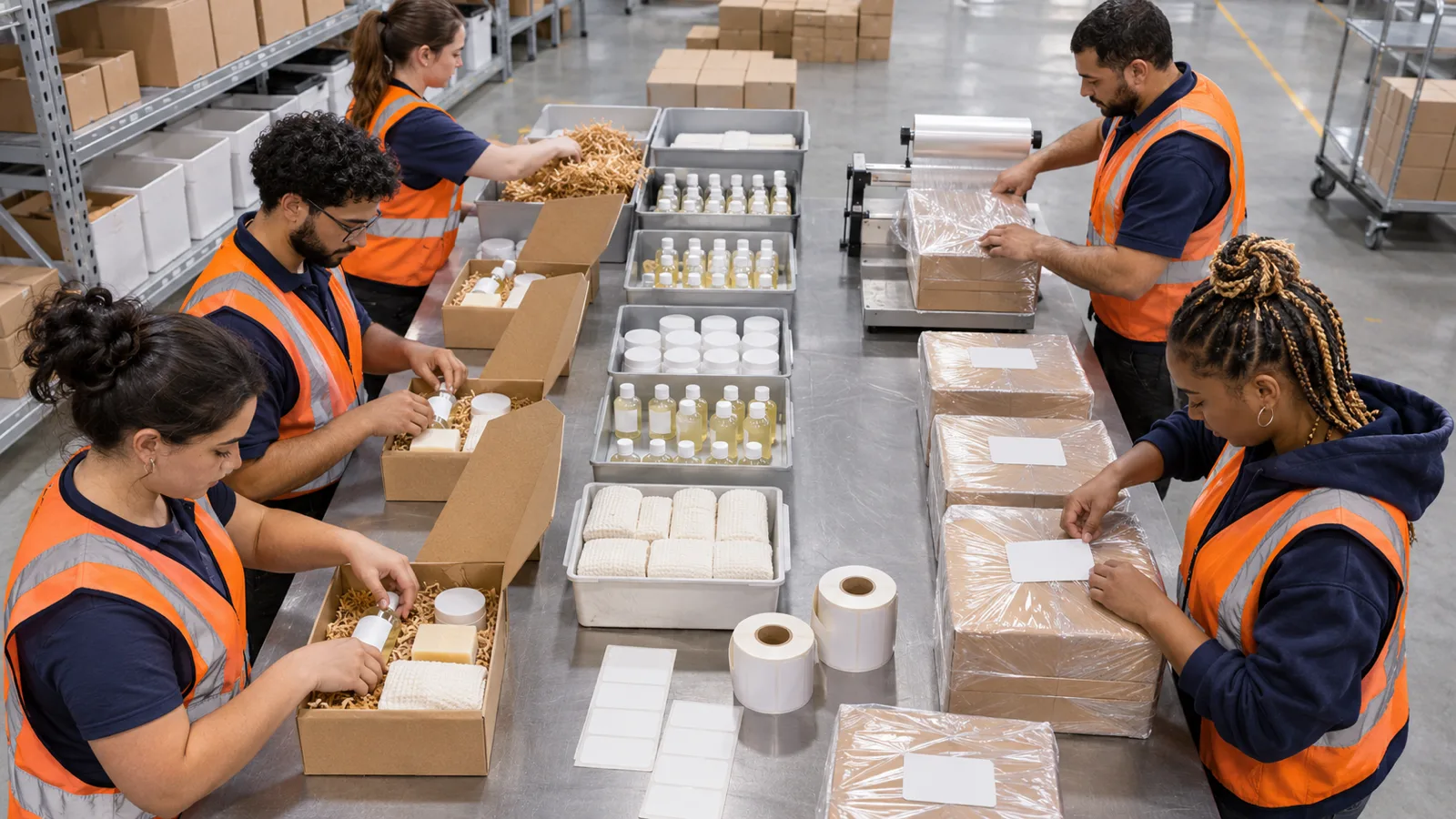
A container of product lands at the Port of Vancouver, clears customs and makes its way by rail to a warehouse in Ontario. On paper, it is ready to sell. In reality, the retail buyer wants it shrink-wrapped in packs of three, the packaging is missing French on the front panel, Amazon needs every unit labelled with its own barcode, and the marketing team wants a holiday gift set built from two of the SKUs before December. None of that is storage, and none of it is ordinary pick and pack. It is the work that sits in between.
That in-between work is what the logistics industry calls value-added services. For brands selling in Canada, it often makes the difference between inventory that is technically in stock and inventory that can actually be sold through every channel. Done inside the same warehouse that stores and ships the goods, it also saves the cost and delay of moving product to a separate co-packer and back.
This article explains the most common value-added warehouse services, when Canadian brands typically need them, the regulatory reasons behind some of them, and how to brief a project so it is done correctly the first time.
What Counts as a Value-Added Service?
Broadly, any task that changes, prepares or customises a product or its packaging after it arrives at the warehouse and before it ships to the end customer. The most common categories are:
- Kitting and assembly
- Labelling and relabelling
- Repacking and bundling
- Marketplace and retail preparation
- Quality inspection
- Gift wrapping and personalisation
- Inserts and promotional material
Each has its own pricing, usually per unit or per labour hour, and its own planning requirements.
Kitting and Assembly
Kitting means combining separate SKUs into a single sellable unit. A coffee roaster bundles a bag of beans with a mug. A skincare brand builds a three-step starter set. A hardware company packs a bracket, screws and instructions into a single bag. The kit gets its own SKU, and the warehouse tracks both the finished kits and the component inventory.
There are two ways to run kitting:
- Pre-kitting, where kits are assembled in advance in batches and stored ready to ship. This suits predictable demand, such as holiday gift sets, and speeds up order fulfillment during peaks.
- Kit-on-demand, where components are picked together when an order arrives. This avoids tying up components in kits that may not sell, and suits brands with many combinations or uncertain demand.
The key to successful kitting is a clear bill of materials for every kit and a sample built and approved before production begins. ShipCarte's kitting and assembly service is set up to work from exactly that kind of specification.
Labelling and Relabelling
Labelling projects are some of the most common value-added requests in Canada, and many are driven by regulation or by the requirements of a specific sales channel.
Bilingual labelling
Under the Consumer Packaging and Labelling Act and its regulations, most prepackaged consumer products sold in Canada must show certain mandatory information, such as the product identity and net quantity, in both English and French. Food products have their own bilingual requirements under food labelling rules administered by the CFIA, and Quebec's Charter of the French Language adds further requirements for products sold in that province. Imported goods originally packaged for the US market frequently need bilingual stickers or overlabels before they can be sold here.
A warehouse can apply compliant labels that you supply, but the content of the label is your responsibility. Confirm the wording with a regulatory advisor before printing, and make sure the placement does not cover other required information.
Textile labelling
Clothing and many household textiles sold in Canada fall under the Textile Labelling Act, which requires fibre content and dealer identity, often shown with a CA identification number. Apparel brands importing goods without compliant labels sometimes need sewn-in or affixed labels added before sale. Some of these fixes are suited to warehouse teams; others require a specialist.
Barcode and channel labels
Marketplaces and retailers each have their own barcode and labelling rules. Amazon, for example, may require units to carry its own product labels, while large retailers often require carton labels with specific information for their distribution centres. Relabelling inventory to meet these rules is routine warehouse work.
Correcting mistakes
Sometimes a labelling project is simply a correction: a supplier printed the wrong barcode, a best-before date needs to be added, or a price sticker must come off. Catching these at receiving and fixing them in the warehouse is far cheaper than discovering them after products reach customers.
Repacking and Bundling
Repacking changes the unit of sale or the packaging. Common examples include:
- Breaking master cartons down into individual retail units, or the reverse.
- Creating multipacks, such as three-packs shrink-wrapped for a warehouse club retailer.
- Moving product from bulk packaging into retail-ready display packaging.
- Replacing damaged outer packaging so that otherwise good stock can be sold.
- Repacking returned items to a sellable standard.
Food, supplements and health products need extra care here. Repacking or relabelling these items can carry regulatory requirements, including lot traceability, and in some cases licensing. If your product is regulated by Health Canada or the CFIA, check what is permitted before you plan a repacking project.
Marketplace and Retail Preparation
Selling through Amazon or into a big-box retailer usually means meeting strict preparation standards. For Amazon, that can include poly-bagging with suffocation warnings, bubble wrapping fragile items, labelling units and building shipments to Amazon's carton and pallet rules. ShipCarte's Amazon FBA prep service handles this work for sellers who want inventory checked in without problems.
Retail distribution centres have their own routing guides covering pallet configuration, carton labels, advance ship notices and delivery appointments. Mistakes can lead to chargebacks or refused deliveries. Having the same warehouse that stores your stock also prepare retail orders keeps the process in one place. Learn more on our retail fulfillment page.
Quality Inspection
Inspection at receiving checks that what arrived matches what was ordered and is fit to sell. It can be as simple as verifying counts and SKUs, or as detailed as opening a sample of units to check for defects, colour variation or missing components. For brands buying from overseas suppliers, inspection on arrival is a second line of defence after any pre-shipment inspection at the factory.
Gift Wrapping, Inserts and Personalisation
These services shape the customer experience rather than compliance. They include gift wrapping, handwritten or printed notes, promotional inserts, samples and branded tissue. They are especially popular in the lead-up to the holidays. Our article on designing an unboxing experience for customers in Canada explores how to use them without slowing fulfillment down.
How to Brief a Value-Added Project
The quality of the result depends on the quality of the brief. Before any project starts, prepare:
- A written specification. What goes in, what comes out, in what quantities, and by when.
- A bill of materials. Every component and the quantity per finished unit, including labels, bags, inserts and outer cartons.
- A physical or photographed sample. One finished unit showing exactly how it should look, approved by you before production.
- Materials on site. All components and labels delivered and received before the start date, with a small overage for spoilage.
- SKU set-up. New SKUs for finished goods created in the warehouse system, so inventory converts cleanly from components to finished kits.
- Quality checks. How many units will be inspected and what counts as a defect.
- Timeline. A realistic deadline that leaves time for shipping to the retailer or to customers.
In-Warehouse Versus a Separate Co-Packer
Brands often ask whether value-added work should be done by their fulfillment warehouse or sent to a specialist co-packer. Both have a place.
Doing the work in the same building where inventory is stored avoids an extra round of freight, extra receiving and the risk of stock getting lost between two facilities. It also keeps inventory records in one system, so components are deducted and finished kits appear as soon as the work is done. For labelling, simple kitting, multipacks, marketplace prep and inserts, this is usually the more efficient option.
A dedicated co-packer can make more sense for work that needs specialised equipment or licensing, such as filling, sealing food or blister packing at high volumes, or for very large runs where automated lines beat hand assembly. In that case, a good plan coordinates the flow: components go to the co-packer, finished goods come back to the fulfillment warehouse with a clean advance shipping notice, and both sides agree on counts.
Keeping Inventory Records Straight
Value-added work changes inventory, and that is where problems can creep in if records are not managed carefully. When fifty three-packs are built from one hundred and fifty single units, the system needs to reduce the singles and add the three-packs at the same moment. When a kit is broken apart, the components must return to stock. Agree up front how work orders will be recorded, who approves the conversion, and how spoilage is written off. ShipCarte's inventory management tools track components and finished goods separately so you can see exactly what is available to sell on each channel.
How Value-Added Services Are Priced
Pricing varies widely with complexity. Simple tasks such as applying a single label are often charged per unit. More complex assembly is often quoted per unit after a time study of the sample, or billed per labour hour. Materials such as shrink film, poly bags or boxes may be billed separately. Rush projects and projects requiring special equipment usually cost more. Ask for a written quote based on your sample before work begins, and confirm how spoilage and rework are handled. See our overview of value-added warehouse services for the range of work ShipCarte supports.
Planning for the Holidays and Beyond
Late November is when many value-added projects collide: gift sets, holiday inserts, retailer promotions and Boxing Day multipacks. Brands that plan these projects in late summer and early autumn get their slots booked, their materials in on time and their finished goods ready to ship. Those that start in November compete for limited labour. Whatever the season, the same rule applies: the earlier you brief, the better the outcome.
Talk to ShipCarte About Your Next Project
Whether you need bilingual relabelling for imported stock, gift sets for a retail partner or prep for Amazon, ShipCarte can scope the work alongside your storage and fulfillment across Canada. Request a quote with a description of your project and, ideally, a sample unit.