
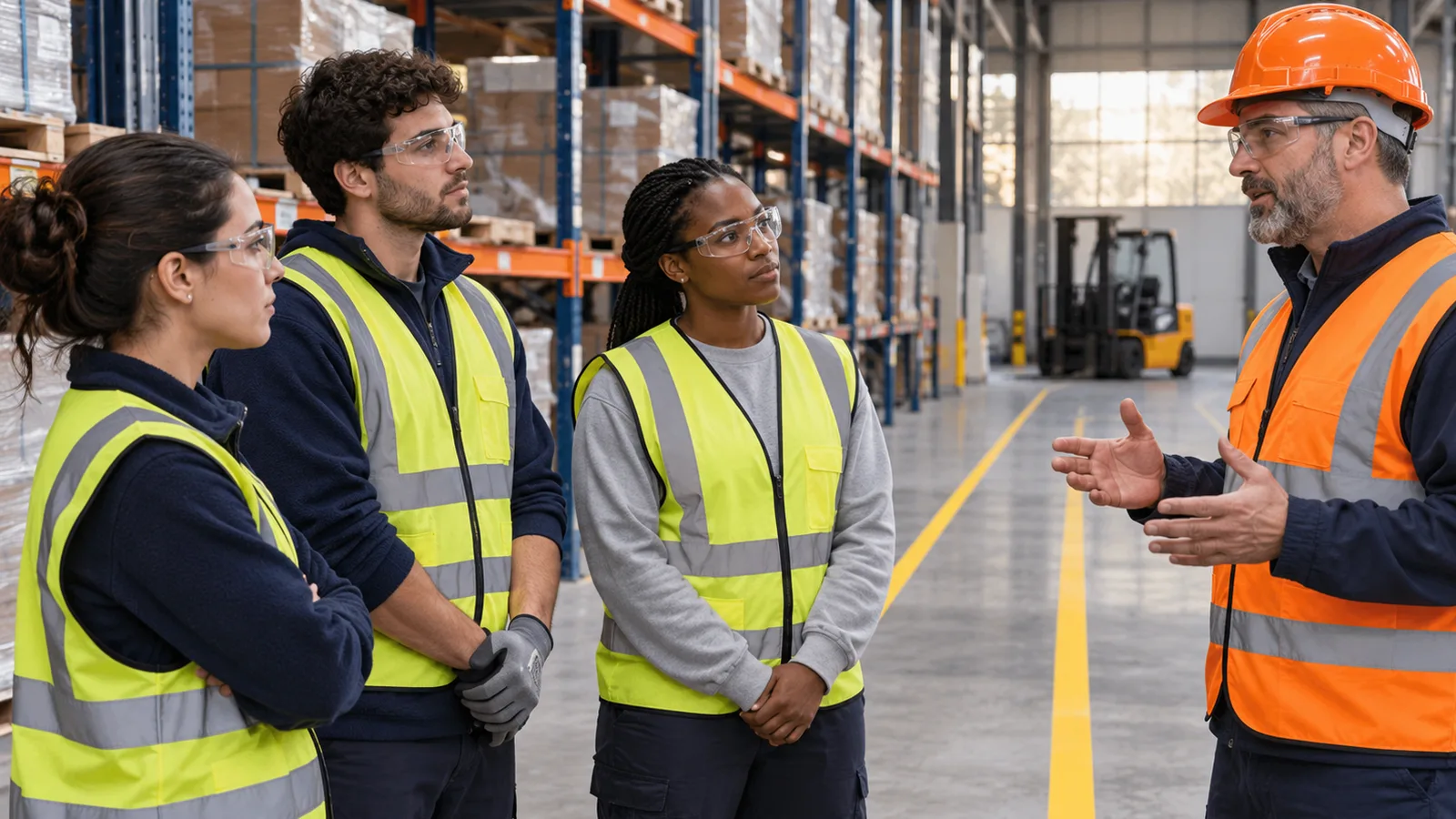
It is 6:45 a.m. at a distribution warehouse near the 401 and Tomken Road. The first trailers of the day are backing into dock doors, a reach truck operator is pulling pallets from the top beam, and a new seasonal hire is learning the pick path. Nothing about the scene is unusual for Mississauga, which has one of the largest concentrations of warehouses in Canada. Yet every one of those activities carries a real risk of injury if the basics slip.
Warehouse safety is often discussed purely as a people issue, and protecting workers is rightly the first priority. But the same practices that keep people safe also protect product, equipment and customer commitments. A pallet that falls from a rack can injure someone and destroy inventory in the same moment. A forklift collision can put an operator off work and take a dock door out of service. Safe warehouses tend to be accurate, reliable warehouses too.
This article walks through the main hazard areas in a typical Mississauga warehouse, the practices that address them, and the Ontario framework that sets the baseline. It is a practical overview, not legal advice, so always check current requirements with the Ministry of Labour, Training and Skills Development and your own health and safety advisers.
The legal baseline in Ontario
Warehouses in Mississauga fall under Ontario's Occupational Health and Safety Act (OHSA) and the Regulation for Industrial Establishments, among other rules. A few obligations come up in almost every warehouse:
- Health and safety awareness training for workers and supervisors, which Ontario has made mandatory.
- Worker representation: a health and safety representative or a Joint Health and Safety Committee, depending on the number of workers regularly employed.
- Workplace violence and harassment policies and programmes.
- WHMIS training for workers who handle or may be exposed to hazardous products, including cleaning chemicals, battery acid and some products stored for clients.
- Competent operators for powered lift trucks, with training appropriate to the equipment.
- Accident reporting to the Ministry and to the Workplace Safety and Insurance Board (WSIB) when required.
Compliance is the floor, not the goal. The best warehouses treat these requirements as a starting point for a broader safety culture.
Hazard area 1: Forklifts and powered equipment
Lift trucks, reach trucks, order pickers and powered pallet jacks are essential and dangerous. Collisions with pedestrians, tip-overs and falling loads are among the most serious warehouse incidents.
Practices that help:
- Train and evaluate every operator on the specific type of equipment they use, and refresh training periodically and after any incident.
- Complete a pre-shift inspection checklist for each truck: brakes, horn, lights, forks, chains, hydraulics, tires and battery or propane connections. Pull defective equipment from service immediately.
- Separate pedestrians from equipment with painted walkways, physical barriers where practical and clear rules about right of way.
- Use blue or red spot lights and travel alarms so pedestrians can see equipment approaching around corners.
- Set and enforce speed limits, especially near dock doors and intersections.
- Never allow riders on forks or pallets, and never lift people except on equipment designed for it.
Hazard area 2: Racking and storage
Pallet racking that is overloaded, damaged or poorly installed can collapse, and loads stored badly can fall from height.
- Post load capacity signs on every rack bay and make sure staff know how to read them.
- Inspect racking regularly for bent uprights, damaged beams, missing safety clips and loose anchors. Ontario has specific requirements for pre-start health and safety reviews when certain racking is installed or modified, so involve a qualified professional for new installations.
- Use column guards and end-of-aisle protectors where trucks turn.
- Put pallets squarely on beams, with no overhang into flue spaces, which matter for sprinkler performance.
- Use wire decking or pallet supports where loads could fall through.
- Store heavy items low and keep the top beam for lighter, stable loads.
Good racking practice is also inventory practice. Pallets placed in the right location, at the right height, are easier to find and less likely to be damaged. Our article on the putaway process explains how location discipline supports both.
Hazard area 3: Loading docks
Docks combine heavy equipment, moving trailers, changes in height and weather. They deserve extra attention.
- Restrain trailers before anyone enters them, using vehicle restraints or wheel chocks, and communicate clearly with drivers using lights or a lockout system.
- Check that the trailer floor can bear the weight of the equipment entering it. Older or damaged trailer floors can fail under a loaded forklift.
- Keep dock plates and levellers in good repair, and use them within their rated capacity.
- Close dock doors or use barriers when no trailer is present, so nobody falls from the dock edge.
- Provide adequate lighting inside trailers.
- Keep drivers in a designated safe area while their trailer is being loaded or unloaded.
Hazard area 4: Manual handling and ergonomics
Musculoskeletal injuries from lifting, twisting, reaching and repetitive motion are a leading cause of lost time in warehousing. They build up quietly, so prevention has to be designed into the job.
- Place fast-moving and heavy SKUs at waist height in pick areas.
- Provide height-adjustable pack stations and anti-fatigue mats.
- Use lift assists, carts and conveyors to reduce carrying.
- Set team-lift rules for heavy or awkward items and mark those items in the system.
- Rotate tasks so nobody repeats the same motion for an entire shift.
- Encourage early reporting of discomfort, before it becomes an injury.
The design of packing stations matters especially for pick and pack operations, where workers may handle hundreds of items per shift.
Hazard area 5: Slips, trips and the Ontario winter
Mississauga winters bring snow, slush and salt into the building on every truck and boot. Dock areas and entrances become slippery, and meltwater from trailers pools on the floor.
- Use absorbent mats at entrances and dock doors, and replace them when saturated.
- Clear and salt walkways, parking areas and yard routes early, before the first shift arrives.
- Keep aisles free of stretch wrap, strapping, broken pallets and cardboard.
- Provide appropriate safety footwear and, for yard work, traction aids.
- Make sure cold-weather gear does not interfere with visibility or equipment operation.
Summer heat matters too. Trailers and upper mezzanines can get very hot, so plan hydration, breaks and ventilation, particularly during heat waves.
Hazard area 6: Hazardous products and batteries
Even a general merchandise warehouse often stores aerosols, cleaning chemicals, lithium batteries, perfumes and other regulated items. Battery charging areas for electric forklifts carry their own risks, including hydrogen gas from some battery types and acid exposure.
- Maintain current safety data sheets and WHMIS labels for hazardous products in the workplace.
- Segregate incompatible products and store flammables appropriately.
- Ventilate charging areas, provide eyewash facilities where needed, and train staff on battery handling.
- Follow Transportation of Dangerous Goods (TDG) rules for anything shipped as dangerous goods.
How safety protects product
It is worth making the connection explicit for managers who think of safety and productivity as competing goals:
- Clear aisles reduce both trips and forklift collisions with racking and stock.
- Correctly stacked and wrapped pallets are less likely to fall and less likely to arrive damaged at the customer. Our guide to packing fragile items applies the same thinking at carton level.
- Trained, unhurried operators place pallets accurately, which improves inventory accuracy.
- Good lighting helps people read labels and scan barcodes correctly.
- Lower injury rates mean less turnover and a more experienced team.
In other words, a safe operation and a high-quality operation are built from the same habits.
Building the culture: daily habits
- Start each shift with a short huddle: the day's volume, any equipment out of service, a safety reminder relevant to the week.
- Encourage near-miss reporting without blame. Near misses are free lessons.
- Walk the floor. Supervisors who see hazards first-hand fix them faster.
- Onboard seasonal staff properly, even in peak. New workers face a disproportionate share of incidents, and peak is exactly when shortcuts are tempting.
- Track leading indicators such as inspections completed, training up to date and hazards closed, not just injuries.
If you are looking at broader warehouse performance metrics, our list of logistics KPIs includes several that pair well with safety tracking.
What to ask a 3PL about safety
When you trust a warehouse with your inventory, you are trusting its safety culture too. Reasonable questions include: How are forklift operators trained and evaluated? How often is racking inspected? How are pedestrians separated from equipment? How are new and seasonal staff onboarded? How are incidents and near misses reviewed? A provider that answers these openly is usually one that takes care of your product as well. It is also fair to ask to walk the floor during a working shift, not just a quiet afternoon, so you can see how equipment, pedestrians and docks interact in practice.
Work with a partner that takes care seriously
Warehouse safety in Mississauga is a shared responsibility between employers, supervisors and workers, and it shows up in every pallet that leaves the dock intact. If you are looking for storage and fulfillment built on careful handling, explore ShipCarte's distribution warehousing and inventory management services, then schedule a consultation to talk about your products.