
A distributor of premium headphones and smartwatches runs a tidy operation out of a unit near the 401 and Dixie Road. One Monday, the warehouse lead notices a count discrepancy on a fast-moving SKU. It is small at first, a few units here and there, easy to write off as a miscount. Over a few months the gap grows. By the time the company investigates properly, it is clear the losses are not clerical errors. Nobody broke in. The stock walked out quietly, a few boxes at a time.
When people think about warehouse security, they tend to picture break-ins and stolen trailers. Those risks are real in the GTA. Peel Regional Police and other agencies have publicly highlighted cargo and trailer theft as a serious problem in the region, which is no surprise given how much freight moves through Mississauga's industrial areas, Pearson's cargo zone and the 400-series highways. But for many businesses, the bigger day-to-day risk is quieter: internal shrinkage, mis-shipments, fraudulent pickups and gaps in process that nobody notices until the numbers stop adding up.
This article lays out a layered approach to securing high-value inventory in a Mississauga warehouse, whether you run your own facility or are evaluating a 3PL. It covers the physical site, people, processes, systems and transport, and ends with questions to ask any provider who will hold your stock.
Think in layers, not single fixes
No single measure makes a warehouse secure. Cameras without anyone reviewing footage are decoration. A locked cage is useless if the key hangs on a hook by the door. Strong security comes from several layers that each catch what the others miss. A useful way to organize them is from the outside in.
Layer 1: The perimeter and yard
Many industrial buildings in Mississauga sit in large business parks with shared roads and open parking. That openness makes it easy for anyone to drive around and watch who comes and goes. Measures at the perimeter include:
- Fencing and gated yards where trailers are parked, especially overnight and on weekends.
- Good lighting across the yard, docks and parking areas.
- Camera coverage of entrances, exits and the trailer yard, with recordings retained long enough to investigate.
- Trailer security such as king pin locks, landing gear locks and parking loaded trailers back-to-dock so doors cannot be opened.
- Controlled visitor parking away from dock doors.
Long weekends and holiday periods deserve extra attention. Loaded trailers left unattended from Friday to Tuesday are an obvious target.
Layer 2: The building envelope
Doors, windows, roof hatches and dock doors are all entry points. The basics are a monitored alarm system with sensors on all openings, sturdy locks, and a clear process for who arms and disarms the system and when. Dock doors should be closed and locked when not in active use, not left open for convenience on a warm day.
Access control systems using cards or fobs create a record of who entered and when, and let you revoke access instantly when someone leaves the company. That is much more reliable than collecting physical keys.
Layer 3: Inside the warehouse
Secure cages and zones
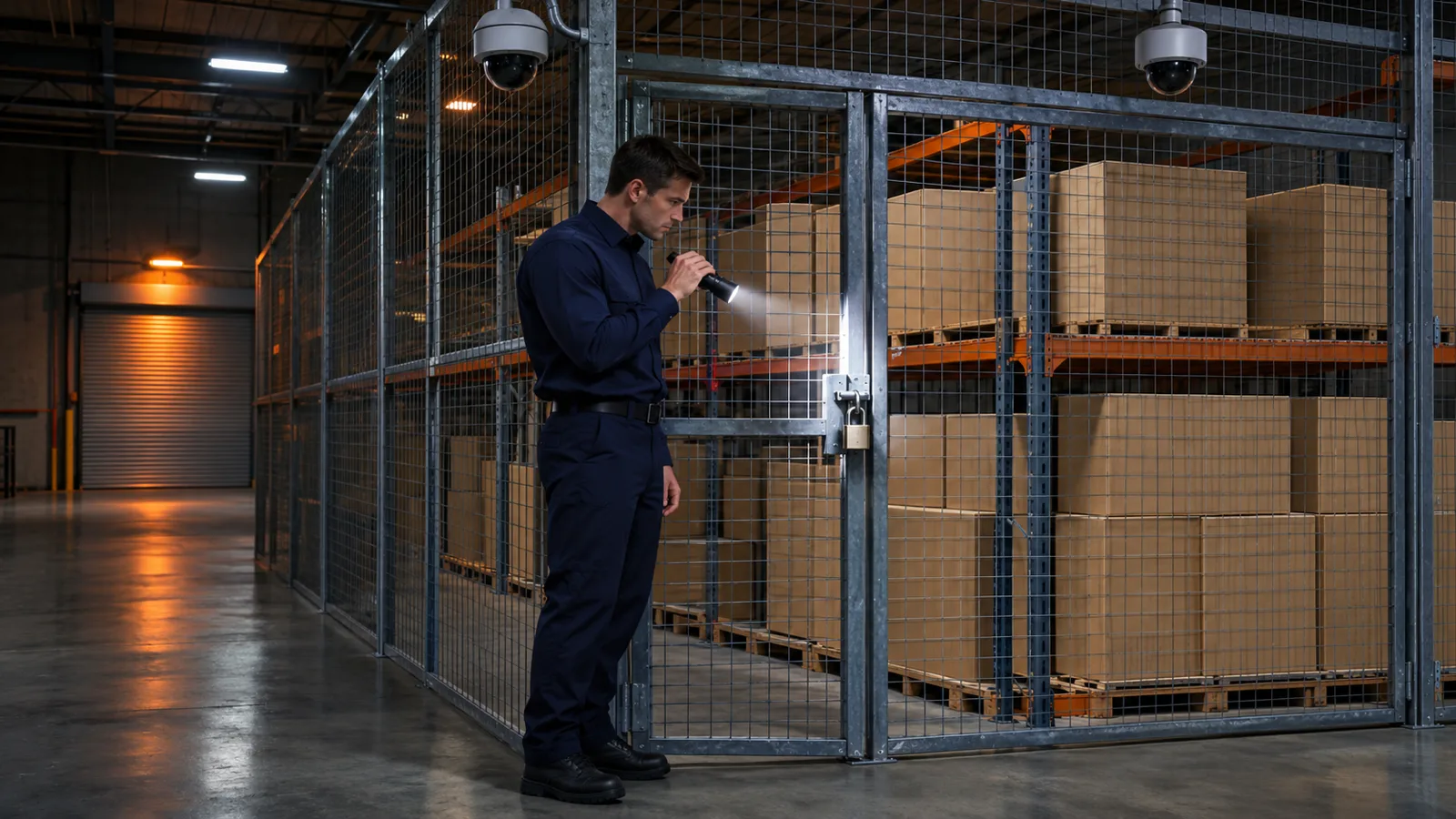
High-value products, such as electronics, cosmetics, fragrances, designer goods, pharmaceuticals and certain spirits, should live in a caged or walled area with restricted access. Only named staff should be able to enter, and entry should be logged. Picks from the cage can be handled by a small, trusted team and handed off to packing with a scan at each step.
Camera placement
Inside, cameras should cover the cage, packing stations, dock doors, the returns area and any spot where goods change hands. Packing stations matter in particular, because they are where items can be quietly left out of a box or slipped aside. Some operations record each pack and link the footage to the order number, which also helps resolve customer claims of missing items.
Personal belongings
Many warehouses keep personal bags, coats and phones in lockers outside the operational area. This is a simple measure that removes an easy opportunity for loss.
Layer 4: People
Most warehouse staff are honest, and treating everyone as a suspect damages morale. But good people practices reduce risk without creating a hostile environment:
- Background checks for roles with access to high-value areas, done within the limits of Ontario's employment and privacy rules.
- Clear policies on what is and is not allowed, explained during onboarding.
- Separation of duties, so the person who receives stock is not the only one who counts it, and the person who adjusts inventory is not the person who picks it.
- A way to report concerns anonymously.
- Prompt access removal when people leave.
Temporary and agency staff, common in peak season, deserve particular thought. They may not go through the same checks, so it is sensible to keep them out of high-value zones.
Layer 5: Process and inventory control
The opening example was caught through counts, and that is no accident. Inventory accuracy is one of the strongest security tools available. Practices that make a real difference include:
- Scan-based receiving and picking, so every movement is recorded against a user and time.
- Cycle counts of high-value SKUs, more often than for low-value stock. Our post on warehouse inventory management systems explains the role of the system.
- Investigating every variance, not just writing it off.
- Restricting inventory adjustments to supervisors, with reasons recorded.
- Weight checks at packing, where the expected weight of an order is compared with the actual weight to catch missing or extra items.
- Sealed outbound trailers with seal numbers recorded on the bill of lading.
A capable warehouse management system makes all of this practical by recording who did what, and when. ShipCarte's inventory management service is built on that discipline.
Layer 6: The dock and carrier handoff
The moment goods leave your building is a classic weak point. Fraudulent pickups, where someone poses as a legitimate carrier with fake paperwork, have been a known tactic in the freight industry. Protect against it by:
- Verifying the carrier, driver, truck and trailer against the booking before loading
- Checking driver identification and recording it
- Never releasing freight to a carrier that turns up unannounced
- Being cautious about last-minute changes to pickup details sent by email
- Recording seal numbers and photographing the loaded trailer before it leaves
For parcel shipments, make sure only scheduled carrier drivers collect, and that the number of parcels handed over matches the manifest. Our guide on the purpose of a bill of lading explains why that document matters so much at handoff.
Layer 7: In transit
Security does not end at the dock. For high-value freight moving from Mississauga to customers across Canada or into the US, consider:
- Using trusted carriers with good security practices
- Avoiding unattended stops, especially in the first stretch of a trip
- GPS tracking on high-value loads
- Discreet packaging that does not advertise the contents
- Appropriate cargo insurance, since carrier liability limits are often well below the value of high-end goods. See what freight insurance covers.
Returns: the overlooked back door
Returns areas are often busy, untidy and less closely watched than outbound packing. That makes them a weak spot. A returned box might be empty, contain a different or counterfeit item, or hold a genuine product that never makes it back into stock. Treat returns of high-value goods with the same care as outbound orders:
- Open returns on camera at a dedicated station
- Scan serial numbers where products have them and compare them with what was shipped
- Move inspected high-value returns into the secure cage promptly rather than leaving them on a table
- Record the condition and outcome of every return in the system
This also helps with returns fraud from customers, which is covered in our article on returns fraud and how to avoid it. A structured returns management process closes the gap.
Insurance and documentation
Even with strong security, losses can happen. Make sure your own insurance and any 3PL's coverage are clear about what is covered, at what value and under what conditions. Many warehouse contracts limit liability per pound or per unit unless you declare higher values or arrange separate coverage. Read that clause carefully if you store expensive goods.
Questions to ask a 3PL about security
- Is there a secured cage or restricted zone for high-value stock, and who has access?
- Which areas do cameras cover, and how long is footage retained?
- Is the building alarmed and monitored outside operating hours?
- How are staff screened, and are temporary workers allowed in high-value areas?
- How often are high-value SKUs cycle counted, and how are variances investigated?
- How do you verify carriers and drivers before releasing freight?
- What is your liability for loss, and how can coverage be increased?
- Can I see inventory movements and adjustments in real time?
Ask to see the high-value area during a site visit. How a warehouse handles security in practice usually tells you more than any written policy.
Keep your inventory where it belongs
ShipCarte stores and ships products for businesses across Mississauga and the GTA, with process controls and scan-based tracking designed to keep inventory accurate and accounted for. If you hold high-value stock and want to talk about how it is protected, schedule a consultation or explore our dedicated warehousing options for segregated space.