
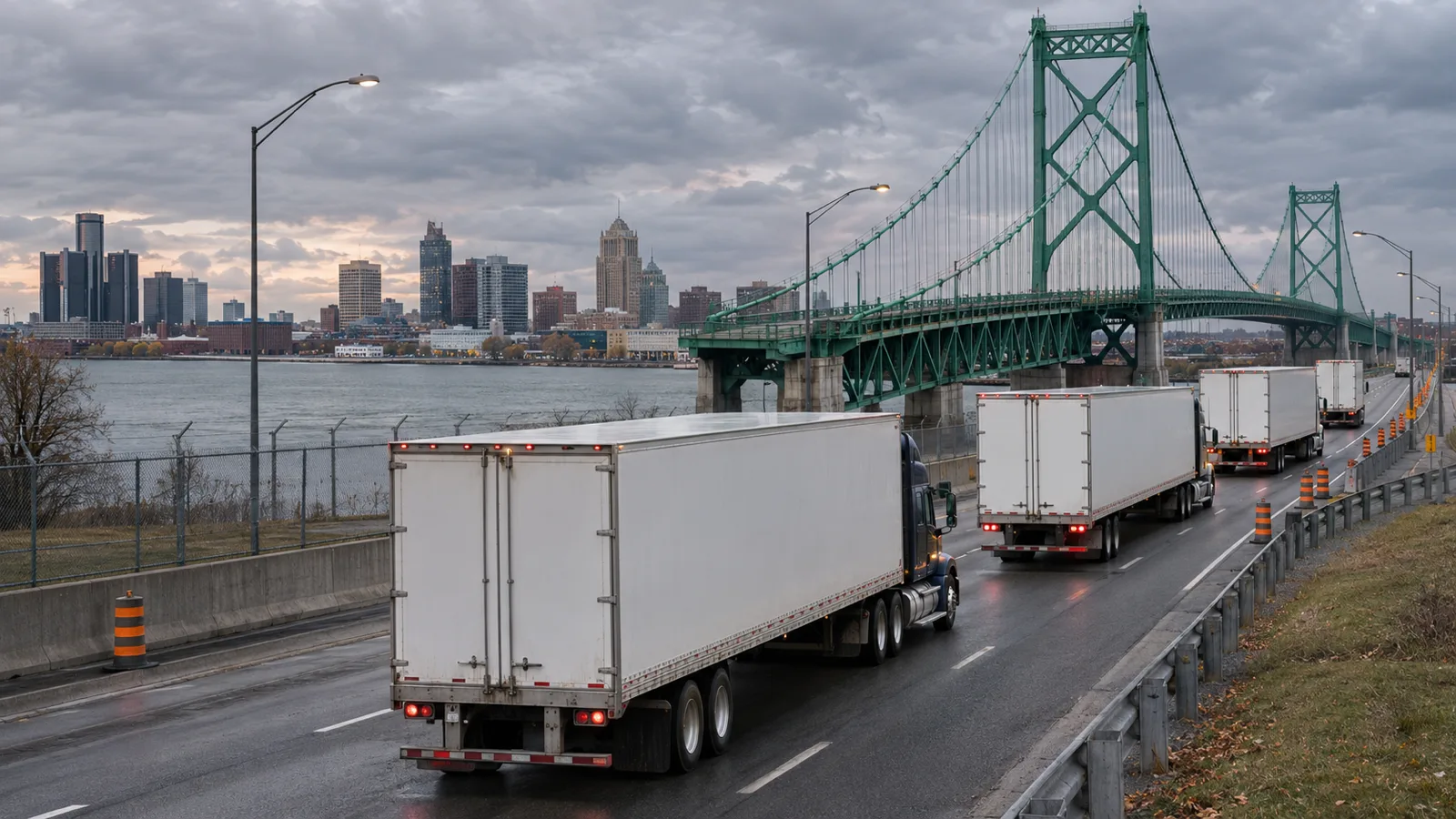
A load of automotive components leaves a plant in Woodstock at 5 a.m., bound for an assembly line near Detroit. On paper, the drive is a little over two and a half hours. In practice, the truck reaches the Ambassador Bridge just as the morning queue builds, the US customs entry has a mismatch between the invoice and the eManifest, and the driver is sent to secondary inspection. The parts arrive after lunch, the receiving plant has already called twice, and the shipper is left wondering what went wrong.
Almost every Ontario business that ships to the US Midwest eventually sends freight across the Detroit River. The Windsor–Detroit corridor carries more trade than any other crossing between Canada and the United States, and the vast majority of those trucks cross without incident. The ones that get stuck usually share a short list of causes, nearly all of which are preventable before the truck leaves the dock.
This guide explains how the crossing works, the options available, what paperwork and timing matter, and how Ontario shippers can make the trip predictable.
The Crossings at Windsor–Detroit
The Ambassador Bridge
The Ambassador Bridge, opened in 1929 and privately owned, is the busiest commercial crossing on the Canada–US border. Thousands of trucks use it every day, carrying roughly a quarter of the merchandise trade between the two countries that moves by road. It connects to Huron Church Road on the Windsor side and directly to the I-75 and I-96 interstates in Detroit. Since the Herb Gray Parkway opened in 2015, trucks coming off Highway 401 avoid most of Windsor's city streets, although the final stretch along Huron Church Road can still back up.
The Detroit–Windsor Tunnel
The tunnel links downtown Windsor and downtown Detroit. It is mostly used by passenger vehicles and has significant restrictions on commercial trucks, so it is rarely an option for freight.
The Detroit–Windsor Truck Ferry
The truck ferry carries loads that cannot use the bridge, notably many dangerous goods shipments and oversized or overweight freight. If you ship hazardous materials regulated under Canada's Transportation of Dangerous Goods rules and US hazmat rules, your carrier may be routed via the ferry or a different crossing altogether.
The Gordie Howe International Bridge
Construction of the publicly owned Gordie Howe International Bridge began in 2018, connecting directly to Highway 401 through the Herb Gray Parkway. It is expected to open in the mid-2020s and will add significant capacity, but for now shippers should plan around the existing crossings.
The Blue Water Bridge alternative
About an hour and a half north, the Blue Water Bridge between Sarnia and Port Huron, Michigan is the second-busiest crossing in the region and often has shorter waits. For freight heading to Flint, Lansing, Grand Rapids or Chicago, it can be just as fast overall. Many Southwestern Ontario carriers choose between the two crossings based on real-time wait times.
How a Southbound Crossing Works, Step by Step
- Shipper prepares documents. A commercial invoice, packing list and bill of lading travel with the load. If goods qualify for NAFTA preferential treatment, the importer needs a certificate of origin or equivalent statement.
- US customs broker files the entry. The broker acting for the US importer submits entry information to US Customs and Border Protection in advance, typically through the Pre-Arrival Processing System (PAPS). The PAPS barcode label is attached to the paperwork the driver carries.
- Carrier transmits the eManifest. US rules require highway carriers to send an electronic manifest through the ACE system at least one hour before arrival at the border, or 30 minutes for FAST shipments.
- Primary inspection. The driver presents documents at the booth. CBP matches the manifest to the entry, checks the driver and decides whether to release the truck or refer it.
- Secondary inspection (if referred). The truck may be examined physically or through imaging. Delays here can run from under an hour to most of a day.
- Release and delivery. Once released, the truck continues to its destination. In the Detroit area, that can mean a delivery within minutes of crossing.
Northbound loads follow a similar pattern into Canada, with the carrier transmitting ACI eManifest data to the Canada Border Services Agency at least an hour before arrival and the Canadian customs broker submitting release information, commonly through the Pre-Arrival Review System (PARS). The CBSA is modernising its commercial systems through CARM, but for now the existing processes continue to apply.
The Most Common Causes of Delay
Most border problems come down to information that does not line up. Watch out for these:
- Invoice and manifest mismatches. Piece counts, weights or descriptions that differ between documents trigger questions.
- Vague product descriptions. "Parts" or "samples" is not enough. Customs wants specific descriptions that match the tariff classification.
- Late broker filings. If the broker has not received the paperwork before the truck arrives, the entry cannot be matched and the truck waits.
- Missing partner agency information. Food, plant and animal products, some electronics, medical devices and certain chemicals need information for other US agencies, such as the FDA or USDA, in addition to customs.
- Wood packaging. Pallets and crates must meet ISPM 15 heat-treatment standards and carry the proper mark. Non-compliant wood packaging can lead to the entire shipment being refused.
- Driver eligibility. FAST lanes require both the carrier and the driver to be enrolled. A non-FAST driver cannot use them even if the shipper is approved.
Trusted Trader Programs Worth Knowing
Several programs speed up the crossing for businesses that invest in security and compliance:
- FAST (Free and Secure Trade): dedicated lanes and expedited processing for approved importers, carriers and registered drivers.
- Partners in Protection (PIP): the CBSA's supply chain security program for Canadian businesses.
- C-TPAT: the US equivalent, with mutual recognition between the two programs.
These programs take time and effort to join, but for regular shippers through Windsor–Detroit, they can significantly reduce inspection rates and wait times. Even if you do not join yourself, choosing carriers who are FAST-approved helps.
Timing Your Crossings
Wait times at the Ambassador Bridge vary through the day and the week. Early mornings and late afternoons tend to be busiest as plants on both sides receive shipments. Mondays and the days around long weekends on either side of the border, including Victoria Day, Canada Day, US Independence Day, Labour Day and US Thanksgiving, can bring heavier queues. Both CBSA and CBP publish estimated wait times online, and experienced dispatchers check them before choosing a crossing.
For time-critical automotive freight, many shippers schedule departures so the truck reaches the bridge outside the morning peak. Some build in a buffer of an hour or more and set a delivery appointment accordingly, rather than promising a precise arrival time they cannot control.
LTL, Truckload or Parcel?
How you cross the border depends on your shipment size:
- Full truckload: best for a full trailer to a single US customer. The truck crosses with a single entry and delivers direct. See our full truckload service.
- LTL: for a few pallets, cross-border LTL carriers consolidate several shippers' freight. Each shipment needs its own customs entry, and one problem shipment can delay the whole trailer, so accurate paperwork matters even more.
- Parcel: for small packages, courier networks handle customs clearance through their own brokerage. Low-value US-bound parcels may qualify for the US Section 321 exemption, currently up to US$800 per person per day.
For many Ontario ecommerce sellers, consolidated cross-border shipping that combines many parcels into one truck, clears them together, and injects them into the US postal or parcel network can be cheaper than sending each package individually through a courier.
Trade Rules in Late 2019
NAFTA remains in force, and goods that meet its rules of origin continue to cross duty-free. The Canada–United States–Mexico Agreement signed in November 2018 is awaiting ratification in all three countries, and its rules, including changes to automotive content requirements, will only apply once it takes effect. Shippers should keep their origin documentation current and watch for an implementation date.
The US steel and aluminium tariffs imposed in 2018 were lifted for Canadian products in May 2019, along with Canada's retaliatory measures. If you adjusted pricing or sourcing during that period, it is worth reviewing whether those changes are still needed. Our article on cross-border freight to Detroit covers lane-specific planning in more detail.
A Pre-Departure Checklist for Ontario Shippers
- Commercial invoice with full descriptions, values, currency, country of origin and HS codes.
- Packing list that matches the invoice piece counts and weights.
- Bill of lading with the PAPS or PARS number as required.
- NAFTA certificate of origin or importer statement for qualifying goods.
- Any partner agency information, such as FDA prior notice for food.
- ISPM 15-marked wood packaging.
- Confirmation that the broker has received documents before the truck departs.
- Delivery appointment confirmed with the US consignee.
Making the Crossing Routine
For most Ontario businesses, crossing at Windsor–Detroit becomes routine once the documents, broker and carrier are aligned. The shippers who struggle are usually the ones who treat each load as a one-off. Building templates for your commercial invoices, keeping a classification list for your products and working with carriers who know the corridor make the difference between a two-hour transit and a lost day.
ShipCarte arranges cross-border LTL, truckload and parcel shipping for businesses across Ontario, with carriers experienced on the Windsor–Detroit and Sarnia–Port Huron crossings. Request a quote for your next US shipment, or schedule a consultation to review your cross-border process.