
Canada's geography is hard on parcel budgets. A brand fulfilling from Ontario might find that a parcel to a customer in Ottawa costs a modest amount, while the identical parcel to Kelowna or Saskatoon costs far more. Parcel rates are built on zones, and the farther a parcel travels from its origin, the higher the zone and the higher the price. For a seller whose customers are spread from St. John's to Nanaimo, those high-zone parcels can quietly drag down margins.
Zone skipping is a technique that larger shippers have used for years and that has become more accessible to mid-sized ecommerce brands. Instead of handing every parcel to a carrier at your own dock and paying for the full distance, you load many parcels bound for the same region onto a single truck, drive them across the country as freight, and inject them into the carrier's network close to the final destination. The carrier then treats them as local or short-distance parcels.
Done well, zone skipping can reduce costs on long-distance lanes and shorten delivery times. Done at the wrong volume, it adds complexity without much benefit. Here is how to tell the difference.
How Parcel Zones Work
Carriers divide the country into zones measured from the origin postal code. Each zone has its own rate column in the carrier's price table. A parcel moving within the same city or region is billed at a low zone; one crossing several provinces is billed at a high zone. Remote and northern destinations often carry additional surcharges on top of the zone rate.
Zone pricing reflects real costs. Carriers have to move a long-haul parcel through more sortation, over more kilometres, often by more expensive transport. When you zone skip, you take over the long-haul part of that journey yourself, moving parcels in bulk by truckload or LTL, which is usually cheaper per parcel than paying the carrier's high-zone rate for each one individually.
What Zone Skipping Looks Like in Practice
Here is a simplified example. Imagine a fulfillment centre in the Greater Toronto Area that ships several hundred parcels a day, with a steady share going to Alberta and British Columbia.
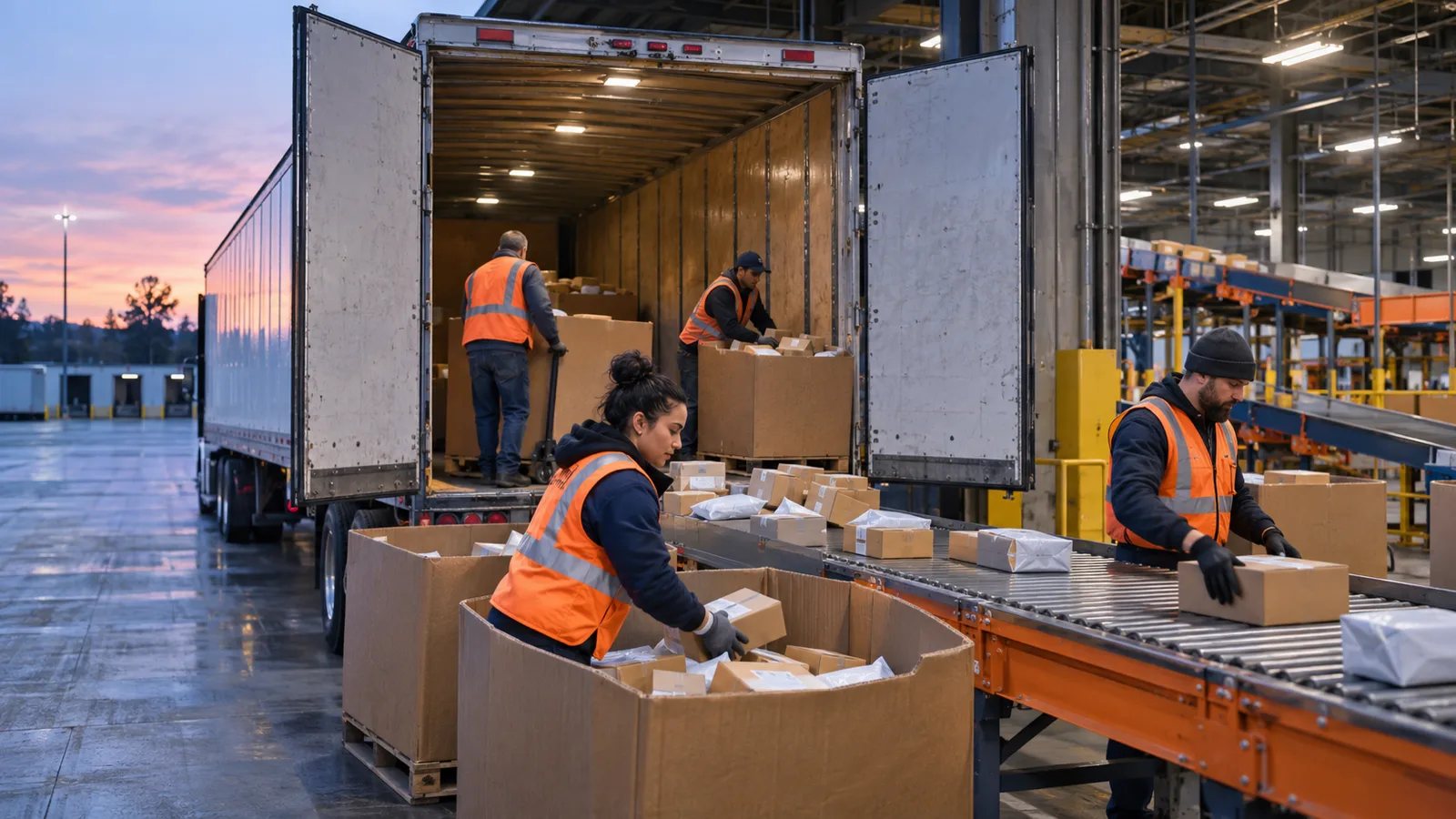
- Sort at origin. Throughout the day, parcels with western destinations are separated from the rest and placed in gaylords or carts by destination region.
- Load the line-haul. At the end of the day, those containers are loaded onto a trailer headed west. Depending on volume, this might be a dedicated truck, a shared truck, or LTL pallets.
- Drive the long leg. The trailer moves along the Trans-Canada and Prairie highway network, often with team drivers to keep it moving, to a carrier facility or partner hub in Calgary or the Lower Mainland.
- Inject into the carrier network. The parcels are handed to a carrier at the destination facility, already labelled for delivery. From the carrier's point of view, they are originating locally.
- Final delivery. The carrier delivers each parcel as a short-zone shipment.
The cost comparison is simple in principle: the line-haul cost plus the lower local parcel rates, versus the full high-zone rates for each parcel shipped directly. Whether the numbers work depends on how many parcels you can fill the truck with.
The Benefits Beyond Rate Savings
Lower rates are the main draw, but zone skipping has other advantages:
- Fewer touches. Parcels skip several of the carrier's sortation hubs, which can reduce handling and the chance of damage or misrouting.
- Potentially faster delivery. A dedicated truck running directly to a regional hub can sometimes beat the time a parcel would spend moving through a national ground network. This is not guaranteed and depends on schedules and distances.
- More control during busy periods. Carrier networks across Canada face heavy volumes during peak season and other surges in online ordering. Having your own line-haul gives you an additional option when standard ground service slows.
- Access to regional carriers. Once parcels are in the West, you can use regional last-mile couriers in addition to national carriers, which can widen your choices.
When Zone Skipping Does Not Make Sense
Zone skipping depends on volume and density. It is usually not worthwhile when:
- You ship only a handful of parcels a day to a given region. The truck will not fill, and the line-haul cost per parcel will exceed what you save.
- Your customers are concentrated close to your warehouse, so few parcels travel long distances.
- You need same-day dispatch on every order and cannot wait for a daily or scheduled line-haul departure.
- Your products are heavy and bulky enough that LTL or direct freight to customers is already the better option.
Is Your Business a Candidate? A Self-Assessment
Answer these questions using a few months of shipping data:
- What share of your parcels ship to the highest two or three zones from your origin?
- Do those parcels cluster in a few metropolitan regions, such as Calgary-Edmonton, the Lower Mainland, or Halifax-Moncton?
- How many parcels per day or per week go to each of those clusters?
- What is your average parcel weight and size? Lighter, smaller parcels pack more densely into a trailer.
- Can you tolerate a fixed daily or several-times-a-week departure schedule for those regions?
- Does your carrier, or a logistics partner, accept injected parcels at a facility in the destination region?
If you have a steady flow to one or two distant regions, light parcels and some flexibility on dispatch timing, zone skipping is worth modelling. If your long-distance volume is scattered or small, other strategies may fit better.
Zone Skipping Versus Splitting Inventory
The alternative to moving parcels closer to customers is to move inventory closer to customers. Many growing Canadian brands eventually hold stock in both Eastern and Western Canada, fulfilling western orders from a western warehouse.
Each approach has its place:
- Zone skipping keeps all inventory in one location, which is simpler to manage and needs less total stock. It works well while western volume is meaningful but not large enough to justify a second site.
- Multi-location inventory delivers the fastest transit times and lowest last-mile costs once volume is high, but adds the cost of a second warehouse, more safety stock and inter-facility transfers.
Some businesses use zone skipping as a bridge: it lowers costs now, and the data it produces about western demand helps decide when a second location is justified. Our distribution warehousing and distribution services support both models.
Zone Skipping to the United States
The same idea applies across the border. Canadian sellers with large US customer bases often truck consolidated parcels to a US facility and inject them into a domestic US carrier network. This can avoid international parcel rates on each package and simplify customs, since the goods clear as a consolidated shipment. Rules on low-value shipments, documentation and duties apply, so plan this with a provider experienced in cross-border shipping. Our article on Section 321 explains one US provision relevant to low-value entries.
Operational Details That Make or Break It
- Labelling. Parcels need valid carrier labels generated for the injection point, not the origin, so your shipping software must support this.
- Cut-off times. The line-haul must arrive at the injection facility before the carrier's acceptance cut-off, or parcels sit for an extra day.
- Tracking. Customers will see tracking begin when the carrier scans the parcel at the injection point, which may be a day or more after you shipped it. Tell them, or provide your own tracking for the line-haul leg.
- Weather. Winter driving in the Rockies and on northern Ontario highways can delay trucks. Build buffer time into delivery promises from November to March.
Building a Simple Cost Model
Before committing, build a rough model with real numbers rather than estimates. You will need four inputs:
- Current spend on the target region. Total what you paid carriers over the last three months for parcels delivered to, say, Alberta and British Columbia, including fuel and residential surcharges.
- Local rates at the injection point. Ask your carrier or logistics partner for the rates you would pay if the same parcels originated at a facility in Calgary or the Lower Mainland. Run your actual parcel weights and dimensions through those rates.
- Line-haul cost. Get quotes for moving the expected number of gaylords or pallets on the frequency you need, whether daily, three times a week or weekly. Include any accessorial charges at the destination facility.
- Handling cost. Account for the extra labour to sort parcels by region, build and wrap containers, and manage the departure.
Add items two, three and four, and compare the total with item one. If the savings are thin, consider running the line-haul less frequently with more parcels per trip, which lowers the line-haul cost per parcel but adds a day or two to delivery for some orders. If savings are strong, test the lane for a month or two and measure actual results, including delivery times and customer complaints, before rolling it out further. Re-run the model each quarter, since both carrier rates and your volume will change, especially heading into the holiday peak.
Let ShipCarte Run the Numbers
Zone skipping is one of several tools for lowering long-distance shipping costs in Canada. The right answer depends on your volumes, lanes and service promises. ShipCarte can review your shipping data and model options using our shipping platform, comparing zone skipping, direct parcel and multi-location fulfillment. Schedule a consultation to see what fits your business.