
Client Overview
Two business owners acquired a small, family-operated candle-making supply company that had been running from a barn with a modest retail storefront. The business supplied waxes, wicks, fragrances, jars, lids, labels and other accessories used to produce finished candles.
The customer base was primarily B2B and orders were placed through Shopify. Many customers purchased materials in bulk to manufacture finished candles for resale. Because wicks, fragrances, lids and other components were offered in numerous sizes, quantities and variants, the operation carried considerable SKU and preparation complexity.
The Challenge
Complex Variants Created Work at the Point of Shipping
Many products were not ready to ship in the exact configurations customers ordered. Staff had to measure, count, divide, package or otherwise prepare variants after an order was received. This pushed significant labour into the fulfillment window rather than completing that work in advance.
Order Processing Was Taking 3–5 Business Days
The preparation requirements meant that an order could take three to five business days to process before carrier transit time even began. As demand increased, this model became increasingly difficult to scale without adding more labour and more operational pressure.
Space Restricted Purchasing Power
The existing location did not provide enough room to purchase key materials in larger quantities. The owners could not consistently take advantage of volume pricing or build deeper inventory positions when supplier pricing was favourable.
No Room to Pre-Pack for Future Demand
The same space limitation prevented the business from preparing popular products and variants in advance. Instead of picking a ready-to-ship unit, employees repeatedly performed preparation work only after an order entered the system.
Limited Visibility into Product Performance
The owners also needed better information to understand which products generated healthy returns and which products consumed space, labour and capital without providing sufficient return. Historically, the business had continued carrying a broad assortment because customers requested it, making it difficult to rationalize the catalogue.
Owners Were Tied to Daily Operations
The operational model required the owners to remain heavily involved in day-to-day order processing. This reduced the time available for data analysis, purchasing strategy, customer growth and long-term business development.
The ShipCarte Solution
Scalable Warehouse Capacity
ShipCarte provided warehouse capacity that allowed the business to hold deeper inventory and purchase strategically rather than being constrained by the physical limits of the original facility.
Bulk Purchasing and Inventory Positioning
With additional storage available, the customer could purchase larger quantities where appropriate, improve purchasing leverage and position inventory ahead of anticipated demand.
Pre-Pack and Variant Preparation
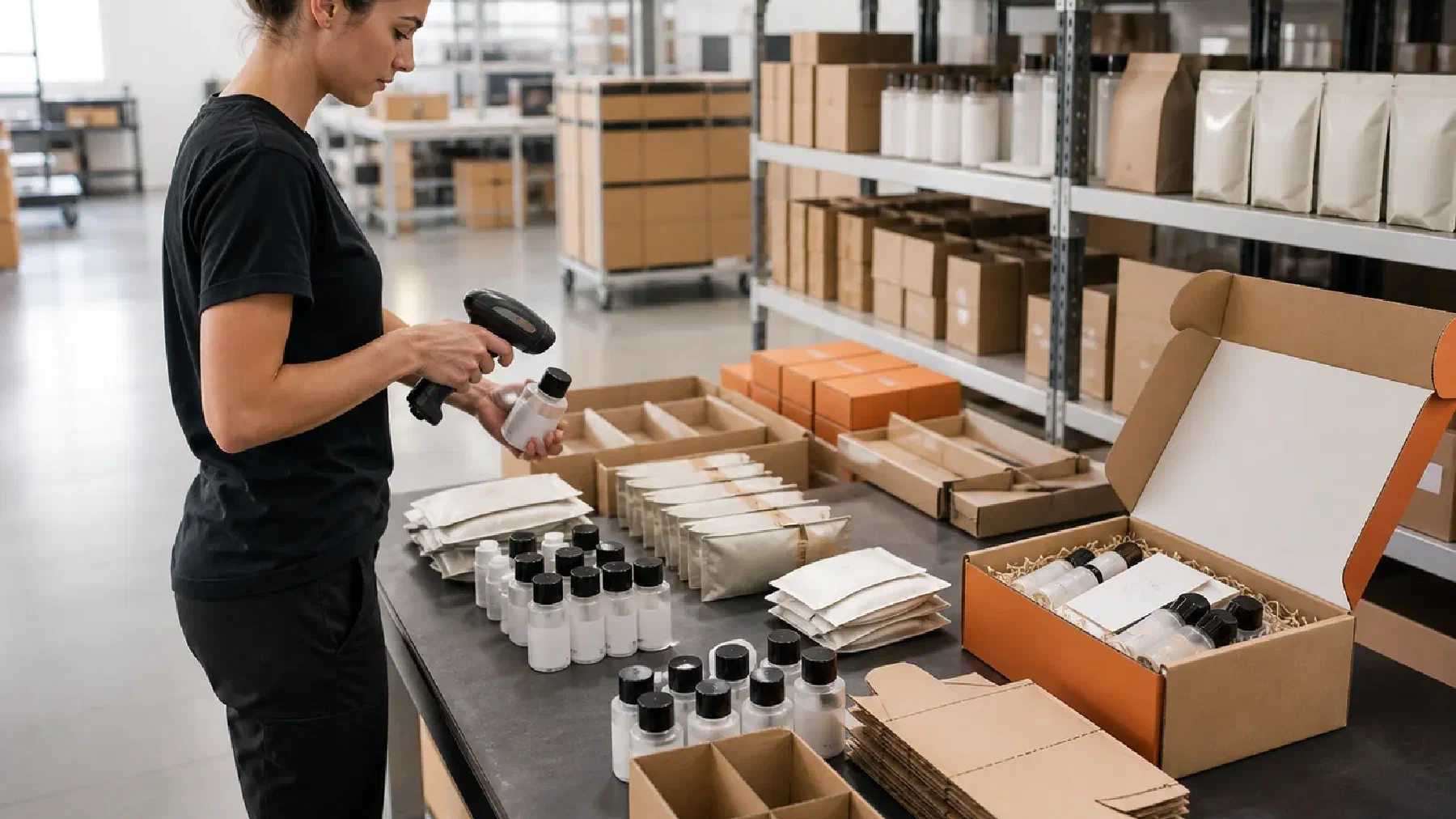
ShipCarte created workflows to prepare frequently ordered products, sizes and variants before customer orders were released for fulfillment. This shifted labour away from the critical shipping window and made the pick-and-pack process substantially faster.
Centralized Inbound and Outbound Logistics
Supplier inbound movements, warehousing, inventory handling and final outbound shipments were brought into a coordinated distribution process. This created clearer visibility into how inventory entered, moved through and exited the operation.
Operational and Inventory Visibility
A more structured fulfillment environment gave ownership better information on order velocity, inventory movement and product demand. That information could then support purchasing decisions, SKU reviews and future planning.
A Fulfillment Model Designed for Growth
Most importantly, the partnership allowed the owners to spend less time physically managing every shipment and more time understanding the business, analysing data and building a model capable of supporting future growth.
Results & Business Impact
Order volume increased from approximately 50 orders per day to more than 300 orders per day as the business grew on top of a fulfillment model capable of handling significantly higher throughput.
Order turnaround improved from approximately three to five business days before shipment to next-business-day fulfillment after the customer’s order-change and cancellation window. Same-day fulfillment can also be accommodated when operationally required and requested.
Pre-prepared inventory reduced repetitive handling during fulfillment, while additional warehouse capacity created the ability to buy ahead, hold appropriate safety stock and take advantage of purchasing opportunities.
Centralizing supplier inbound, storage, preparation and outbound distribution created a clearer picture of inventory inflow and outflow and provided a stronger operational foundation for continued growth.
Before vs. After
| Area | Before ShipCarte | After ShipCarte |
|---|---|---|
| Daily volume | Approximately 50 orders/day | 300+ orders/day |
| Processing time | 3–5 business days before shipping | Next-business-day fulfillment; same-day when required |
| Inventory capacity | Restricted by small operating location | Scalable warehouse capacity |
| Product preparation | Prepared after orders arrived | Popular variants prepared in advance |
| Ownership focus | Heavily involved in daily fulfillment | More time for data, purchasing and growth |
Long-Term Impact
Over a multi-year partnership, the relationship has evolved beyond basic pick-and-pack fulfillment. ShipCarte has become part of the customer’s operating infrastructure, supporting warehousing, inventory preparation, purchasing flexibility and distribution.
The owners gained the ability to focus more attention on business performance, product strategy and expansion while the fulfillment operation scaled behind them. The case demonstrates that outsourced fulfillment is most valuable when it removes operational constraints rather than simply moving boxes from one building to another.